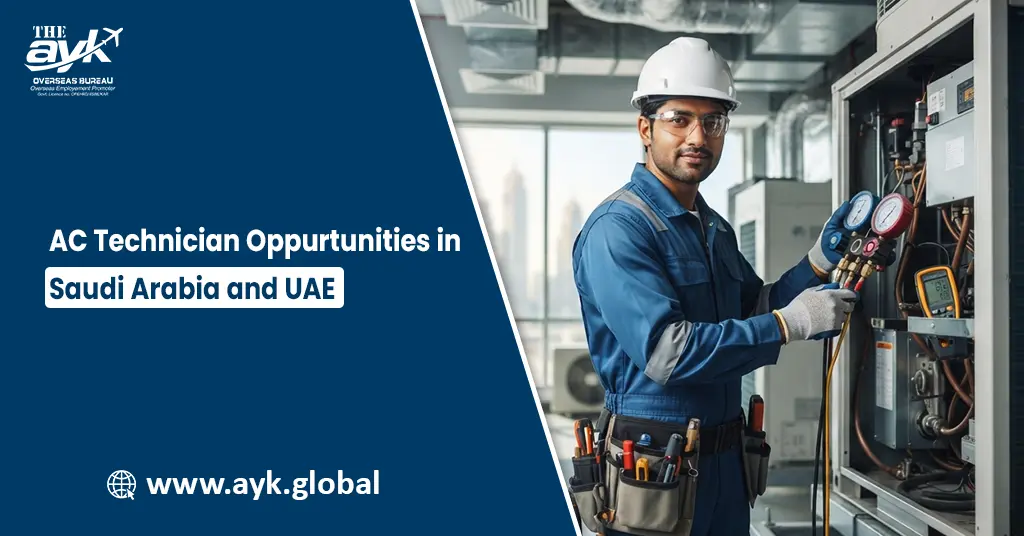
AC Technician Opportunities in Saudi Arabia and UAE
Published: July 02, 2026 | Views: 15
Introduction
Air conditioning technician work represents one of the most practically indispensable skilled trade categories across Gulf countries, where the extreme climate creates essentially year-round demand for qualified HVAC professionals capable of installing, maintaining, and repairing the cooling systems that Gulf residents and businesses genuinely cannot function without throughout the devastating summer heat that defines the region's most challenging seasonal period. Pakistani AC technicians who develop strong technical competency across residential, commercial, and industrial cooling systems find themselves entering a Gulf employment market where their specific skills address a fundamental, non-negotiable operational requirement rather than simply a discretionary service that employers might delay or reduce during lower-budget periods.
This guide provides Pakistani AC technicians with comprehensive information about employment opportunities specifically within Saudi Arabia and UAE, the two largest Gulf economies where HVAC employment demand is particularly strong and the employment infrastructure for Pakistani workers is most well-developed. AYK Overseas Recruitment & HR Manpower Agency, recognized as one of Pakistan's top manpower agencies, regularly places qualified Pakistani AC technicians across both countries and this guide reflects the genuine market knowledge we have developed through consistent HVAC sector placement experience within these major Gulf employment destinations.
Why Gulf Climate Creates Exceptional HVAC Demand
The Gulf region's climate creates a fundamentally different relationship with air conditioning compared to most other parts of the world, where air conditioning represents comfort enhancement during warm periods rather than the survival necessity that Gulf summer temperatures essentially create for the region's entire population throughout the hottest months. Saudi Arabia and UAE temperatures regularly exceed fifty degrees Celsius during peak summer periods, making functional air conditioning an absolute operational requirement for virtually every building, vehicle, and commercial facility rather than the discretionary comfort feature it represents in more temperate climates.
This survival-necessity status means HVAC system failures create genuine emergency situations for building operators and occupants that demand immediate professional response regardless of cost or time pressure, creating distinctively urgent demand dynamics for qualified AC technicians that most other trade categories simply do not experience. Pakistani AC technicians who understand this demand context appreciate why Gulf employers consistently prioritize HVAC technical staff reliability and respond-ability so highly, and why genuine technical competency commands premium compensation within a labor market where the practical urgency of HVAC demand creates strong employer motivation to retain proven, capable technical staff.
Residential AC Installation and Maintenance Demand
Residential cooling system installation and maintenance represents the most widely distributed and continuously available HVAC employment category across both Saudi Arabia and UAE, with the enormous residential building stock in major cities creating ongoing demand for installation work in new developments alongside constant maintenance requirements across existing residential units throughout their operational lifetimes. This residential demand segment provides accessible employment entry for Pakistani AC technicians beginning their Gulf HVAC career, offering practical experience with Gulf-standard residential cooling systems that builds the foundational competency upon which more advanced specializations can be developed.
Saudi Arabia's ongoing residential construction across major cities combined with its enormous existing housing stock creates particularly substantial residential HVAC employment, while UAE's Dubai and Abu Dhabi residential markets provide similarly consistent demand that reflects these cities' continuous population growth and associated residential development activity. Workers who establish strong residential HVAC track records within these markets build the Gulf employment foundation that facilitates access to more demanding and better-compensated commercial and industrial HVAC opportunities as their career progresses.
Commercial HVAC Systems and Their Higher Complexity
Commercial cooling systems serving office buildings, shopping centers, hotels, hospitals, and various other commercial facilities operate at considerably larger scale and greater technical complexity than residential systems, requiring understanding of chiller systems, cooling towers, air handling units, and various central plant components that residential work alone does not prepare technicians to handle competently. This commercial system complexity creates a genuine technical specialization that commands meaningfully stronger compensation than residential work, representing a valuable career development target for Pakistani AC technicians who develop their skills beyond residential installation and maintenance fundamentals.
Saudi Arabia's substantial commercial real estate sector, including massive shopping centers like Riyadh's Kingdom Centre and various other large commercial facilities throughout major cities, creates particularly strong commercial HVAC employment demand that serves as a major market for technically sophisticated HVAC professionals. UAE's Dubai commercial market, with its enormous hotel sector and extensive corporate office infrastructure, similarly creates significant commercial cooling system demand that requires the more sophisticated technical competency that advanced training and experience development can provide for Pakistani technicians willing to invest in their professional advancement.
District Cooling Systems as Emerging Specialty
District cooling systems, which distribute chilled water from centralized plants to multiple buildings through underground pipe networks, represent a growing specialty application in Gulf cities that offers distinctive technical employment for HVAC professionals willing to develop expertise in these large-scale cooling distribution systems. Both Saudi Arabia and UAE have invested substantially in district cooling infrastructure as an energy-efficient alternative to building-specific cooling equipment, creating specialized technical employment that differs meaningfully from both residential and standard commercial cooling system work.
Workers who develop district cooling system expertise find themselves positioned within a distinctive, currently growing specialty that commands strong compensation reflecting both the technical sophistication and the relatively limited technician supply that district cooling's specialized requirements create compared to the more numerous technicians available for standard residential and commercial cooling work. This emerging specialty represents an attractive career development direction for ambitious Pakistani HVAC professionals seeking differentiated positioning within an increasingly competitive Gulf HVAC employment market.
Required Certifications for Gulf AC Technician Employment
Gulf employers across both Saudi Arabia and UAE increasingly require formal certification verification for HVAC technical staff, with recognized credentials significantly strengthening candidates' competitive positioning against alternative applicants who offer experience claims without formal qualification documentation. Pakistani AC technicians should prioritize obtaining relevant trade certifications through recognized Pakistani technical education institutions, ensuring these credentials are properly attested before departure to facilitate smooth employer verification during the recruitment and visa processing stages.
Workers should also research specific refrigerant handling certifications that some Gulf positions require, particularly as international environmental regulations governing refrigerant management continue tightening in ways that make proper refrigerant handling certification an increasingly standard employment requirement across Gulf HVAC employment contexts. This refrigerant certification, while potentially requiring additional preparation investment beyond basic HVAC trade certification, represents genuinely valuable professional credentialing that supports both employment access and long-term career positioning within this increasingly regulation-conscious technical specialty.
Salary Landscape for AC Technicians in Saudi Arabia and UAE
Compensation for AC technicians in Saudi Arabia and UAE varies meaningfully based on technical specialization depth, relevant experience level, the specific sector of HVAC work involved, and whether positions include accommodation and transport provisions that significantly affect complete package value beyond base salary comparison alone. Entry-level residential HVAC positions typically offer packages that provide reasonable financial improvement compared to Pakistani domestic alternatives, while experienced commercial or industrial HVAC specialists can command considerably stronger compensation that reflects their genuine technical value within employment markets where their skills address urgent, non-negotiable operational requirements.
UAE generally offers somewhat stronger base compensation within certain HVAC specialty categories compared to Saudi Arabia for comparable technical levels, though Saudi Arabia's potentially lower cost of living in some expense categories and specific mega-project employment contexts that offer premium compensation for certain technical specializations create enough variation that individual opportunity evaluation remains essential rather than assuming uniform country-level compensation advantage applies across all specific HVAC position comparisons. Workers should research specific compensation ranges for their particular technical level and specialty within their intended destination rather than applying generic country-level salary assumptions to their individual situation evaluation.
Emergency Response and On-Call Technical Work
The emergency nature of Gulf cooling system failures creates a distinctive employment dimension for AC technicians that involves on-call availability requirements during peak demand periods, with employers and facilities management companies valuing technicians who can respond reliably to cooling system emergencies during potentially inconvenient hours when system failures create genuine operational crises for building operators and occupants experiencing extreme heat conditions. This emergency response dimension represents a genuine professional responsibility that AC technicians should understand and prepare for before beginning Gulf employment rather than discovering this expectation only after arrival.
Workers who handle emergency response situations professionally and reliably build particularly strong employer trust and professional reputations within HVAC employment markets where this reliability represents a meaningfully differentiated professional quality that strongly influences compensation, employment retention, and career advancement considerations. This emergency response reliability creates disproportionate professional value for technicians who consistently demonstrate it, making this professional quality genuinely worth developing as a distinctive career asset within Gulf HVAC employment contexts.
Preventive Maintenance Programs and Their Importance
Gulf facilities increasingly emphasize preventive maintenance programs for cooling systems as a cost-effective alternative to reactive repair-focused maintenance approaches that only address problems after they create operational failures often occurring during the worst possible heat conditions. AC technicians who understand and can implement structured preventive maintenance programs bring genuine additional value to facilities management employers seeking to reduce emergency repair incidents through systematic maintenance scheduling rather than simply reacting to cooling failures when they occur.
Workers who develop strong preventive maintenance program skills, including systematic inspection protocols, performance monitoring, filter maintenance scheduling, and various other proactive maintenance activities that sustain cooling system performance before failures occur, position themselves as more complete HVAC professionals rather than simply reactive repair technicians. This preventive maintenance orientation represents a valuable professional quality that sophisticated Gulf facilities management employers specifically seek in HVAC staff, creating genuine additional career value for workers who develop and consistently apply this more complete technical approach to their cooling system responsibilities.
Technological Evolution and Smart Building Systems
Gulf buildings increasingly incorporate smart building management systems that integrate cooling system control with various other building operations through sophisticated digital control platforms that AC technicians must understand to work effectively within these increasingly common modern building environments. Workers who develop basic familiarity with building automation system interfaces and digital cooling system controls position themselves more favorably within modernizing Gulf building environments than those with purely mechanical HVAC expertise without corresponding digital system familiarity.
This technological evolution within Gulf building management creates both challenge and opportunity for Pakistani AC technicians, with those willing to develop their digital system capabilities finding enhanced career opportunities within premium building environments where smart system expertise commands recognition, while those who resist this technological adaptation gradually find their purely mechanical expertise increasingly inadequate for the premium segment of Gulf HVAC employment. Workers should proactively seek exposure to digital building management systems and smart cooling controls within their current employment experience before or during their Gulf employment as important professional development that sustains long-term career relevance within this evolving technical specialty.
Career Path from Technician to HVAC Engineer
Ambitious Pakistani AC technicians who combine strong practical technical expertise with supplementary technical education can pursue career advancement toward HVAC engineering roles that involve system design, technical specification, and project management responsibilities commanding considerably stronger compensation than hands-on technician work. This advancement pathway requires investment in additional technical education including engineering fundamentals, system design principles, and potentially formal engineering qualification that transforms practical technical experience into comprehensive professional engineering capability.
Workers pursuing this ambitious advancement pathway should research available continuing education resources that can supplement their practical expertise with the formal technical knowledge that HVAC engineering roles require, recognizing this as a genuinely achievable long-term career development direction for those willing to invest seriously in their professional advancement. The Gulf HVAC industry's continued growth and increasing technical sophistication creates genuine demand for locally available HVAC engineering talent, making this advancement pathway increasingly accessible for committed workers who systematically develop both their practical expertise and their formal technical knowledge throughout their Gulf career.
Practical Tips for Pakistani AC Technicians Seeking Gulf Jobs
Pakistani AC technicians preparing for Gulf employment applications should specifically develop a detailed competency portfolio documenting their technical experience across different cooling system types, brands, and applications rather than relying on generic employment history that fails to communicate their actual technical breadth and depth to potential Gulf employers evaluating multiple competing candidates. This specific technical portfolio approach helps candidates distinguish their application through substantive competency evidence rather than generic employment history documentation that leaves employers without meaningful comparative information about candidates' actual technical capabilities.
Workers should also research specific cooling system brands and technical specifications commonly used in their target Gulf destination, familiarizing themselves with any standard specifications or brand preferences that differ from Pakistani market conventions that might otherwise create unnecessary adaptation challenges during their initial Gulf employment period. This destination-specific technical preparation demonstrates genuine professional engagement with Gulf market realities that employers interpret as positive professional seriousness distinguishing candidates who have invested genuine preparation effort from those applying without specific Gulf market awareness.
How AYK Overseas Connects Pakistani AC Technicians to Gulf Opportunities
As a government-licensed international recruitment and HR manpower firm with offices in Karachi and Islamabad, AYK Overseas Recruitment & HR Manpower Agency maintains active employer relationships with facilities management companies, construction contractors, and various other HVAC employers across Saudi Arabia and UAE, regularly placing qualified Pakistani AC technicians in genuine, well-matched employment opportunities. Being recognized as one of Pakistan's top manpower agencies, we understand the specific technical competency signals that Gulf HVAC employers evaluate and help candidates present their qualifications most effectively within these competitive hiring processes.
Our team helps AC technician candidates understand the specific certification requirements, documentation expectations, and technical preparation that their target Gulf destination and employment category specifically requires, ensuring their applications reflect genuine competency in formats that position them competitively within demanding Gulf HVAC employment markets. This specialized HVAC sector knowledge has helped AYK Overseas Recruitment & HR Manpower Agency successfully place numerous Pakistani AC technicians in rewarding Gulf employment that genuinely reflects the technical value their professional skills create within markets where this expertise addresses genuinely essential operational requirements.
Conclusion
AC technician work in Saudi Arabia and UAE offers Pakistani HVAC professionals genuinely strong, sustained employment opportunity within markets where their technical skills address fundamental, non-negotiable operational requirements rather than discretionary services, creating employment demand that remains robust across economic cycles in ways that more discretionary employment categories cannot match. Workers who develop comprehensive technical competency across residential, commercial, and emerging specialty applications, pursue relevant formal certification, and approach their Gulf HVAC career with genuine continuous learning orientation are well positioned for rewarding, financially meaningful overseas employment that reflects the genuine value their expertise creates within these extreme climate environments where functional cooling represents an operational necessity rather than simply a comfort enhancement.
 Electrician Jobs in Europe: Requirements and Salary Guide
 KSA Recruitment
 UAE Recruitment
 Qatar Recruitment
 Oman Recruitment
 Kuwait Recruitment
 Libya Recruitment
 Bahrain Recruitment
 Iraq Recruitment
 Malaysia Recruitment
 Malta Recruitment
 Canada Recruitment
 USA Recruitment
 Europe Recruitment
 UK Recruitment
 Romania Recruitment
 Poland Recruitment
 Bulgaria Recruitment
 Albania Recruitment
 Serbia Recruitment
 Lithuania Recruitment
 Japan Recruitment
 Turkey Recruitment
 Kyrgyzstan Recruitment
 South Korea Recruitment