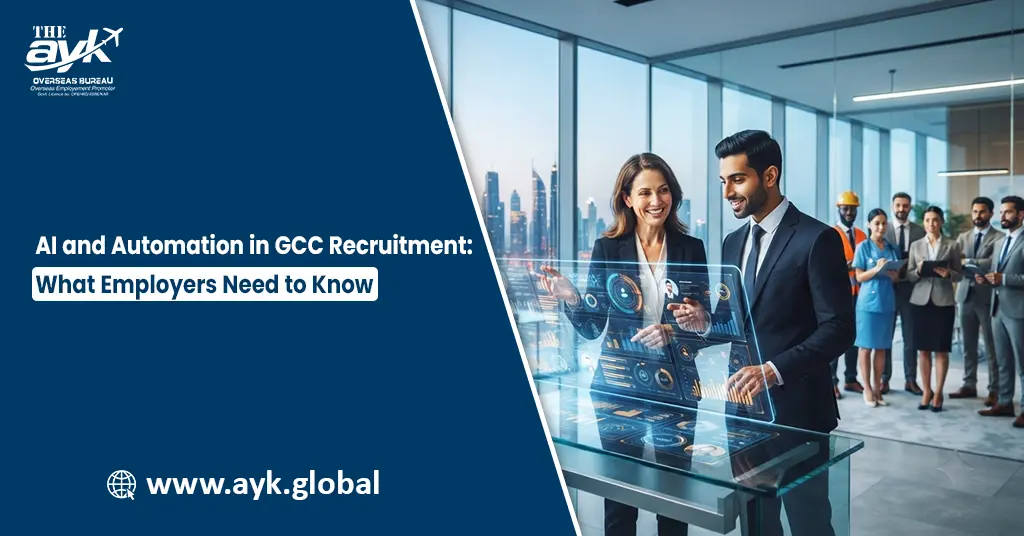
AI and Automation in GCC Recruitment: What Employers Need to Know
Published: July 03, 2026 | Views: 14
GCC countries—including Saudi Arabia, United Arab Emirates, Qatar, Kuwait, Oman, and Bahrain—are rapidly modernizing their recruitment systems through artificial intelligence (AI) and automation technologies. With large-scale infrastructure projects, smart cities, renewable energy developments, and expanding industries, employers are under pressure to hire faster, smarter, and at scale.
Traditional recruitment methods are no longer sufficient for bulk hiring needs in construction, aviation, hospitality, healthcare, logistics, and energy sectors. AI and automation are now being used to streamline candidate sourcing, screening, assessment, and onboarding.
This guide explains how AI and automation are reshaping recruitment in GCC countries and what employers need to know.
AI-Powered Candidate Sourcing and Matching
AI tools are now widely used in GCC recruitment to identify and match candidates with suitable job roles. Instead of manually searching CVs, employers use intelligent systems that scan large databases and match skills with job requirements.
This is especially useful for large-scale hiring in infrastructure and industrial projects where thousands of workers are needed quickly.
Key features include:
- Automated CV parsing and analysis
- Skill-based job matching algorithms
- Smart candidate recommendation systems
- Real-time talent database search
- Faster shortlisting of qualified applicants
Automation in Screening and Shortlisting
Automation has significantly reduced the time required to screen and shortlist candidates. HR systems can now automatically filter applications based on experience, qualifications, and job-specific requirements.
This helps employers focus only on high-quality candidates and reduces manual workload for recruitment teams.
Key benefits include:
- Faster candidate filtering process
- Reduced human bias in selection
- Standardized evaluation criteria
- Higher accuracy in matching job roles
- Efficient handling of bulk applications
AI-Based Interviewing and Assessment Tools
Many GCC employers are now using AI-powered interview platforms and assessment tools to evaluate candidates remotely. These systems analyze communication skills, technical knowledge, and behavioral responses.
This is particularly useful for overseas recruitment from countries like Pakistan, India, Philippines, Bangladesh, and Nepal.
Key features include:
- Video interview analysis tools
- Automated skill assessment tests
- Language and communication evaluation
- Behavioral analysis systems
- Real-time performance scoring
Automated Onboarding and HR Workflows
AI and automation are not limited to hiring; they also extend into onboarding and HR operations. In GCC companies, digital HR systems now manage contracts, document verification, payroll setup, and employee onboarding with minimal manual effort.
This is especially important for industries like construction, aviation, and hospitality where large numbers of employees are hired simultaneously.
Key features include:
- Digital employment contracts and e-signatures
- Automated document verification workflows
- AI-driven onboarding training modules
- HR chatbots for employee support
- Centralized employee data management
Benefits of AI and Automation in GCC Recruitment
AI and automation bring significant advantages to employers in GCC countries, especially those managing large-scale hiring projects. These technologies improve speed, accuracy, and cost efficiency in recruitment operations.
They also help organizations make better hiring decisions based on data rather than manual judgment alone.
Key benefits include:
- Faster hiring cycles for bulk recruitment
- Reduced recruitment operational costs
- Improved candidate quality and job fit
- Better workforce planning and forecasting
- Enhanced transparency in hiring decisions
Challenges of AI-Driven Recruitment Systems
Despite its benefits, AI in recruitment also comes with challenges. Some employers face difficulties in system integration, data accuracy, and candidate digital literacy. Additionally, over-reliance on automation may sometimes lead to overlooking human qualities in candidates.
Key challenges include:
- Limited digital skills among candidates
- Data privacy and security concerns
- Risk of algorithm bias in selection
- High initial setup and technology costs
- Need for continuous system updates
Future of AI in GCC Recruitment
The future of recruitment in GCC countries is expected to become highly automated and AI-driven. Employers will increasingly rely on predictive analytics, smart hiring platforms, and integrated HR ecosystems to manage workforce demands.
AI will not replace human recruiters completely, but it will significantly enhance decision-making and efficiency.
Expected future trends include:
- Fully AI-powered recruitment platforms
- Predictive workforce demand forecasting
- Blockchain-based credential verification
- Smart global talent sourcing systems
- End-to-end automated hiring pipelines
Conclusion
AI and automation are reshaping recruitment in GCC countries by making hiring faster, smarter, and more efficient. From candidate sourcing to onboarding, every stage of recruitment is becoming increasingly digital and data-driven.
Employers who adopt these technologies early will gain a strong competitive advantage in attracting and managing global talent.
 Recruitment Agency in Pakistan for Australia, Complete Employer Guide 2026
 Why Choose a Licensed Overseas Recruitment Agency?
 KSA Recruitment
 UAE Recruitment
 Qatar Recruitment
 Oman Recruitment
 Kuwait Recruitment
 Libya Recruitment
 Bahrain Recruitment
 Iraq Recruitment
 Malaysia Recruitment
 Malta Recruitment
 Canada Recruitment
 USA Recruitment
 Europe Recruitment
 UK Recruitment
 Romania Recruitment
 Poland Recruitment
 Bulgaria Recruitment
 Albania Recruitment
 Serbia Recruitment
 Lithuania Recruitment
 Japan Recruitment
 Turkey Recruitment
 Kyrgyzstan Recruitment
 South Korea Recruitment