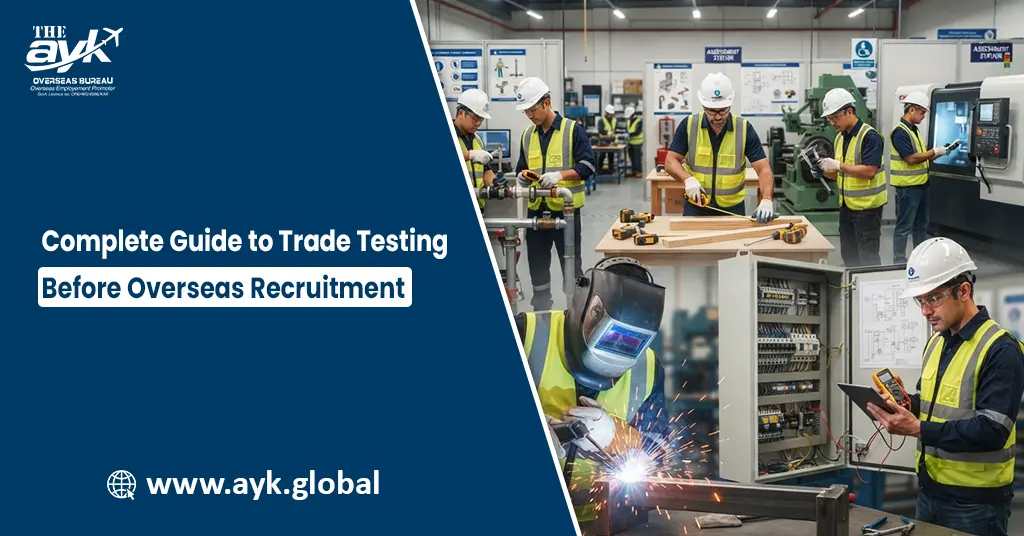
Complete Guide to Trade Testing Before Overseas Recruitment
Published: July 03, 2026 | Views: 14
Introduction
Trade testing is one of the most important steps in overseas recruitment, especially for GCC countries such as Saudi Arabia, UAE, Qatar, Kuwait, Oman, and Bahrain. Large-scale industries like construction, oil & gas, manufacturing, infrastructure development, and maintenance services depend heavily on skilled manpower. Employers cannot rely only on CVs or interviews when hiring workers for technical roles, so trade testing becomes essential to verify real skills before deployment.
In overseas recruitment, trade testing ensures that candidates truly possess the practical abilities required for their job roles. It helps employers avoid hiring unqualified workers, reduces project risks, improves productivity, and ensures safety compliance on work sites. This guide explains everything about trade testing before overseas recruitment, including its process, importance, methods, and benefits for GCC employers and recruitment agencies.
What is Trade Testing in Overseas Recruitment?
Trade testing is a practical evaluation process used to assess a candidate’s technical skills before hiring them for overseas jobs. Instead of relying only on education certificates or interviews, employers test candidates in real working conditions to verify their abilities. This is especially important for skilled trades such as welding, electrical work, plumbing, carpentry, masonry, HVAC, and heavy equipment operation.
The main purpose of trade testing is to ensure that candidates can perform job tasks efficiently and meet international work standards. In GCC recruitment, trade testing is conducted either by recruitment agencies or directly by employers before issuing final job offers. This step significantly reduces hiring mistakes and ensures that only qualified workers are deployed.
Importance of Trade Testing Before Overseas Hiring
Trade testing plays a critical role in ensuring workforce quality for overseas projects. Many candidates may have experience listed on their CVs, but their actual practical skills may vary. Trade testing helps employers identify the true capability of workers before investing in visa processing, travel, and onboarding costs.
Another major importance is risk reduction. Hiring unskilled or underqualified workers can lead to project delays, safety hazards, and increased operational costs. Trade testing ensures that only competent workers are selected, improving efficiency and reducing the chances of rework or accidents on job sites.
Industries That Require Trade Testing
Trade testing is widely used across industries where technical skills are essential. GCC employers depend on this process to maintain high standards of work quality and safety. It is especially important in sectors where even small mistakes can lead to major project losses.
Common industries include:
- Construction and Infrastructure
- Oil & Gas Industry
- Manufacturing and Production
- Mechanical and Electrical Services
- Shipbuilding and Marine Engineering
- Facility Management
- Heavy Equipment Operations
Each of these industries requires workers who are technically skilled and job-ready, making trade testing a mandatory recruitment step.
Types of Trade Tests Conducted
Trade testing varies depending on job roles and industry requirements. Different skill levels require different evaluation methods to ensure accuracy in hiring decisions.
Common types include:
- Practical skill tests (hands-on job tasks)
- Technical written tests (theory-based knowledge)
- Simulation-based tests (real work environment tasks)
- Tool handling assessments
- Safety and compliance tests
Each type helps employers evaluate different aspects of a candidate’s capability, from technical knowledge to practical execution and safety awareness.
Trade Testing Process Step-by-Step
The trade testing process follows a structured system to ensure fairness and accuracy in evaluation. It usually begins after initial candidate screening and continues until final selection.
First, candidates are shortlisted based on their CVs and experience. Then they are invited to a testing center where they are assigned specific tasks related to their job role. For example, welders may be asked to perform different welding techniques, while electricians may be tested on wiring systems.
After completing the test, candidates are evaluated by technical experts. Their performance is assessed based on accuracy, speed, safety practices, and overall technical ability. Only candidates who meet the required standards are selected for final recruitment.
Role of Recruitment Agencies in Trade Testing
Recruitment agencies play a major role in organizing trade testing for overseas recruitment. Licensed agencies maintain testing centers where candidates are evaluated under professional supervision. These agencies ensure that the testing process is standardized, transparent, and aligned with GCC employer requirements.
They also coordinate between employers and candidates, manage logistics, and provide detailed performance reports. This helps employers make informed hiring decisions without needing to physically be present during every stage of the recruitment process.
Common Trade Testing Methods Used in GCC Recruitment
Trade testing methods vary depending on the nature of the job, industry standards, and employer requirements. In GCC overseas recruitment, employers prefer practical, hands-on evaluation methods because they give a real picture of a candidate’s ability to perform on-site tasks.
The most widely used method is practical skill testing, where candidates perform real job tasks such as welding joints, electrical wiring, pipe fitting, or operating heavy machinery. This method is highly effective because it directly reflects on-the-job performance. Another method is simulation testing, where candidates are placed in controlled environments that mimic actual work conditions.
In addition, some roles require written technical tests to assess theoretical knowledge, especially for supervisors, engineers, and technicians. Safety awareness tests are also conducted to ensure that workers understand workplace safety rules, which is critical in high-risk industries like construction and oil & gas.
Benefits of Trade Testing for Employers and Recruitment Agencies
Trade testing offers significant benefits for both employers and recruitment agencies involved in overseas hiring. For employers, it ensures that only skilled and capable workers are selected, reducing the risk of poor performance, project delays, and safety incidents. It also improves productivity because job-ready workers require minimal training after deployment.
For recruitment agencies, trade testing enhances credibility and trust with GCC clients. Agencies that consistently provide high-quality, trade-tested candidates build long-term relationships with employers. This also reduces candidate rejection rates and improves overall recruitment efficiency, making the hiring process smoother and more reliable.
Cost Efficiency Through Trade Testing
Although trade testing may seem like an additional step in the recruitment process, it actually helps reduce long-term hiring costs. By filtering out unskilled or underqualified candidates early, employers avoid expensive mistakes such as visa processing for unsuitable workers, travel costs, onboarding expenses, and early replacements.
Trade testing also reduces project-related costs by minimizing errors, rework, and accidents on job sites. Skilled workers perform tasks more efficiently, which leads to faster project completion and better resource utilization. In large-scale GCC projects, these savings can be substantial over time.
Challenges in Trade Testing and How to Overcome Them
Despite its benefits, trade testing comes with certain challenges. One common issue is lack of standardized testing procedures across different recruitment agencies. This can lead to inconsistent evaluation results and difficulty in comparing candidates fairly.
Another challenge is logistical complexity, especially when handling large groups of candidates in bulk recruitment campaigns. Limited testing facilities or equipment can also slow down the process. Additionally, candidates may sometimes struggle due to nervousness or unfamiliar testing environments, which may affect their performance.
These challenges can be overcome by using standardized testing systems, improving facility infrastructure, training assessors properly, and ensuring clear communication with candidates before testing begins. Digital tools and structured evaluation frameworks also help improve consistency and efficiency.
Best Practices for Effective Trade Testing
To ensure successful trade testing in overseas recruitment, employers and agencies should follow best practices that improve accuracy and fairness. One important practice is designing job-specific test modules that match real workplace conditions. This ensures that candidates are evaluated based on actual job requirements.
Another best practice is using qualified technical assessors who have industry experience and can accurately evaluate candidate performance. Maintaining proper documentation of test results also helps in transparent decision-making and future reference. Additionally, providing clear instructions to candidates before testing improves performance accuracy and reduces confusion.
Key best practices include:
- Job-specific test design
- Experienced technical evaluators
- Standardized evaluation criteria
- Proper documentation of results
- Clear candidate instructions
- Use of modern testing tools
Conclusion
Trade testing is a vital component of overseas recruitment that ensures only skilled, reliable, and job-ready candidates are selected for GCC projects. It helps employers improve workforce quality, reduce risks, and achieve better project outcomes. By adopting structured testing methods, addressing challenges, and following best practices, recruitment agencies and employers can significantly enhance hiring efficiency.
In industries like construction, oil & gas, manufacturing, and infrastructure development, trade testing is not just a selection tool—it is a quality assurance system that ensures long-term workforce success in demanding international environments.
 Documents Required for GCC Employment Visa from Pakistan
 Best Schengen Countries for Pakistani Workers: Salary, Demand & Visa Process
 Hire Pakistani Workers for Scotland, A Practical Guide for Employers
 KSA Recruitment
 UAE Recruitment
 Qatar Recruitment
 Oman Recruitment
 Kuwait Recruitment
 Libya Recruitment
 Bahrain Recruitment
 Iraq Recruitment
 Malaysia Recruitment
 Malta Recruitment
 Canada Recruitment
 USA Recruitment
 Europe Recruitment
 UK Recruitment
 Romania Recruitment
 Poland Recruitment
 Bulgaria Recruitment
 Albania Recruitment
 Serbia Recruitment
 Lithuania Recruitment
 Japan Recruitment
 Turkey Recruitment
 Kyrgyzstan Recruitment
 South Korea Recruitment