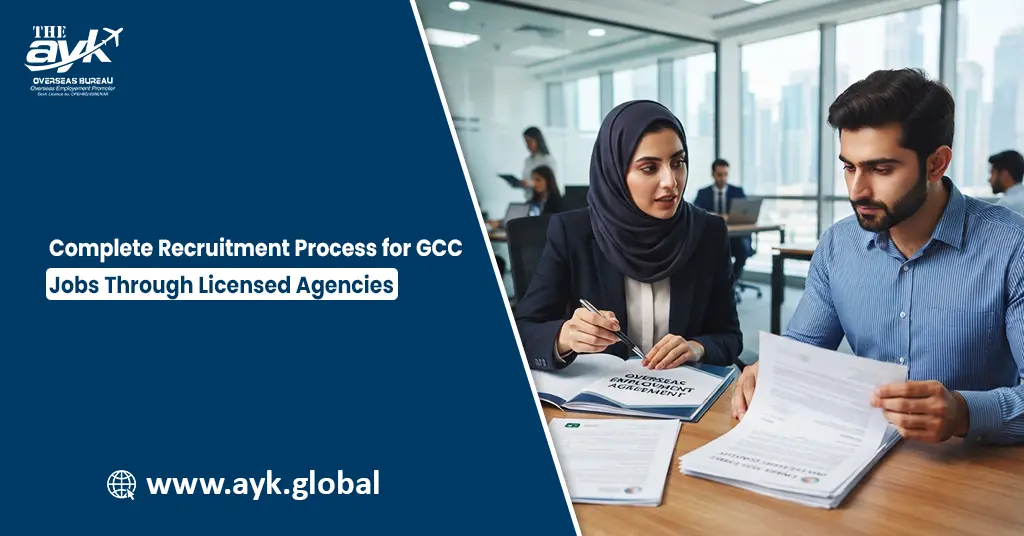
Complete Recruitment Process for GCC Jobs Through Licensed Agencies
Published: July 02, 2026 | Views: 11
Introduction
The recruitment process for GCC jobs through licensed agencies is one of the most structured and important pathways for Pakistani job seekers who want to work in Gulf countries such as Saudi Arabia, United Arab Emirates (UAE), Qatar, Kuwait, Oman, and Bahrain. Every year, thousands of workers and professionals from Pakistan are hired through official recruitment agencies that connect them with verified employers in the Gulf region.
These agencies play a critical role in ensuring legal employment, proper documentation, and safe job placement. However, many candidates do not fully understand how the recruitment process works, which leads to confusion, delays, or even falling victim to fake job offers.
Understanding the complete recruitment process helps candidates prepare better, avoid scams, and increase their chances of getting selected for high-quality jobs in GCC countries. This guide explains every step in detail from application to final departure.
Understanding Licensed Recruitment Agencies
Licensed recruitment agencies are government-approved organizations authorized to send workers from Pakistan to foreign countries for employment. These agencies work directly with GCC employers and follow strict legal procedures for hiring candidates.
Their main responsibilities include sourcing candidates, conducting interviews, verifying documents, coordinating with employers, and managing visa processing. A licensed agency ensures that both employer and employee are protected under legal agreements.
Candidates should always verify that the agency is officially registered before applying. This helps avoid fraud and ensures safe recruitment.
Job Advertisement and Initial Application
The recruitment process usually begins with a job advertisement posted by the licensed agency. These advertisements may appear on official websites, newspapers, social media platforms, or through direct recruitment campaigns.
Job postings include details such as job title, required qualifications, experience level, salary package, benefits, and country of employment. Candidates interested in the job submit their applications along with resumes and required documents.
At this stage, it is important for applicants to carefully read job requirements and ensure they meet eligibility criteria before applying.
Shortlisting of Candidates
After receiving applications, the recruitment agency reviews all candidates and shortlists those who meet the job requirements. Shortlisting is based on qualifications, experience, skills, and overall suitability for the role.
Only selected candidates are invited for the next stage, which may include interviews or skill assessments. Candidates who do not meet requirements are usually not considered further.
This stage ensures that only qualified and relevant applicants move forward in the recruitment process.
Interview Process with Employers
The interview stage is one of the most important parts of GCC recruitment. Interviews may be conducted by GCC employers, HR representatives, or technical supervisors. These interviews can take place in person or online.
For skilled jobs, interviews often include technical questions related to the job role. For example, engineers, electricians, welders, and technicians may be asked about tools, processes, and practical knowledge.
For unskilled jobs, interviews focus on physical fitness, attitude, willingness to work, and basic communication skills.
Successful interview performance is essential for final selection.
Skill Tests and Practical Assessments
In many skilled job categories, candidates are required to pass practical tests. These tests are conducted to evaluate real-world job skills.
For example, welders may be asked to perform welding tasks, electricians may be tested on wiring systems, and mechanical workers may be asked to demonstrate equipment handling.
These tests ensure that candidates are capable of performing job duties efficiently in real work environments. Performance in skill tests has a direct impact on selection chances.
Final Selection and Offer Letter
After interviews and tests, successful candidates receive a job offer letter from the employer. This document contains important details such as job title, salary, working hours, accommodation, transport, medical benefits, and contract duration.
Candidates must carefully review the offer letter before accepting it. Any confusion should be clarified with the recruitment agency or employer.
Once the offer is accepted, the official employment contract is signed by both parties.
Medical Examination Process
Medical fitness is a mandatory requirement for all GCC jobs. Selected candidates must undergo medical tests at approved medical centers authorized by GCC embassies.
Medical tests include blood tests, chest X-rays, and screening for infectious diseases. The purpose is to ensure that the candidate is physically fit to work in Gulf countries.
If a candidate fails the medical examination, the job offer may be withdrawn. Therefore, maintaining good health is essential before applying.
Document Verification and Attestation
Before visa processing, all educational and experience documents must be verified and attested by relevant authorities. This includes educational boards, higher education commissions, and foreign affairs departments.
Attestation confirms the authenticity of documents and ensures compliance with GCC immigration requirements. Without proper attestation, visa approval is not possible.
Candidates must ensure all documents are accurate, updated, and properly verified.
Visa Processing Stage
Once medical and documentation processes are completed, the employer initiates visa processing. The recruitment agency submits all required documents to GCC immigration authorities for approval.
After verification, an employment visa is issued in the candidate’s name. This visa allows legal entry and employment in the respective GCC country.
Visa processing time may vary depending on country and job category.
Visa Stamping and Final Approval
After visa approval, the passport is submitted for visa stamping. This step officially confirms that the candidate is allowed to travel and work in the GCC country.
Visa stamping is a crucial step and must be handled carefully through authorized agencies or embassies.
Once stamping is complete, the candidate receives final travel authorization.
Pre-Departure Orientation
Before departure, recruitment agencies often conduct orientation sessions for selected candidates. These sessions include information about workplace rules, cultural expectations, safety guidelines, and travel instructions.
Candidates are also informed about company policies, accommodation arrangements, and reporting procedures upon arrival.
This preparation helps candidates adjust smoothly to their new work environment.
Travel and Deployment to GCC Countries
The final step in the recruitment process is travel and deployment. Candidates receive flight tickets and travel instructions from the recruitment agency or employer.
Upon arrival in the GCC country, candidates are received by company representatives and taken to accommodation or workplace.
At this stage, employment officially begins under the terms of the contract.
Conclusion
The recruitment process for GCC jobs through licensed agencies is a well-structured and legal pathway for Pakistani workers and professionals seeking employment in Saudi Arabia, UAE, Qatar, Kuwait, Oman, and Bahrain. From application to final deployment, each step ensures transparency, safety, and proper verification.
By understanding this complete process, candidates can avoid scams, prepare better, and increase their chances of successful employment abroad. Working through licensed agencies not only ensures legal protection but also provides long-term career opportunities in the Gulf region.
 Why Azerbaijan Is Becoming a Popular Overseas Employment Destination
 Gulf Jobs vs European Jobs: An Honest Comparison
 KSA Recruitment
 UAE Recruitment
 Qatar Recruitment
 Oman Recruitment
 Kuwait Recruitment
 Libya Recruitment
 Bahrain Recruitment
 Iraq Recruitment
 Malaysia Recruitment
 Malta Recruitment
 Canada Recruitment
 USA Recruitment
 Europe Recruitment
 UK Recruitment
 Romania Recruitment
 Poland Recruitment
 Bulgaria Recruitment
 Albania Recruitment
 Serbia Recruitment
 Lithuania Recruitment
 Japan Recruitment
 Turkey Recruitment
 Kyrgyzstan Recruitment
 South Korea Recruitment