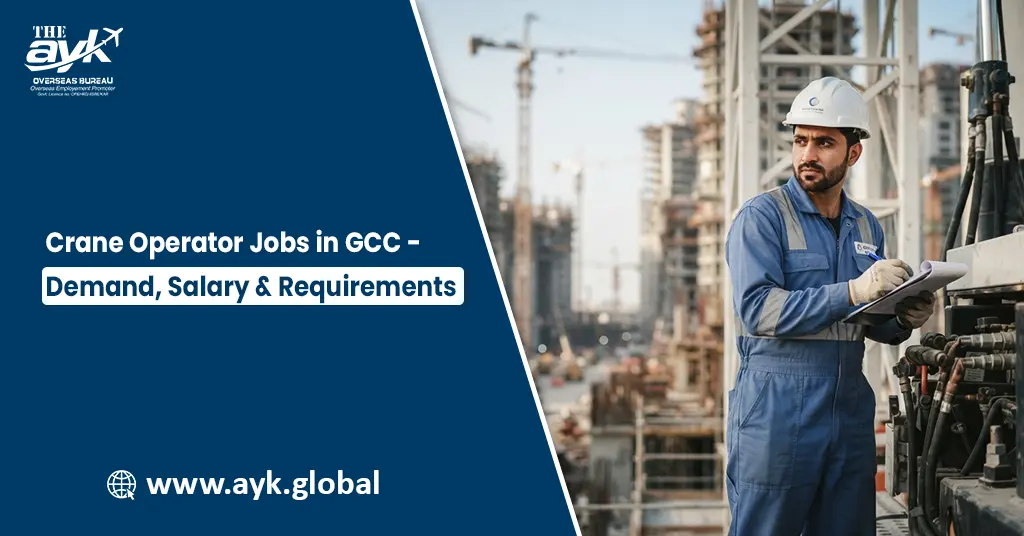
Crane Operator Jobs in GCC – Demand, Salary and Requirements
Published: July 02, 2026 | Views: 12
Introduction
Crane operator jobs in GCC countries such as Saudi Arabia, United Arab Emirates (UAE), Qatar, Kuwait, Oman, and Bahrain are among the most important and high-demand skilled trades in the construction and industrial sectors in 2026. With continuous mega infrastructure projects like smart cities, airports, ports, highways, metro systems, oil refineries, and commercial towers, the need for qualified crane operators has increased significantly.
Crane operators play a critical role in lifting and moving heavy materials safely and efficiently on construction sites, industrial zones, and logistics hubs. Without crane operators, large-scale projects cannot be completed on time or with proper safety standards.
For Pakistani workers, crane operator jobs are especially attractive because they offer high salaries, overtime opportunities, accommodation, transport, and long-term job stability in GCC countries.
Growing Demand for Crane Operators in GCC
The demand for crane operators in GCC countries is increasing rapidly due to ongoing development projects across all major sectors. Saudi Arabia alone is investing billions in Vision 2030 projects such as NEOM, The Line, Qiddiya, and Red Sea developments. Similarly, UAE continues expanding Dubai and Abu Dhabi infrastructure, including airports, skyscrapers, and industrial zones.
All these projects require heavy lifting operations, which makes crane operators essential workers on every major site. Tower cranes, mobile cranes, and hydraulic cranes are used extensively in construction, shipping ports, and oil and gas facilities.
Because of this constant expansion, crane operators enjoy steady employment opportunities throughout the year, especially in large construction companies and government-backed projects.
Types of Crane Operator Jobs in GCC
Crane operator jobs in GCC countries are categorized based on machinery type and industry requirements. The most common types include:
- Tower crane operators
- Mobile crane operators
- Hydraulic crane operators
- Crawler crane operators
- Port crane operators (shipyard cranes)
Each type of crane requires specific technical skills and certification.
Tower crane operators are mainly used in high-rise building construction, while mobile cranes are used for flexible lifting operations across different sites.
Role and Responsibilities of Crane Operators
Crane operators are responsible for safely lifting, moving, and positioning heavy materials on construction and industrial sites. Their role requires precision, attention to detail, and strong safety awareness.
Key responsibilities include:
- Operating different types of cranes safely
- Lifting construction materials and equipment
- Following load capacity limits
- Communicating with signalmen and site supervisors
- Ensuring safe movement of loads
- Inspecting crane systems before operation
Even a small mistake in crane operation can cause serious accidents, which is why employers highly prioritize trained and experienced operators.
Skills Required for Crane Operator Jobs
To work as a crane operator in GCC countries, candidates must have strong technical and operational skills. These include:
- Knowledge of crane controls and functions
- Ability to read load charts
- Basic mechanical understanding
- Strong hand-eye coordination
- Communication skills for site coordination
- Safety awareness and discipline
Operators must also understand hand signals and radio communication used on construction sites.
Experience Requirements
Most GCC employers require crane operators to have at least 3 to 5 years of relevant experience. This is because crane operation involves high-risk work and expensive machinery.
Experienced operators are preferred for:
- Large construction projects
- Oil and gas facilities
- Ports and shipping yards
- High-rise building sites
Some entry-level assistant crane operator roles may be available, but full operator positions usually require proven experience and certification.
Certification and Licensing
In GCC countries, crane operators are often required to hold valid licenses or certifications. These certifications prove that the operator has been trained to handle heavy machinery safely.
Common requirements include:
- Crane operator license
- Safety training certification (OSHA or equivalent)
- Medical fitness certificate
- Practical training experience
Some companies provide training after hiring, but most prefer certified operators to reduce risk and improve efficiency.
Salary of Crane Operators in GCC
Crane operator salaries in GCC countries are among the highest in skilled trade categories. The exact salary depends on experience, type of crane, and project size.
General salary structure includes:
- Entry-level operators: moderate salary range
- Experienced tower crane operators: high salary range
- Specialized port or oil & gas crane operators: very high salary range
In addition to basic salary, workers often receive:
- Overtime pay
- Free accommodation
- Transport facilities
- Medical insurance
- Annual leave benefits
Overtime work significantly increases monthly earnings, making this job financially rewarding.
Work Environment and Conditions
Crane operators typically work in outdoor environments such as construction sites, ports, and industrial zones. The job requires working at heights (especially tower cranes) and in different weather conditions.
Work conditions include:
- Long shifts (8–12 hours or more)
- Exposure to heat in GCC climate
- Strict safety rules
- Shift-based schedules
Despite challenging conditions, the job is well-organized and professionally managed with strong safety protocols.
Safety Importance in Crane Operation
Safety is the most critical aspect of crane operation. GCC employers enforce strict safety standards to prevent accidents and ensure smooth project execution.
Operators must:
- Follow load capacity limits strictly
- Inspect equipment before use
- Communicate clearly with signalmen
- Avoid unsafe lifting practices
- Wear protective safety gear
Any violation of safety rules can lead to serious consequences, including job termination.
Career Growth Opportunities
Crane operator jobs in GCC countries offer strong career growth. With experience, workers can move into higher positions such as:
- Senior crane operator
- Site lifting supervisor
- Safety coordinator
- Equipment manager
Experienced operators are also highly valued in international construction markets, opening opportunities for global employment.
Continuous skill improvement and safety training can significantly enhance career progression.
Why Pakistani Workers Are Preferred
Pakistani workers are highly preferred for crane operator jobs in GCC countries due to several reasons:
- Strong technical experience in construction
- Ability to work in tough environments
- Discipline and reliability
- Cost-effective workforce
- Adaptability to different job conditions
Many Pakistani workers already have experience in heavy equipment operations, making them suitable candidates for GCC projects.
How to Apply for Crane Operator Jobs
Pakistani workers can apply for crane operator jobs in GCC through:
- Licensed recruitment agencies
- Verified overseas job portals
- Direct employer hiring
- Government-approved manpower companies
A proper application process includes:
- Submission of CV
- Experience verification
- Skill testing or trade test
- Interview with employer
- Visa processing and medical tests
Using licensed agencies is the safest method to avoid fraud.
Conclusion
Crane operator jobs in GCC countries offer excellent career opportunities for skilled Pakistani workers in 2026. With increasing demand due to large-scale construction, infrastructure, and industrial projects, crane operators are essential workers in every major development.
These jobs provide high salaries, overtime earnings, accommodation, and long-term job security. However, they require experience, technical skills, certification, and strict safety awareness.
For Pakistani job seekers, crane operation is one of the most stable and high-paying overseas career paths in Saudi Arabia, UAE, Qatar, Kuwait, Oman, and Bahrain.
 How to Avoid Fake Recruitment Agencies in Pakistan
 Why Choose a Licensed Overseas Recruitment Agency?
 The Complete Guide to Hiring Pakistani Workers for Overseas Projects
 KSA Recruitment
 UAE Recruitment
 Qatar Recruitment
 Oman Recruitment
 Kuwait Recruitment
 Libya Recruitment
 Bahrain Recruitment
 Iraq Recruitment
 Malaysia Recruitment
 Malta Recruitment
 Canada Recruitment
 USA Recruitment
 Europe Recruitment
 UK Recruitment
 Romania Recruitment
 Poland Recruitment
 Bulgaria Recruitment
 Albania Recruitment
 Serbia Recruitment
 Lithuania Recruitment
 Japan Recruitment
 Turkey Recruitment
 Kyrgyzstan Recruitment
 South Korea Recruitment