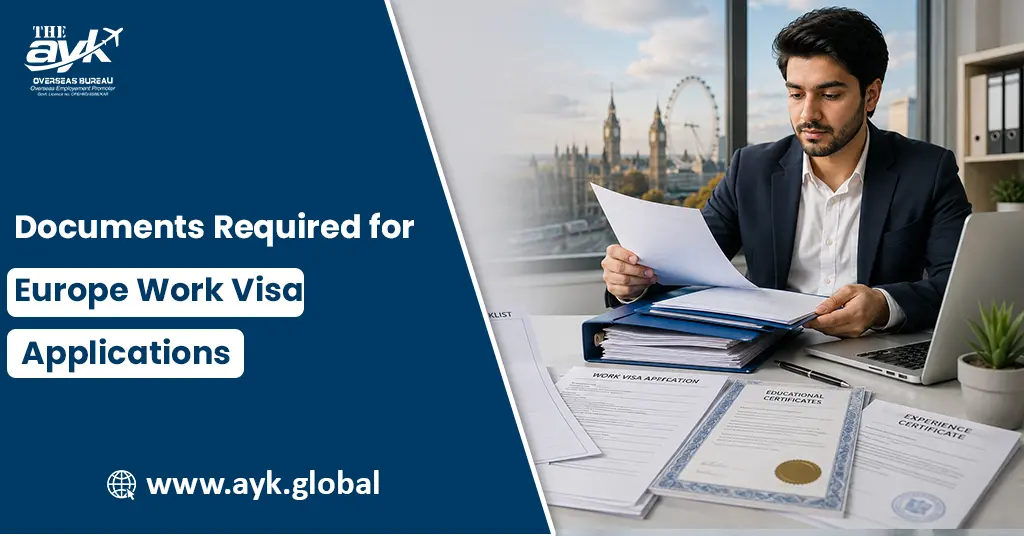
Documents Required for Europe Work Visa Applications
Published: July 06, 2026 | Views: 14
Documents Required for Europe Work Visa Applications
Applying for a Europe work visa in 2026 requires proper documentation to ensure legal entry and employment in European countries. Whether you are applying for jobs in Germany, Poland, Netherlands, Czech Republic, Italy, Spain, or other EU countries, the visa process is strict and highly organized. Immigration authorities carefully check documents to verify identity, qualifications, job offers, and financial stability. For skilled and semi-skilled workers from countries like Pakistan, India, Bangladesh, and Nepal, preparing the correct documents is the most important step in securing a work visa. Any missing or incorrect document can delay or reject the application. In most cases, employers or recruitment agencies guide applicants through the documentation process after a job offer is confirmed. However, understanding the full list of required documents helps candidates prepare in advance and avoid delays. This guide explains all essential documents required for Europe work visa applications in 2026, including personal, educational, professional, and legal requirements.
Valid Passport and Travel Documents
A valid passport is the most important document for applying for a Europe work visa. The passport must be valid for at least 6 months to 1 year depending on the country’s visa policy. It should have enough blank pages for visa stamps and entry/exit records. In some cases, applicants may also need to submit old passports to show travel history. A clear scanned copy of the passport’s bio page is usually required for online applications. Some countries may also require passport-size photographs with specific background and size requirements. Without a valid passport, no visa application can be processed. It is also important to ensure that all personal details in the passport match other documents such as educational certificates and job contracts. Any mismatch can cause delays or rejection of the application. Therefore, keeping a valid and updated passport is the first step in preparing for a Europe work visa application.
Job Offer Letter or Employment Contract
A job offer letter or employment contract is a mandatory document for most Europe work visa applications. This document proves that you have been officially hired by a European employer. It includes details such as job title, salary, working hours, job location, and contract duration. In many cases, employers also mention whether they are providing visa sponsorship or work permit support. Immigration authorities use this document to verify the authenticity of your employment. Without a confirmed job offer, it is usually not possible to apply for a work visa in most European countries. Recruitment agencies often help candidates obtain these contracts after successful interviews. The contract must be signed by both the employer and the employee. It is important to carefully read all terms and conditions before signing. A genuine job offer is the foundation of a successful Europe work visa application.
Educational and Professional Certificates
Educational and professional certificates are required to prove your qualifications and skills for the job you are applying for. These may include matric, intermediate, diploma, bachelor’s degree, or technical certifications depending on the job role. Skilled jobs such as engineering, healthcare, IT, and technical trades require relevant qualifications. In many cases, certificates must be translated into English or the official language of the destination country. Some countries may also require degree recognition or equivalency approval before visa processing. Experience certificates from previous employers are also important, especially for skilled and semi-skilled jobs. These documents help immigration officers confirm that you are qualified for the job offered. Without proper educational or experience proof, visa approval becomes difficult. Therefore, candidates should prepare verified copies of all academic and professional documents before applying for Europe work visas.
Medical Fitness Certificate
A medical fitness certificate is required to ensure that the applicant is physically and mentally fit to work in Europe. This certificate is issued by approved medical centers or hospitals authorized by the embassy or immigration department. The medical test usually includes general health checks, blood tests, chest X-rays, and screening for infectious diseases. Some countries may have additional health requirements depending on the job type. For example, healthcare workers or food industry employees may require stricter medical testing. The certificate must be recent and valid at the time of visa submission. A medically unfit report can lead to visa rejection. Employers also use this certificate to ensure that workers can handle job responsibilities safely. In many cases, recruitment agencies assist candidates in booking approved medical appointments. Having a valid medical fitness certificate is a key requirement for almost all Europe work visa applications.
Police Clearance Certificate (PCC)
A Police Clearance Certificate (PCC) is required to verify that the applicant has no criminal record. This document is issued by local police authorities or government departments in the applicant’s home country. It confirms that the individual is not involved in any criminal activities and is eligible to work abroad. Most European countries strictly require a PCC for work visa approval to ensure safety and security. The certificate must be recent, usually issued within the last 3 to 6 months. It is often required to be attested or verified by relevant government departments or embassies. Without a PCC, visa applications are generally not accepted. Applicants should apply for this document early, as processing time may vary. A clean background record significantly increases the chances of visa approval and smooth immigration processing.
Proof of Work Experience
Proof of work experience is an important requirement for many Europe work visa applications, especially for skilled and semi-skilled jobs. This includes experience letters from previous employers, salary slips, appointment letters, or reference letters that confirm your job role and duration of employment. Immigration authorities use this document to verify that you have the necessary skills for the job offered in Europe. For example, construction workers, electricians, welders, machine operators, truck drivers, and healthcare assistants usually need relevant work experience proof. The experience letter should clearly mention job title, duties, and employment period. In some cases, employers may also contact previous companies for verification. If documents are missing or fake, visa rejection is highly likely. Therefore, providing genuine and verifiable work experience documents is essential for a successful Europe work visa application.
Visa Application Form and Photographs
A completed visa application form is mandatory for all Europe work visa applications. This form includes personal details such as name, date of birth, nationality, passport information, job details, and travel purpose. Applicants must fill out the form carefully and ensure that all information matches their supporting documents. Any mistake or mismatch can lead to delays or rejection. Along with the form, recent passport-size photographs are also required. These photographs must meet specific embassy guidelines such as size, background color, and facial visibility. Some countries require digital submission while others require printed copies. The visa form is usually submitted online or through the embassy or visa center. Recruitment agencies often help candidates correctly fill out the application form to avoid errors. Proper completion of this step is essential for smooth visa processing and approval.
Proof of Accommodation and Travel Details
Some European countries require proof of accommodation and travel arrangements as part of the work visa application process. This document shows where the applicant will stay after arriving in Europe. In most cases, employers provide accommodation details such as company housing or rented apartments. If not provided, applicants must arrange temporary accommodation and submit proof such as hotel bookings or rental agreements. Travel details such as flight reservations may also be required in some visa categories. These documents help immigration authorities ensure that the applicant has proper living arrangements upon arrival. In many skilled worker programs, accommodation is included in the job contract, making this requirement easier to fulfill. Providing clear and verified accommodation details increases the chances of smooth visa approval and reduces the risk of rejection or delays during processing.
Financial Proof or Bank Statement
A bank statement or financial proof is sometimes required to show that the applicant has enough funds to support initial expenses. This is not mandatory for all work visas, especially when the employer provides full sponsorship. However, some countries may still request proof of financial stability. The bank statement usually covers the last 3 to 6 months and must show consistent activity and sufficient balance. This document helps immigration officers ensure that the applicant can manage personal expenses before receiving the first salary. In some cases, a sponsor letter from the employer may replace this requirement. Fake or manipulated bank statements can lead to visa rejection and future bans. Therefore, applicants should provide genuine financial documents if required by the embassy or visa center.
Final Thoughts on Europe Work Visa Documents
Preparing the correct documents is the most important step in successfully applying for a Europe work visa in 2026. Each document plays a key role in verifying identity, qualifications, job offer, and legal eligibility for employment. Missing or incorrect paperwork can delay or completely reject the application process. Therefore, applicants should carefully prepare all required documents in advance, including passport, job contract, educational certificates, medical report, and police clearance certificate. It is also important to follow embassy guidelines and ensure all documents are valid and properly attested if required. Recruitment agencies and employers often assist in organizing paperwork, but applicants must also stay aware of requirements. With proper documentation and preparation, securing a Europe work visa becomes much easier and increases chances of successful employment abroad.
 Skills Gulf Workers Bring Back That Pakistan Needs
 KSA Recruitment
 UAE Recruitment
 Qatar Recruitment
 Oman Recruitment
 Kuwait Recruitment
 Libya Recruitment
 Bahrain Recruitment
 Iraq Recruitment
 Malaysia Recruitment
 Malta Recruitment
 Canada Recruitment
 USA Recruitment
 Europe Recruitment
 UK Recruitment
 Romania Recruitment
 Poland Recruitment
 Bulgaria Recruitment
 Albania Recruitment
 Serbia Recruitment
 Lithuania Recruitment
 Japan Recruitment
 Turkey Recruitment
 Kyrgyzstan Recruitment
 South Korea Recruitment