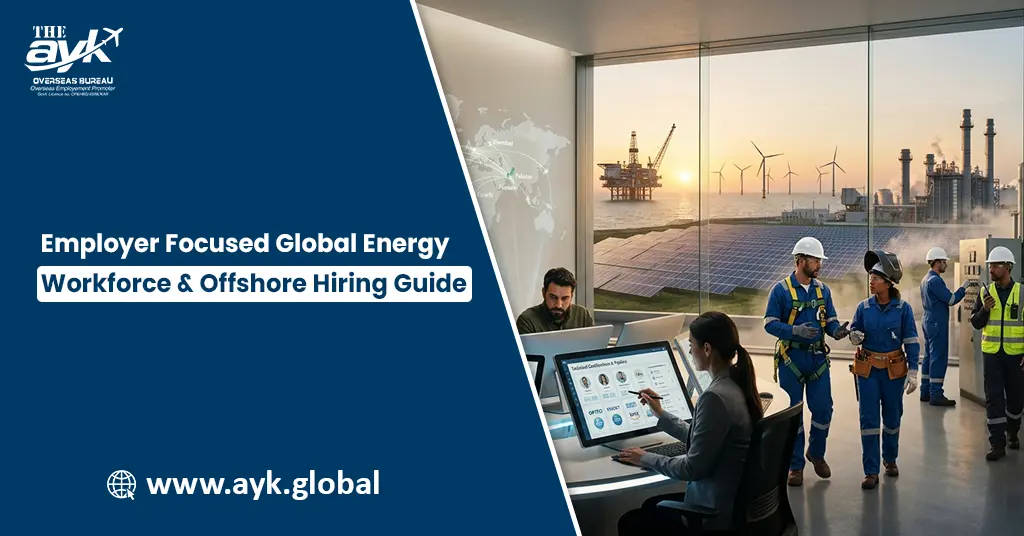
Employer-Focused Global Energy Workforce & Offshore Hiring Guide
Published: June 29, 2026 | Views: 18
Introduction: Why Oil and Gas Industry Depends on International Recruitment
The oil and gas industry is one of the most technically demanding and globally distributed sectors in the world. Projects are often located in remote offshore platforms, desert oilfields, and high-risk industrial environments where skilled manpower is not easily available locally. Because of this, international recruitment has become a core operational strategy for energy companies.
From upstream exploration to downstream refining, every stage of the oil and gas value chain requires highly specialized professionals. These include drilling engineers, rig workers, welders, pipeline technicians, safety officers, mechanical engineers, and maintenance crews. Many countries simply do not have enough local talent to meet these demands, especially for large-scale energy projects.
As a result, companies operating in the Middle East, Africa, and other energy-rich regions increasingly rely on international manpower sourcing to ensure uninterrupted production and operational safety. Pakistan has emerged as one of the important labor markets for oil and gas recruitment due to its skilled workforce, technical training background, and experience in Gulf energy projects.
However, oil and gas recruitment is highly sensitive and requires strict safety compliance, technical verification, and structured workforce planning.
Why Oil and Gas Companies Hire Skilled Workers from Abroad
Oil and gas projects are complex, expensive, and time-sensitive. Even minor delays in manpower availability can result in significant financial losses. This is why companies prefer hiring skilled professionals from international markets to ensure continuous operations.
One of the primary reasons for overseas hiring is technical specialization. Many roles in the oil and gas sector require advanced technical knowledge, certifications, and field experience that may not be widely available in local labor markets.
Another important factor is scalability. Large energy projects often require hundreds or thousands of workers at different stages. Local labor markets cannot always supply such large volumes within short timeframes, making international recruitment necessary.
Cost efficiency also plays a role, but in oil and gas recruitment, quality and safety are far more important than cost alone. Employers focus on hiring experienced professionals who can operate in high-risk environments with strict safety standards.
Key Challenges in Oil and Gas Recruitment
Oil and gas recruitment comes with some of the most complex hiring challenges in any industry. One of the biggest challenges is verifying technical certifications. Many roles require specialized training such as offshore safety certification, welding qualifications, rig operation training, and engineering credentials.
Another major challenge is safety compliance. Workers in oil and gas environments must follow strict international safety standards. Any lack of training or experience can lead to serious accidents or operational hazards.
Visa processing and documentation can also be complex, especially for offshore or remote project locations. Each country has its own regulatory framework for energy sector workers, and compliance must be strictly maintained.
Retention is another issue in this sector. Oil and gas jobs are physically demanding and often located in remote areas, which can lead to early resignations if expectations are not properly managed.
Strategic Recruitment Approach for Oil and Gas Companies
A successful oil and gas recruitment strategy always begins with detailed workforce planning. Employers must define the exact number of workers required, job roles, project duration, and required certifications before starting the hiring process.
Unlike general labor hiring, oil and gas recruitment requires role-specific selection. For example, drilling engineers, rig operators, welders, pipefitters, electricians, and safety officers all require different technical evaluations.
Once planning is complete, companies must focus on certification-based hiring. This ensures that all selected candidates meet international safety and technical standards required for oilfield operations.
At this stage, professional recruitment agencies become essential. Agencies help manage sourcing, verification, documentation, and deployment processes in a structured and compliant manner.
In Pakistan, one of the trusted manpower providers is AYK Overseas Recruitment & HR Manpower Agency, which specializes in supplying skilled oil and gas professionals for international energy projects. Such agencies ensure proper screening, certification verification, and deployment coordination.
Importance of Safety and Certification in Oil and Gas Hiring
Safety is the most critical factor in oil and gas recruitment. Every worker must be trained in industrial safety protocols, emergency procedures, and hazard management systems.
Certifications such as offshore safety training, rig safety training, and equipment handling licenses are often mandatory. Employers must verify that all documents are valid and recognized internationally.
Without proper certification, companies risk not only operational failure but also serious legal and financial consequences.
Country-Based Recruitment Strategy for Oil and Gas Workforce
Successful energy companies diversify their workforce sourcing strategy across multiple countries to ensure stability and flexibility.
Pakistan is a strong source of skilled welders, pipefitters, rig workers, and mechanical technicians. India provides a large pool of engineering and technical professionals. Other regions also contribute specialized manpower depending on project requirements.
By diversifying recruitment sources, companies reduce dependency risks and ensure continuous workforce availability for critical energy operations.
Role of Recruitment Agencies in Oil and Gas Staffing
Recruitment agencies play a vital role in global oil and gas staffing. These agencies ensure that employers receive pre-screened, certified, and job-ready professionals.
A manpower agency handles the entire recruitment lifecycle, including candidate sourcing, certification verification, documentation, visa processing, and deployment logistics. This reduces administrative burden on employers and ensures compliance with international energy sector standards.
A trusted agency like AYK Overseas Recruitment & HR Manpower Agency connects oil and gas companies with skilled Pakistani professionals and ensures smooth recruitment execution.
Advanced Offshore Hiring Strategies, Safety Systems, Cost Control & FAQs
Oil and gas recruitment becomes far more complex once companies move from basic hiring to full-scale international project staffing. Offshore rigs, refineries, pipeline projects, and desert oilfields require not just manpower, but highly trained, safety-certified, and experienced professionals who can work in extreme and high-risk environments.
After understanding the foundation in Part 1, this section focuses on advanced recruitment systems that help oil and gas companies build reliable, compliant, and long-term workforce structures for global energy projects.
Advanced Recruitment Strategy for Oil and Gas Projects
In the oil and gas industry, recruitment cannot be treated as a short-term hiring activity. Projects are long, expensive, and technically demanding, which means workforce planning must be done months in advance.
Successful companies use predictive workforce planning, where they estimate manpower requirements based on project phases such as exploration, drilling, construction, production, and maintenance. Each phase requires different technical skills, and recruitment must align with these operational stages.
Another advanced strategy is maintaining a standby talent pool. Instead of hiring only when demand arises, companies build a database of pre-screened, certified professionals who can be deployed immediately when required. This reduces downtime and ensures project continuity.
Pre-deployment simulation and training awareness is also becoming common. Workers are briefed on offshore conditions, safety expectations, and technical environments before they arrive on site. This reduces adaptation time and improves performance from day one.
Offshore Workforce Management in Oil and Gas Industry
Managing offshore workers requires a completely different approach compared to standard industrial hiring. Offshore environments are physically demanding, isolated, and highly regulated.
Employers must ensure that workers are mentally and physically prepared for long shifts, confined living conditions, and strict safety protocols. Rotation systems are commonly used in offshore projects, where workers are deployed for specific cycles and then rotated out for rest periods.
Communication systems also play a major role in offshore workforce management. Clear reporting structures, safety communication protocols, and emergency response systems must be in place to ensure smooth operations.
Without proper workforce management, even highly skilled professionals can face performance issues in offshore environments.
Safety Compliance and Risk Management
Safety is the most critical aspect of oil and gas recruitment. Every worker must comply with international safety standards because even minor errors can result in serious accidents, environmental damage, or financial loss.
Companies must ensure that all workers have completed mandatory safety certifications such as offshore survival training, fire safety training, and hazard awareness programs. These certifications are not optional—they are legal and operational requirements in most countries.
Regular safety audits and training refreshers are also important. Employers must continuously monitor compliance to maintain operational safety standards across all project sites.
Recruitment agencies play an important role in ensuring that only safety-certified candidates are selected and deployed for oilfield projects.
Cost Optimization in Oil and Gas Recruitment
Oil and gas projects involve extremely high operational costs, and manpower expenses form a significant portion of the overall budget. However, cost optimization should never compromise safety or skill quality.
One of the most effective cost strategies is reducing turnover rates. Every time a skilled worker leaves, companies incur additional costs for replacement, training, and downtime. By improving worker satisfaction and retention, companies can significantly reduce hidden recruitment expenses.
Another cost-saving approach is hiring multi-skilled professionals. Workers who can handle multiple technical roles reduce the need for large workforce numbers, improving efficiency and lowering overall staffing costs.
Working with experienced recruitment agencies also reduces financial risk. Agencies handle documentation, certification verification, visa processing, and deployment coordination, which helps prevent costly delays and errors.
Common Mistakes in Oil and Gas Recruitment
One of the biggest mistakes companies make is underestimating certification requirements. Oil and gas roles require strict compliance with international standards, and skipping verification can lead to serious operational risks.
Another common mistake is hiring based only on experience without safety validation. In this industry, experience alone is not enough—safety training and certification are equally important.
Poor onboarding is another issue. Workers who are not properly introduced to offshore conditions, safety protocols, and job expectations often struggle to adapt, which affects performance and retention.
Some companies also rely on unverified manpower sources, which increases the risk of unqualified workers entering critical oilfield operations. This is why structured recruitment partners like AYK Overseas Recruitment & HR Manpower Agency are essential for safe and compliant hiring.
Long-Term Workforce Planning in Energy Sector
Oil and gas companies must adopt long-term workforce planning to ensure operational stability. Energy projects often run for years, and manpower requirements change at different stages.
By forecasting future staffing needs, companies can reduce emergency hiring and ensure smooth transitions between project phases. Long-term planning also helps maintain consistent safety standards and operational efficiency.
A structured workforce pipeline ensures that skilled professionals are always available when needed, reducing downtime and improving productivity.
Technology in Oil and Gas Recruitment
Technology is transforming how oil and gas companies hire and manage workers. Digital recruitment systems now allow employers to track candidate profiles, certifications, and deployment status in real time.
Virtual interviews and online assessments are also being used to evaluate technical knowledge before final selection. This reduces travel costs and speeds up recruitment decisions.
Automation in documentation and visa processing has further improved efficiency, reducing human error and improving coordination between employers and recruitment agencies.
Role of AYK Overseas Recruitment & HR Manpower Agency
In the global oil and gas recruitment ecosystem, professional manpower agencies are essential partners for employers. These agencies ensure compliance, quality assurance, and efficient workforce delivery.
AYK Overseas Recruitment & HR Manpower Agency provides end-to-end recruitment solutions for oil and gas companies by sourcing skilled professionals from Pakistan. The agency focuses on proper screening, certification verification, safety compliance coordination, and deployment management.
For energy companies, working with a structured recruitment partner reduces operational risks, ensures workforce quality, and improves hiring speed for international projects.
Conclusion of Full Guide
Oil and gas recruitment is one of the most specialized forms of international hiring. It requires strict safety compliance, technical verification, structured workforce planning, and reliable recruitment partnerships.
Companies that invest in proper systems and long-term workforce strategies achieve better safety performance, lower costs, and higher operational efficiency in global energy projects.
 Workplace Friendships Across Nationalities: A Guide
 10 Reasons to Recruit Skilled Pakistani Workers for Your Business
 How Performance Reviews Work in Gulf Companies
 KSA Recruitment
 UAE Recruitment
 Qatar Recruitment
 Oman Recruitment
 Kuwait Recruitment
 Libya Recruitment
 Bahrain Recruitment
 Iraq Recruitment
 Malaysia Recruitment
 Malta Recruitment
 Canada Recruitment
 USA Recruitment
 Europe Recruitment
 UK Recruitment
 Romania Recruitment
 Poland Recruitment
 Bulgaria Recruitment
 Albania Recruitment
 Serbia Recruitment
 Lithuania Recruitment
 Japan Recruitment
 Turkey Recruitment
 Kyrgyzstan Recruitment
 South Korea Recruitment