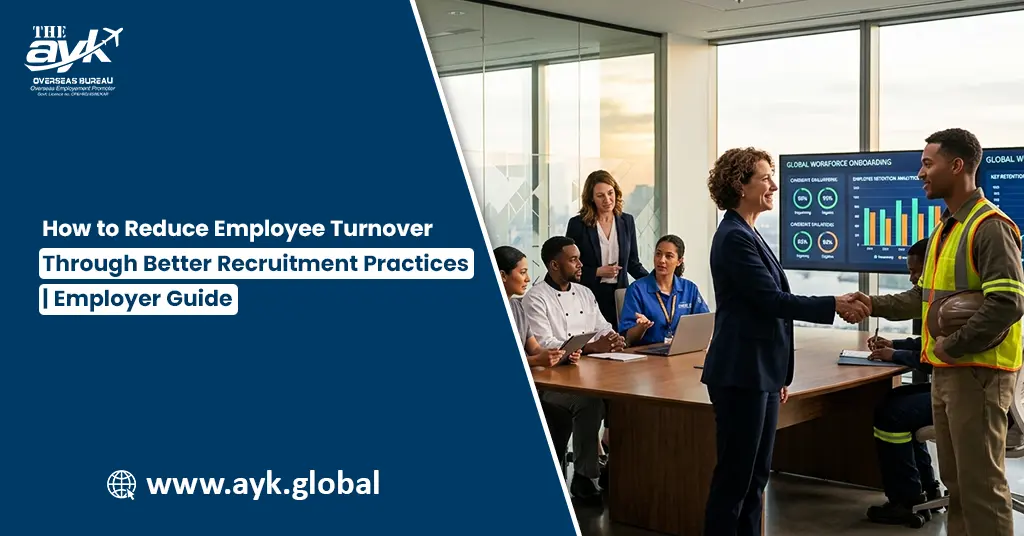
Employer-Focused Retention Strategy, Smart Hiring Systems & Workforce Stability Guide
Published: June 29, 2026 | Views: 15
Why Employee Turnover is a Serious Business Problem
Employee turnover is one of the most expensive and disruptive challenges faced by modern organizations, especially those operating in international and large-scale industries such as construction, healthcare, logistics, manufacturing, hospitality, engineering, and oil and gas. When employees leave frequently, companies do not just lose manpower—they lose productivity, training investment, operational stability, and sometimes even client trust.
Many employers focus heavily on recruitment speed but overlook recruitment quality. As a result, they end up hiring candidates who may not fully match job expectations, workplace culture, or long-term business needs. This mismatch becomes one of the biggest reasons for early resignations and high turnover rates.
Reducing employee turnover is not only about improving salaries or working conditions. It starts much earlier in the process—during recruitment. The way companies select, evaluate, and onboard employees has a direct impact on how long those employees stay and how well they perform.
Why Recruitment Quality Directly Impacts Employee Retention
The foundation of employee retention is built during the recruitment phase. If the wrong candidate is hired, no amount of training or compensation can fully solve the mismatch problem. Employees who are not aligned with job expectations or skill requirements tend to leave early, creating constant disruption in operations.
Better recruitment practices ensure that candidates clearly understand job roles, responsibilities, and workplace conditions before they are hired. This alignment reduces confusion and dissatisfaction after joining.
When recruitment is done properly, employees feel more confident in their roles because they were selected based on accurate expectations and proper skill matching. This naturally leads to higher job satisfaction and longer retention.
Role of Structured Hiring in Reducing Turnover
Structured hiring means following a consistent and well-defined recruitment process instead of making quick or unplanned hiring decisions. This process includes clear job descriptions, skill-based screening, behavioral evaluation, and realistic job previews.
When companies use structured hiring systems, they are able to filter out candidates who are not suitable for long-term roles. This significantly reduces the chances of early resignations.
Structured hiring also ensures that every candidate is evaluated on the same criteria, which improves fairness and consistency in selection decisions. Over time, this leads to a more stable and reliable workforce.
Importance of Skill Matching Before Hiring
One of the biggest reasons for employee turnover is poor skill-job matching. When employees are placed in roles that do not match their abilities or experience, they struggle to perform and eventually leave.
Better recruitment practices focus on matching technical skills, experience level, and job complexity before hiring. This ensures that employees are placed in roles where they can succeed from day one.
In industries like engineering, healthcare, logistics, and construction, skill matching is especially important because even small performance gaps can affect project timelines and safety standards.
Proper skill alignment not only improves performance but also increases employee confidence and job satisfaction.
Setting Realistic Job Expectations During Recruitment
Another major factor in reducing turnover is setting clear and realistic job expectations before hiring. Many employees leave because the actual job conditions do not match what they were initially told during recruitment.
Better recruitment practices involve transparent communication about job responsibilities, working hours, salary structure, accommodation, and workplace environment. When candidates have a clear understanding of what to expect, they are more likely to stay long-term.
Realistic job previews help eliminate misunderstandings and build trust between employer and employee even before the employment begins.
Importance of Behavioral and Cultural Fit Assessment
Technical skills alone are not enough to ensure long-term employee retention. Behavioral traits such as communication, discipline, adaptability, and teamwork play a major role in determining whether an employee will stay in a company.
Cultural fit is especially important in international recruitment, where employees work in foreign environments with different work cultures and expectations. Candidates who are adaptable and open to learning new systems tend to stay longer and perform better.
Better recruitment practices include behavioral interviews and personality assessments to evaluate whether a candidate is suitable for long-term employment.
Role of Recruitment Agencies in Improving Retention
Professional recruitment agencies play a key role in reducing employee turnover by ensuring that only properly screened and job-ready candidates are selected.
A structured agency handles candidate sourcing, skill verification, documentation, and pre-selection processes to ensure better hiring outcomes. This reduces the chances of mismatch and improves employee satisfaction.
In Pakistan, AYK Overseas Recruitment & HR Manpower Agency provides structured recruitment solutions that focus on proper screening and job-role matching, helping international employers reduce turnover and improve workforce stability.
Advanced Retention Systems, Onboarding Strategy, Cost Control & Workforce Stability Framework
Reducing employee turnover is not achieved by one single action. It is the result of a complete system that starts before hiring and continues long after an employee joins the organization. Companies that only focus on recruitment but ignore onboarding, workplace experience, and retention strategy often continue facing repeated hiring cycles.
After understanding the foundation in Part 1, this section explains advanced systems that help employers build long-term workforce stability and reduce unnecessary employee exits.
Advanced Retention Strategy Starts Before Hiring
Most companies think retention begins after hiring, but in reality, it starts much earlier—during candidate selection. When recruitment is aligned with long-term business needs, turnover automatically decreases.
Advanced retention-focused recruitment means selecting candidates not only for their current skills but also for their ability to grow within the organization. Employers who focus on long-term potential instead of short-term filling of vacancies build more stable teams.
This approach also includes identifying candidates who show consistency in past employment history, willingness to learn, and adaptability to new environments. These indicators are strong predictors of long-term retention.
Importance of Structured Onboarding Systems
Onboarding is one of the most critical stages in reducing employee turnover. Many employees leave within the first few weeks or months not because of the job itself, but because of poor onboarding experiences.
A structured onboarding system introduces employees to job responsibilities, workplace rules, safety procedures, reporting systems, and company expectations in a clear and organized way. When employees understand their role clearly from the beginning, they feel more confident and settled.
Good onboarding also includes mentorship or supervision during the initial phase. This helps employees adjust faster and reduces early-stage confusion or frustration.
In international recruitment, onboarding becomes even more important because employees are adapting to new countries, cultures, and work systems.
Role of Workplace Communication in Employee Retention
Clear communication between employers and employees plays a major role in reducing turnover. Many employees leave because of misunderstandings, unclear instructions, or lack of feedback.
When communication systems are strong, employees feel valued and informed. Regular feedback sessions help employees understand their performance and improve over time.
In global teams, communication also includes cultural understanding and language clarity. Employers who invest in communication training and structured reporting systems experience significantly lower turnover rates.
Training and Skill Development for Long-Term Retention
Employees are more likely to stay in organizations where they see opportunities for growth. Training and skill development programs create a sense of career progression, which directly improves retention.
Better recruitment practices include hiring candidates who are willing to learn and then supporting them with structured training programs after joining. This ensures that employees continue to grow within the organization instead of looking for external opportunities.
In industries such as engineering, logistics, healthcare, and manufacturing, continuous training is essential because technologies and processes constantly evolve.
Cost Impact of High Employee Turnover
High employee turnover is not just an HR issue—it is a financial burden. Every time an employee leaves, companies must spend additional money on recruitment, training, onboarding, and lost productivity.
Frequent turnover also disrupts workflow and affects team performance. In project-based industries, this can lead to delays, penalties, and reduced client satisfaction.
Reducing turnover through better recruitment practices is therefore not only a human resource strategy but also a financial optimization strategy. Companies that invest in retention-focused hiring save significant long-term costs.
Common Recruitment Mistakes That Increase Turnover
One of the most common mistakes employers make is hiring quickly without proper evaluation. When hiring decisions are rushed, candidates may not be fully suitable for the role, leading to early resignations.
Another major mistake is ignoring cultural and behavioral fit. Even skilled employees may leave if they do not adjust well to the work environment or team structure.
Poor job communication during recruitment is also a major issue. When job expectations are not clearly explained, employees often feel misled after joining.
Avoiding these mistakes is essential for building a stable and long-term workforce.
Role of Recruitment Agencies in Reducing Turnover
Professional recruitment agencies help reduce turnover by ensuring that only properly screened and job-matched candidates are selected. This significantly improves hiring accuracy and long-term employee satisfaction.
A structured agency manages candidate sourcing, skill testing, verification, and job matching before sending candidates to employers. This reduces the risk of hiring mismatches.
In Pakistan, AYK Overseas Recruitment & HR Manpower Agency provides structured international recruitment services focused on proper screening and long-term workforce stability for global employers.
Building a Long-Term Workforce Stability System
Long-term workforce stability is achieved when recruitment, onboarding, training, and communication systems all work together. Companies that treat hiring as a long-term investment rather than a short-term need achieve better retention results.
A stable workforce reduces operational disruption, improves productivity, and creates a stronger organizational culture. Over time, this leads to higher efficiency and better business performance.
Conclusion
Reducing employee turnover through better recruitment practices requires a complete system approach. Employers must focus on structured hiring, skill matching, onboarding quality, communication, and long-term employee development.
Companies that implement these practices successfully build stable, productive, and loyal workforces that support long-term business growth.
 Best Schengen Countries for Pakistani Workers: Salary, Demand & Visa Process
 Hire Pakistani Workers for Chile, A Practical Guide for Employers
 Hire Pakistani Workers for Argentina, A Practical Guide for Employers
 KSA Recruitment
 UAE Recruitment
 Qatar Recruitment
 Oman Recruitment
 Kuwait Recruitment
 Libya Recruitment
 Bahrain Recruitment
 Iraq Recruitment
 Malaysia Recruitment
 Malta Recruitment
 Canada Recruitment
 USA Recruitment
 Europe Recruitment
 UK Recruitment
 Romania Recruitment
 Poland Recruitment
 Bulgaria Recruitment
 Albania Recruitment
 Serbia Recruitment
 Lithuania Recruitment
 Japan Recruitment
 Turkey Recruitment
 Kyrgyzstan Recruitment
 South Korea Recruitment