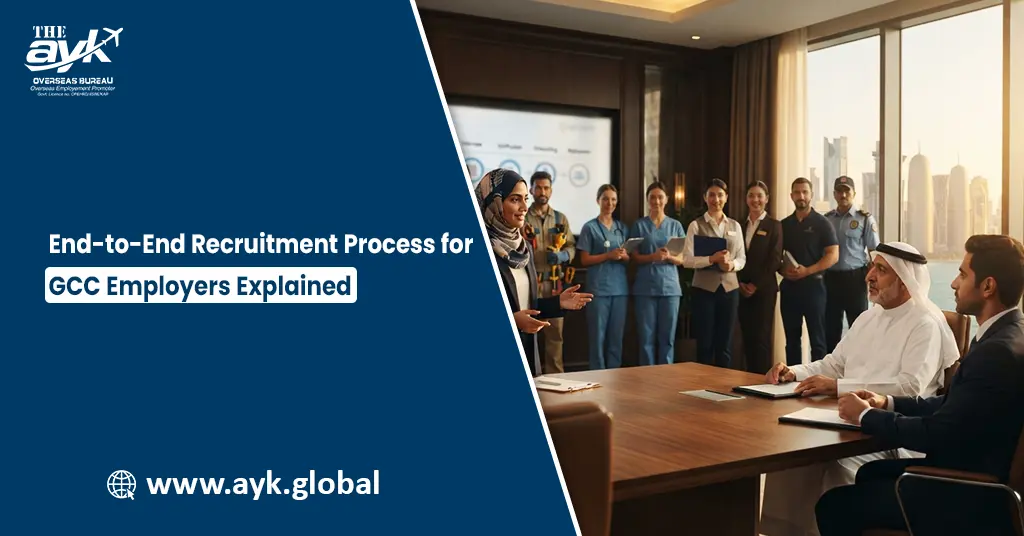
End-to-End Recruitment Process for GCC Employers Explained
Published: July 03, 2026 | Views: 12
Introduction
Recruiting manpower for GCC projects is a highly structured and multi-stage process that ensures only qualified, verified, and job-ready candidates are deployed to international workplaces. Employers in Saudi Arabia, UAE, Qatar, Kuwait, Oman, and Bahrain rely on a systematic recruitment cycle because large-scale projects demand precision, compliance, and speed. Whether it is a construction mega project, an oil & gas facility, a manufacturing plant, or a hospitality expansion, the recruitment process must be carefully managed to avoid delays, cost overruns, and workforce shortages.
The end-to-end recruitment process is not limited to hiring alone; it includes planning, sourcing, screening, technical evaluation, documentation, visa processing, medical clearance, travel arrangements, and final deployment. Each stage is interconnected and plays a vital role in ensuring that the right workforce reaches the right project at the right time. Understanding this process helps GCC employers improve efficiency, reduce risks, and build a reliable workforce pipeline for long-term operational success.
1. Workforce Requirement Analysis and Planning
The recruitment process begins with a detailed workforce requirement analysis. Employers first identify the exact number of workers needed, job roles, skill levels, project duration, and budget allocation. This step is crucial because incorrect planning can lead to over-hiring, under-hiring, or mismatched skill sets, all of which negatively impact project performance and cost efficiency.
During this stage, HR departments work closely with project managers and site engineers to create a structured manpower plan. This includes defining job descriptions, required certifications, experience levels, and reporting structures. A well-prepared workforce plan ensures that recruitment efforts are aligned with project timelines and operational requirements, reducing delays and unnecessary hiring expenses.
2. Candidate Sourcing from International Markets
Once requirements are finalized, recruitment agencies begin sourcing candidates from international labor markets such as Pakistan, India, Bangladesh, Nepal, Sri Lanka, Egypt, and the Philippines. Pakistan is one of the most preferred sources due to its large skilled workforce, technical training institutions, and experience in GCC environments.
Sourcing involves multiple channels including recruitment databases, job portals, vocational training institutes, trade unions, and referral networks. Agencies maintain pre-screened candidate pools to speed up the hiring process. This stage ensures a continuous supply of qualified candidates for different job categories, enabling employers to meet urgent project demands efficiently.
3. Resume Screening and Shortlisting
After sourcing candidates, the next step is screening resumes to filter out unsuitable applicants. Recruitment specialists carefully evaluate education, experience, certifications, technical skills, and previous GCC experience. Only candidates who meet the minimum job criteria are shortlisted for further evaluation.
This step significantly reduces hiring time and ensures that employers only interview relevant candidates. Proper screening also improves hiring accuracy, minimizes rejection rates, and enhances overall recruitment efficiency. Shortlisting is often done using both manual review and digital applicant tracking systems for better accuracy and speed.
4. Technical Trade Testing and Skill Evaluation
For skilled and semi-skilled roles, technical trade testing is a critical stage of the recruitment process. Candidates are assessed in practical environments to evaluate their job-specific skills. Welders, electricians, plumbers, HVAC technicians, heavy equipment operators, mechanics, scaffolders, and fabricators are tested to ensure they meet international standards.
Trade testing helps employers verify real-world capabilities before hiring, reducing the risk of underperformance after deployment. Many recruitment agencies operate dedicated testing centers where candidates perform job-related tasks under supervision. This step ensures that only competent workers move forward in the recruitment pipeline.
5. Employer Interviews and Final Selection
After successful screening and trade testing, shortlisted candidates are presented to employers for final interviews. These interviews may be conducted in person or online, depending on the employer's location and recruitment strategy. Employers assess communication skills, technical knowledge, attitude, and suitability for the project environment.
Final selection is a crucial decision-making stage where employers choose candidates based on performance, experience, and project requirements. Once selected, candidates receive official job offers, marking the transition from recruitment to documentation and deployment phases.
6. Documentation Verification and Background Checks
Once candidates are selected, the documentation process begins. Recruitment agencies verify all essential documents including passports, educational certificates, professional licenses, and experience records. This step ensures that all information provided by the candidate is authentic and compliant with GCC labor requirements.
Background checks may also be conducted depending on job roles and employer requirements. Any discrepancies in documentation are resolved before proceeding to visa processing. Proper verification reduces the risk of legal issues, visa rejections, and employment disputes, ensuring a smooth recruitment journey.
Some key documents include:
- Valid Passport
- Educational Certificates
- Technical Trade Certificates
- Experience Letters
- Medical Fitness Reports
- Employment Contract
- Police Clearance Certificate (if required)
7. Visa Processing and Work Permit Approval
After documentation verification, the recruitment process moves into one of the most critical stages: visa processing and work permit approval. At this stage, employers in GCC countries initiate official procedures with immigration authorities to obtain legal permission for selected candidates to work in their respective countries. Each GCC nation—Saudi Arabia, UAE, Qatar, Kuwait, Oman, and Bahrain—has its own visa regulations, timelines, and approval requirements, making this step highly sensitive and detail-oriented.
Recruitment agencies coordinate closely with employers to ensure that all visa applications are submitted correctly and on time. Any missing information, incorrect data, or document mismatch can lead to delays or rejections, which may directly impact project timelines. Once work permits are approved, candidates are officially authorized to travel and begin employment procedures, marking a major milestone in the recruitment cycle.
8. Medical Examination and Fitness Clearance
Medical examination is a mandatory requirement for almost all GCC employment visas. Selected candidates must undergo health screening at approved medical centers to ensure they meet the medical standards set by destination countries. These tests typically include general physical examinations, blood tests, chest X-rays, and screenings for infectious diseases.
This step is crucial because it ensures that only medically fit candidates are deployed for physically demanding roles such as construction, oil & gas operations, manufacturing, and logistics. Any candidate who fails the medical test may be replaced before visa finalization. Proper medical clearance not only ensures compliance with GCC regulations but also protects employers from potential workforce disruptions caused by health-related issues.
9. Travel Arrangements and Pre-Departure Orientation
Once visa and medical approvals are completed, recruitment agencies proceed with travel arrangements. This includes booking airline tickets, organizing airport transfers, and coordinating arrival schedules based on project requirements. Proper travel planning ensures smooth workforce mobilization and prevents delays in project execution.
Before departure, candidates also undergo pre-departure orientation sessions. These sessions prepare workers for life and work in GCC countries by explaining workplace rules, safety procedures, cultural expectations, accommodation details, and job responsibilities. Orientation helps reduce confusion upon arrival and ensures workers are mentally and professionally prepared for their assignments.
Key orientation topics include:
- Workplace safety rules
- Job responsibilities
- Cultural awareness
- Accommodation and transport details
- Company policies
- Emergency procedures
10. Onboarding and Workforce Deployment
Onboarding is the final step before workers officially begin their jobs. Upon arrival in GCC countries, employees are received by employer representatives or site coordinators who manage their initial settlement process. This includes document verification, accommodation allocation, safety induction, and job assignment briefing.
Proper onboarding ensures that workers integrate smoothly into the organization and begin productive work quickly. Efficient onboarding reduces downtime, improves employee satisfaction, and ensures that large projects maintain operational continuity without disruptions caused by workforce adjustment issues.
11. Benefits of a Structured Recruitment Process for GCC Employers
A well-structured end-to-end recruitment process offers multiple benefits to GCC employers. It ensures that only qualified, verified, and medically fit candidates are selected for employment, reducing the risk of hiring errors. Structured recruitment also improves compliance with international labor laws and reduces the chances of visa rejection or legal complications.
Additionally, a systematic process enhances workforce quality and project efficiency. Employers benefit from faster hiring cycles, reduced administrative burden, improved workforce stability, and better project execution. When recruitment is managed professionally, companies can focus more on core operations rather than dealing with hiring challenges.
Key benefits include:
- Improved hiring accuracy
- Faster workforce deployment
- Reduced recruitment risks
- Better legal compliance
- Higher employee retention
- Increased project efficiency
12. Common Challenges in Recruitment and How to Overcome Them
Despite having a structured process, GCC recruitment still faces several challenges. These include visa delays, documentation errors, candidate shortages, high competition for skilled labor, and last-minute candidate withdrawals. Such issues can disrupt project timelines if not managed effectively.
To overcome these challenges, employers should work with experienced recruitment agencies, maintain backup candidate pools, and start recruitment planning well in advance. Using digital tools for tracking applications and maintaining clear communication between stakeholders also helps reduce delays and improve efficiency.
Best practices to overcome challenges:
- Early workforce planning
- Strong recruitment partnerships
- Backup candidate databases
- Accurate documentation handling
- Continuous communication
- Use of digital recruitment systems
Conclusion
The end-to-end recruitment process for GCC employers is a comprehensive and structured system designed to ensure the selection, verification, and deployment of high-quality manpower for large-scale projects. Each stage—from workforce planning and candidate sourcing to visa processing, medical clearance, and onboarding—plays a critical role in ensuring operational success and legal compliance.
By following a systematic recruitment approach and partnering with experienced manpower agencies, GCC employers can significantly improve hiring efficiency, reduce risks, and maintain a stable workforce. As industries across the Gulf continue to expand, a well-managed recruitment process remains essential for achieving timely project completion and long-term business growth.
 Why Global Companies Trust Pakistan for Skilled Manpower Recruitment in 2026
 How Digital Platforms Are Reshaping Overseas Job Hiring
 KSA Recruitment
 UAE Recruitment
 Qatar Recruitment
 Oman Recruitment
 Kuwait Recruitment
 Libya Recruitment
 Bahrain Recruitment
 Iraq Recruitment
 Malaysia Recruitment
 Malta Recruitment
 Canada Recruitment
 USA Recruitment
 Europe Recruitment
 UK Recruitment
 Romania Recruitment
 Poland Recruitment
 Bulgaria Recruitment
 Albania Recruitment
 Serbia Recruitment
 Lithuania Recruitment
 Japan Recruitment
 Turkey Recruitment
 Kyrgyzstan Recruitment
 South Korea Recruitment