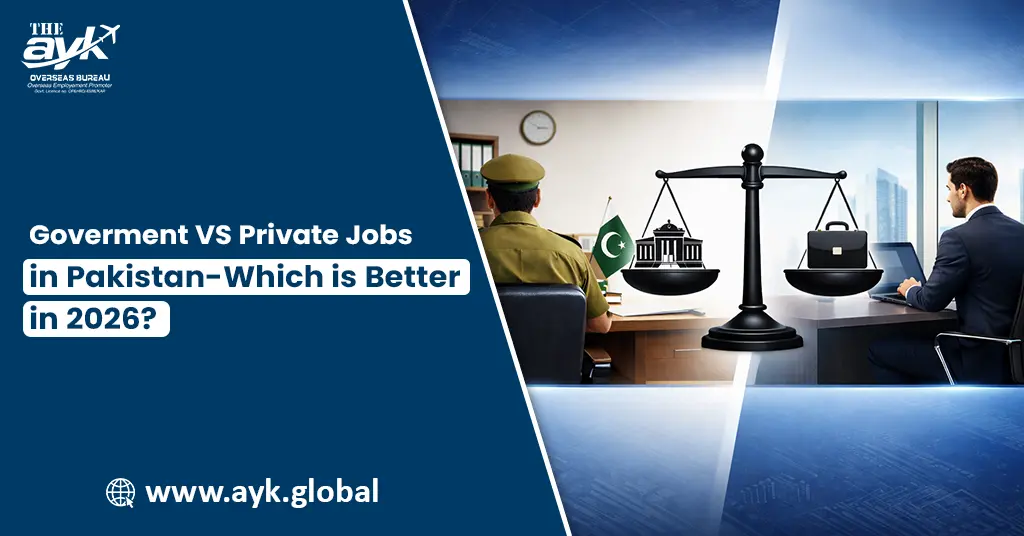
Government vs Private Jobs in Pakistan – Which Is Better in 2026?
Published: June 17, 2026 | Views: 9
Government vs Private Jobs in Pakistan – Which Is Better in 2026?
Choosing between government jobs and private sector jobs in Pakistan has always been one of the biggest career dilemmas for students and professionals. In 2026, with inflation, economic reforms, digitization, and global remote opportunities reshaping the job market, this debate has become even more relevant.
Parents often prefer government jobs for stability and pension. Young professionals lean toward private jobs for higher salaries and faster growth. But which is actually better in 2026?
This complete guide will compare:
• Salary structure
• Job security
• Promotions & career growth
• Work-life balance
• Benefits & allowances
• Retirement plans
• Future scope
• Real-life suitability
Let’s explore everything in detail.
Overview of Government Jobs in Pakistan


Government jobs in Pakistan are positions offered by federal and provincial institutions. These jobs are regulated under public service rules and offer structured pay scales.
Popular Government Sectors
• Civil Services (through Federal Public Service Commission)
• Provincial services (via Punjab Public Service Commission)
• Armed Forces (Pakistan Army)
• Education Departments
• Health Departments
• Police Services
• WAPDA, Railways, NADRA
Key Features (2026)
• Fixed Basic Pay Scales (BPS 1–22)
• Annual increments
• Pension after retirement
• Medical benefits
• Housing allowances
• Strong job security
Government jobs remain attractive for long-term stability.
Overview of Private Jobs in Pakistan


Private jobs are offered by companies, corporations, startups, banks, and multinational organizations.
Popular Private Sectors in 2026
• IT & Software Houses
• Banking & Finance
• Textile Industry
• E-commerce
• Telecom
• Startups & Tech Companies
Key Features
• Performance-based salary
• Fast promotions
• No fixed pension
• Market-driven pay scale
• Higher risk but higher rewards
With freelancing and remote jobs growing rapidly, private sector exposure has increased significantly.
Salary Comparison in 2026
Government Salary Structure
Government salaries follow Basic Pay Scale (BPS) system.
Example (2026 Estimated Ranges):
• BPS-17 Officer: PKR 90,000 – 150,000
• BPS-18 Officer: PKR 150,000 – 220,000
• BPS-19 Officer: PKR 250,000+
Allowances include:
• House Rent
• Medical
• Conveyance
• Utility
• Special allowances
However, salary growth is slow and based on annual increments or promotions.
Private Sector Salary Structure
Private salaries vary by skill, company, and performance.
In 2026:
• IT Professional: PKR 120,000 – 500,000+
• Bank Manager: PKR 150,000 – 400,000
• Marketing Executive: PKR 80,000 – 250,000
• Remote Freelancer: Unlimited potential
Private jobs clearly offer higher earning potential — especially in IT and digital skills.
Winner (Salary): Private Sector
Job Security – Who Wins?
Government Jobs
Permanent positions
Rare layoffs
Strong legal protection
Pension security
Termination is extremely rare unless serious misconduct occurs.
Private Jobs
Layoffs during recession
Company closures
Performance pressure
No guaranteed job stability
Especially after economic challenges, private employees face higher risk.
Winner (Job Security): Government Jobs
Promotions & Career Growth
Government Sector
• Promotion based on seniority
• Time-bound promotions
• Political influence sometimes
• Slow hierarchy movement
For example, through CSS under Federal Public Service Commission, officers move gradually over decades.
Private Sector
• Promotion based on performance
• Fast career jumps
• International exposure
• Skill-based growth
You can become a manager within 5–7 years in private companies if performance is strong.
Winner (Career Growth Speed): Private Sector
Work-Life Balance
Government Jobs
Fixed working hours
Public holidays
Less workload pressure
Family-friendly
Private Jobs
Long hours
Weekend work
High KPIs
Flexible remote options (in IT)
Winner: Government (for balance)
Retirement & Pension Benefits
Government employees receive:
• Lifetime pension
• Gratuity
• Benevolent funds
• Family pension
Private employees:
• Provident fund (if offered)
• No guaranteed pension
• Self-investment required
Winner: Government Sector
Respect & Social Status in Pakistan
In Pakistani society:
• Government officers receive high respect.
• CSS officers, police officers, and armed forces officials are socially admired.
• Parents prefer government jobs for marriage proposals.
Private sector respect depends on salary and company reputation.
Skill Development & Exposure
Private jobs offer:
• International exposure
• Digital tools
• Innovation
• Continuous skill upgrades
Government sector:
• Traditional systems
• Limited innovation
• Slower modernization
Winner: Private Sector
Risk vs Reward Analysis
| Factor | Government | Private |
|---|---|---|
| Security | High | Medium-Low |
| Salary Potential | Medium | Very High |
| Promotion Speed | Slow | Fast |
| Pension | Yes | No |
| Pressure | Low | High |
| Risk | Low | High |
2026 Economic Reality – What Has Changed?
In 2026:
• Inflation remains a major concern.
• IT exports from Pakistan have increased.
• Remote jobs allow dollar income.
• Government reforms are digitizing departments.
This means:
• Private sector earnings are stronger.
• Government stability is still unmatched.
Which Career Is Better for YOU?
Choose Government Job If:
• You prefer stability over risk
• You value pension
• You want work-life balance
• You don’t like performance pressure
Choose Private Job If:
• You are ambitious
• You want high income
• You can handle stress
• You have technical skills
Special Case: CSS vs Corporate Career
Clearing CSS via Federal Public Service Commission gives authority, power, and prestige.
Corporate careers give wealth potential, especially in IT and multinational companies.
Decision depends on personality type.
Final Verdict – Government vs Private Jobs in Pakistan 2026
For stability → Government wins
For money → Private wins
For respect → Government wins
For fast growth → Private wins
For retirement security → Government wins
For international exposure → Private wins
Conclusion
In 2026, Pakistan’s job market is evolving rapidly. Government jobs remain the backbone of stability and social respect. Private jobs are driving economic growth and innovation.
Your ideal choice depends on:
• Risk tolerance
• Financial goals
• Personality
• Long-term vision
If you want a safe life, choose government.
If you want a big life, choose private.
The future belongs to skilled professionals — whether in public service or private enterprise.
 Connecting Baghdad Employers with Skilled Pakistani Manpower
 How AYK Overseas Helps You Get Jobs in Germany, Poland & Romania
 Documents Required for Overseas Jobs – Complete Checklist by AYK Overseas
 KSA Recruitment
 UAE Recruitment
 Qatar Recruitment
 Oman Recruitment
 Kuwait Recruitment
 Libya Recruitment
 Bahrain Recruitment
 Iraq Recruitment
 Malaysia Recruitment
 Malta Recruitment
 Canada Recruitment
 USA Recruitment
 Europe Recruitment
 UK Recruitment
 Romania Recruitment
 Poland Recruitment
 Bulgaria Recruitment
 Albania Recruitment
 Serbia Recruitment
 Lithuania Recruitment
 Japan Recruitment
 Turkey Recruitment
 Kyrgyzstan Recruitment
 South Korea Recruitment