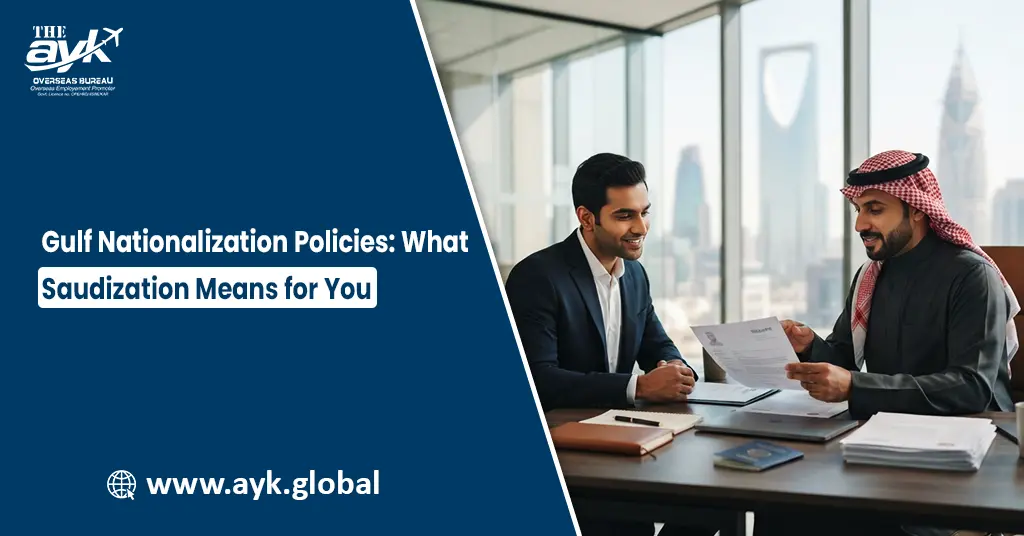
Gulf Nationalization Policies: What Saudization Means for You
Published: July 04, 2026 | Views: 21
Introduction
Gulf nationalization policies, including Saudi Arabia's Nitaqat and Saudization programs, UAE's Emiratisation, Oman's Omanization, Kuwait's Kuwaitization, Qatar's Qatarization, and Bahrain's Bahrainization, collectively represent one of the most significant structural factors shaping overseas worker employment across Gulf labor markets, with each country's specific nationality-preferencing policies creating both genuine employment restrictions in certain categories and often misunderstood dynamics that workers frequently either overestimate as threats or underestimate without adequate awareness of how specific policies affect their particular employment situation. Understanding these nationalization frameworks accurately, rather than through the partial information and community rumor that often shapes Pakistani worker understanding of how these policies actually work, provides workers with the genuine knowledge they need to make informed decisions about which Gulf employment opportunities offer sustainable positioning versus which may face progressive restriction as nationalization programs mature and enforcement intensifies across different employment categories. AYK Overseas Recruitment & HR Manpower Agency, recognized as one of Pakistan's top manpower agencies, monitors nationalization policy developments across all major Gulf employment markets as an essential component of providing candidates with genuinely informed placement guidance, and this guide provides the most practically relevant understanding of these policies for Pakistani workers planning their Gulf employment careers.
Understanding the Basic Logic of Nationalization Policies
Gulf nationalization policies share a common foundational logic of attempting to increase employment of national citizens within private sector employment that has historically been dominated by overseas workers whose lower wage expectations and labor market flexibility made them commercially preferred by Gulf private sector employers operating without obligations to hire more expensive national citizen workers. Gulf governments implement these policies through various mechanisms including minimum national hiring quotas that companies must achieve to maintain compliance status, financial incentives that subsidize national citizen employment costs, restrictions on overseas worker permits in specific employment categories that nationals are expected to fill, and compliance monitoring systems that reward compliant companies with business licensing advantages while penalizing non-compliant companies through permit restrictions and financial penalties. Understanding this commercial incentive dynamic helps workers recognize that nationalization policies primarily target employment categories where nationals can realistically compete with adequate government support rather than attempting comprehensive replacement of all overseas labor across every employment category regardless of whether sufficient qualified nationals are available.
Saudization's Nitaqat System Explained
Saudi Arabia's Nitaqat system categorizes companies into compliance tiers based on their percentage of Saudi national employees relative to total workforce, with companies in higher compliance tiers enjoying expanded overseas worker permit access and various other business operating advantages while companies in lower tiers face permit restrictions that limit their ability to hire overseas workers until their national employee percentage improves to higher tier status. The Nitaqat system applies specific minimum Saudi employee percentage requirements that vary between different industry sectors and company size categories, recognizing that the realistic national hiring potential differs meaningfully between large established sectors with longer national employment development histories and emerging sectors where national candidate supply is more limited relative to employer demand. Pakistani workers should understand that Nitaqat primarily affects which companies can freely hire overseas workers rather than directly prohibiting overseas worker employment across all companies, meaning companies in strong Nitaqat compliance tiers continue hiring Pakistani workers freely while companies in poor compliance tiers face permit restrictions that limit their ability to bring in new overseas workers until their compliance status improves through increased national hiring.
Which Employment Categories Face Most Saudization Pressure
Saudization pressure concentrates most significantly in employment categories where Saudi nationals can realistically compete for positions given their educational preparation and employment expectations, including retail and commercial customer service roles, administrative and clerical positions, human resources functions, some professional service roles, and increasingly technical positions where Saudi Arabia's growing technical education programs are producing qualified national candidates in meaningful numbers. Construction trade employment, manufacturing production roles, and various other physically demanding blue-collar categories face considerably less Saudization pressure because these employment categories attract very limited national candidate interest despite government encouragement, creating genuine continued overseas worker demand that sustainable national employment development in these categories cannot realistically address at the scale these industries require. Pakistani workers in physically demanding construction and manufacturing roles can generally approach their Saudization risk with more confidence than those in retail, administrative, or commercial service roles where Saudi Arabia has more actively and successfully developed national candidate pipelines that create genuine preference for Saudi employment in those specific categories.
UAE Emiratisation and Its Practical Impact
UAE's Emiratisation program has progressively expanded its scope and enforcement intensity, particularly within the private sector where historical Emirati employment rates remained very low despite government encouragement, with recent initiatives establishing specific Emiratisation percentage targets for companies across different size categories and imposing meaningful financial penalties on companies that fail to meet specified national employment quotas by required compliance deadlines. The specific categories facing strongest Emiratisation pressure in UAE include financial services, technology, professional services, and increasingly retail management roles where the UAE government has focused national career development programs that create growing qualified Emirati candidate supply alongside the employer quota demand these policies create. Pakistani workers in UAE employment categories with stronger Emiratisation pressure should monitor policy development carefully and consider career repositioning toward employment categories that Emiratisation pressure affects less intensely, while workers in construction, hospitality operations, and various other physically demanding categories where Emirati employment interest remains limited despite policy encouragement face less immediate Emiratisation employment risk.
Omanization and Its Effect on Pakistani Employment in Oman
Oman's Omanization program has historically been one of the Gulf region's more actively enforced nationalization frameworks, with specific minimum Omani employee percentages applied across different industry sectors and government monitoring that has meaningfully reduced overseas worker access in some employment categories compared to earlier periods when Oman's overseas worker employment was less regulated by nationalization quota requirements. Oman's challenging economic circumstances and high youth unemployment rates have intensified pressure on Omanization enforcement in recent years, with the government increasingly motivated to ensure that private sector employment growth genuinely serves Omani national employment rather than simply expanding overseas worker employment within a growing economy that fails to translate economic growth into national employment improvement. Pakistani workers should research current Omanization requirements specific to their intended employment sector before pursuing Oman employment, recognizing that some sectors now face quite restrictive overseas worker access compared to historical patterns while other sectors retain meaningful overseas worker employment given the ongoing gap between Omani national candidate supply and employer demand in those specific categories.
How Nationalization Policies Create Opportunity Alongside Restriction
While nationalization policies restrict overseas worker access in certain employment categories, they simultaneously create distinctive opportunities for Pakistani workers in categories where national candidate supply remains insufficient to meet employer demand despite government encouragement, with these supply gap categories often offering particularly stable employment continuity because employers face genuine operational necessity to hire overseas workers given the absence of adequate national candidate alternatives. The categories most affected by this supply gap dynamic tend to be physically demanding, less socially prestigious, technically specialized beyond current national education system output, or requiring unusual shift patterns that national workers are reluctant to accept, collectively creating a distinct tier of Gulf employment where overseas workers retain strong demand despite comprehensive nationalization policy frameworks that might superficially appear to restrict all overseas employment. Pakistani workers who specifically target employment categories with genuine ongoing supply gap dynamics position themselves in more sustainable Gulf employment compared to workers who compete for categories where nationalization policies are actively creating realistic national candidate competition that progressively reduces overseas worker hiring over time.
Monitoring Policy Changes and Their Employment Implications
Nationalization policies across Gulf countries are not static but evolve through periodic policy updates, quota adjustment announcements, enforcement intensification periods, and new sector coverage extensions that can meaningfully change the employment access situation for Pakistani workers within specific employment categories faster than workers who rely on outdated information sometimes appreciate. Workers and their families should develop habits of monitoring Gulf nationalization policy developments through reliable current information sources including government official communications, established Gulf media coverage, and guidance from actively practicing recruitment agencies whose continuous Gulf employer engagement provides current market intelligence about policy implementation realities that official policy statements alone sometimes cannot fully convey. Recruitment agencies with active ongoing Gulf employer relationships provide particularly valuable nationalization policy intelligence because they observe how policies actually affect employer hiring behavior in real time rather than only knowing the formal policy text whose implementation sometimes diverges from stated policy provisions in ways that only current market engagement reveals accurately.
Positioning Your Career for Nationalization Resistance
Workers who want to position their Gulf careers most strongly against nationalization pressure should focus their skill development on technical specializations that are genuinely difficult for national educational systems to produce in sufficient quantities quickly, physical employment categories that national workers consistently show limited interest in despite policy encouragement, and emerging technical sectors where national workforce development is still in early stages relative to the employment demand these growing sectors create. Developing genuine technical expertise at levels that exceed what current national candidate pipelines are producing provides the strongest individual protection against nationalization displacement, because Gulf employers facing genuine operational need for specialized technical expertise that national candidates cannot yet adequately supply continue seeking overseas workers in these specific technical categories regardless of broader nationalization policy intentions that remain constrained by workforce development realities. The combination of genuine technical specialization, formal certification that verifies competency levels, and continued professional development that maintains genuine expertise currency creates the most durable employment positioning against nationalization policy pressure that workers can develop through deliberate career investment over their Gulf employment careers.
The Long-Term Outlook for Pakistani Workers Under Nationalization Regimes
The long-term outlook for Pakistani workers under Gulf nationalization frameworks is one of gradual employment category restructuring rather than wholesale displacement, with specific employment categories where nationals genuinely compete progressively reducing overseas worker access while other categories retain or expand overseas worker demand based on genuine supply gap realities that national workforce development cannot close quickly regardless of policy intention intensity. Pakistani workers who maintain career adaptability, continuously develop relevant technical capabilities, monitor policy developments, and work with knowledgeable recruitment agencies that provide current market intelligence about employment category sustainability are well positioned to navigate this evolving employment landscape across extended career horizons that span multiple Gulf employment cycles affected by nationalization policy evolution. The aggregate Pakistani worker employment in Gulf countries is likely to remain substantial for decades despite nationalization pressures, because Gulf development ambitions genuinely require labor force scale and technical capability diversity that national populations cannot provide at required levels within the near and medium-term policy horizon, creating continued meaningful Pakistani worker employment demand even within the nationalization policy environments that restrict access in specific categories.
How AYK Overseas Guides Candidates Through Nationalization Policy Realities
As a government-licensed international recruitment and HR manpower firm with offices in Karachi and Islamabad, AYK Overseas Recruitment & HR Manpower Agency provides candidates with current, accurate guidance about nationalization policy implications for specific employment categories across different Gulf destinations, helping workers understand which specific opportunities offer sustainable positioning versus which face progressive nationalization pressure that workers should consider in their longer-term career planning rather than discovering only after their employment becomes affected by policy developments they were unprepared for. Being recognized as one of Pakistan's top manpower agencies, we monitor nationalization policy developments as a core component of our market intelligence that ensures our placement recommendations reflect genuine current and near-term employment sustainability rather than simply matching available positions without consideration of the policy environment affecting those positions' longer-term availability for overseas workers.
Conclusion
Gulf nationalization policies including Saudization, Emiratisation, Omanization, and their equivalents across other Gulf countries represent a genuine and evolving employment landscape factor that Pakistani workers must understand accurately rather than through fear-based misunderstanding or dismissive ignorance that leaves them unprepared for policy impacts that careful awareness and strategic positioning can meaningfully navigate. Workers who understand which specific employment categories face genuine nationalization pressure versus which retain strong overseas worker demand due to genuine national candidate supply gaps, continuously develop the technical specializations that provide nationalization resistance, monitor policy developments through reliable current sources, and work with experienced recruitment agencies that provide genuine market intelligence are well positioned for sustained, rewarding Gulf employment careers despite the nationalization policy environment that will continue reshaping Gulf labor markets across the coming decades.
 Hire Pakistani Workers for Peru, A Complete Guide for Employers
 The Complete Guide to Hiring Pakistani Workers for Overseas Projects
 How to Prepare for a Gulf Job Interview Successfully
 KSA Recruitment
 UAE Recruitment
 Qatar Recruitment
 Oman Recruitment
 Kuwait Recruitment
 Libya Recruitment
 Bahrain Recruitment
 Iraq Recruitment
 Malaysia Recruitment
 Malta Recruitment
 Canada Recruitment
 USA Recruitment
 Europe Recruitment
 UK Recruitment
 Romania Recruitment
 Poland Recruitment
 Bulgaria Recruitment
 Albania Recruitment
 Serbia Recruitment
 Lithuania Recruitment
 Japan Recruitment
 Turkey Recruitment
 Kyrgyzstan Recruitment
 South Korea Recruitment