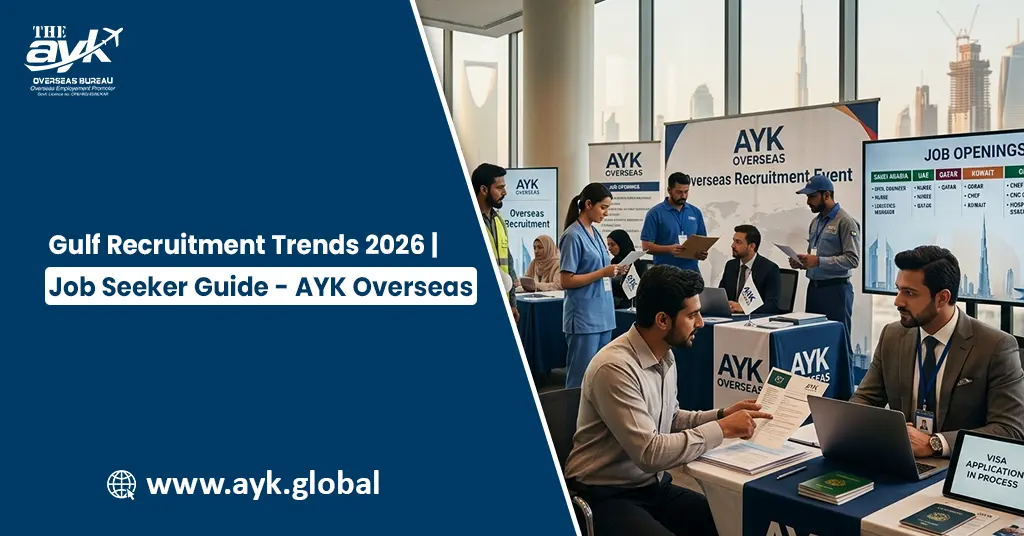
Gulf Recruitment Trends 2026: What Job Seekers Need to Know
Published: June 30, 2026 | Views: 17
The Gulf region continues to be the single most important overseas employment destination for Pakistani workers, and 2026 is proving to be a year of major shifts in how recruitment is conducted. Countries like Qatar, Saudi Arabia, UAE, Kuwait, Bahrain, and Oman are expanding their infrastructure, healthcare, hospitality, and logistics sectors at a pace that has not been seen in recent years, creating a wave of fresh opportunities for skilled and semi-skilled Pakistani labor. For job seekers, this means more openings than before, but it also means the competition and the documentation requirements have become more detailed, requiring candidates to be better prepared than ever.
Understanding these recruitment trends is no longer optional for anyone serious about working abroad. The way Gulf employers screen, hire, and onboard workers has evolved, and outdated strategies or relying on unverified local agents can cost a candidate both time and money. AYK Overseas Recruitment & HR Manpower Agency, recognized as one of Pakistan's top manpower agencies, has spent years tracking these shifts closely so that every candidate we work with applies for roles that are genuinely available, properly documented, and backed by a legitimate employer on the other side.
Digital-First Hiring Is the New Normal
Gulf employers have moved decisively away from paper-heavy hiring processes and are now relying on digital verification systems, recorded video interviews, and instantly shareable documentation. This shift has dramatically reduced the time between initial application and final job offer, with many employers now able to shortlist and confirm candidates within days rather than weeks. For job seekers, this means that having a clean, professionally prepared digital CV, scanned certificates, and a ready set of experience letters is no longer a bonus — it is a basic requirement to even be considered.
This digital transformation has also opened the door to greater transparency, since recruitment platforms now track applications, interview stages, and offer letters in a traceable manner that reduces the chances of miscommunication or fraud. Candidates who understand this shift and prepare their documentation digitally in advance are consistently landing offers faster than those who still depend on physical paperwork submitted through informal channels. This is one of the core reasons agencies are now expected to guide applicants through digital readiness as part of the recruitment process itself.
Construction and Infrastructure Boom Continues
Qatar's continued investment in urban development, Saudi Arabia's Vision 2030 megaprojects, and the UAE's ongoing real estate expansion have kept construction-sector hiring at an all-time high heading into 2026. Electricians, welders, masons, scaffolders, and heavy machine operators remain some of the most consistently requested trades, with many employers offering multi-year contracts to lock in skilled labor before competing markets absorb the available workforce. This demand is not slowing down, and industry forecasts suggest infrastructure hiring will remain strong throughout the year.
Workers with verifiable trade certificates and prior Gulf experience are particularly sought after, often commanding better salary packages and faster placement timelines compared to first-time applicants. Even for those without prior overseas experience, many construction employers are offering structured on-the-job training programs, recognizing that the volume of ongoing projects requires building a larger skilled workforce rather than relying solely on already-experienced labor. This expansion of training-based hiring is making the construction sector more accessible to new applicants than it has been in previous years.
Healthcare Sector Expansion
The healthcare sector across the Gulf is undergoing significant expansion as governments invest in new hospitals, clinics, and specialized medical centers to keep pace with population growth and rising healthcare expectations. Nurses, laboratory technicians, radiology staff, and paramedical professionals are seeing some of the strongest demand of any sector in 2026, with Qatar and Saudi Arabia leading in terms of new job openings and competitive compensation packages. Many of these roles also come with additional benefits such as housing allowances and family sponsorship, making them especially attractive to experienced healthcare professionals.
This growth is also being driven by an increased focus on quality healthcare standards, which has pushed Gulf hospitals to recruit internationally certified and well-trained staff rather than relying purely on local talent pools. Pakistani healthcare professionals, known for their strong clinical training and English proficiency, are well-positioned to benefit from this trend, provided their qualifications are properly verified and equivalency documents are in order before applying. Agencies that understand the specific licensing requirements of each Gulf country's health authority are proving essential in helping candidates navigate this increasingly technical recruitment pathway.
Stricter Compliance and Licensing Checks
Gulf governments have significantly tightened their scrutiny of recruitment agencies and intermediaries in an effort to reduce worker exploitation, fraudulent job offers, and unethical recruitment practices. New regulatory frameworks now require agencies on both sending and receiving ends to be properly licensed and regularly audited, with unlicensed or informal agents being actively phased out of the legal employment pipeline. This is a significant positive development for job seekers, even though it has made the overall process slightly more document-intensive than before.
For Pakistani workers, this regulatory tightening means that working through a government-licensed agency is now more critical than ever, since informal local agents operating outside the legal framework are increasingly unable to process valid work visas or guarantee legitimate employment. Agencies that maintain full compliance with both Pakistani and Gulf-side regulations are the ones best positioned to continue placing candidates smoothly, while those operating informally are facing growing restrictions and even bans in several Gulf markets.
Salary Transparency Improving
One of the most welcome trends of 2026 is the growing insistence by Gulf labor authorities that employers disclose clear salary structures, allowances, and deduction policies before a worker signs a contract. This shift toward transparency has been driven by years of worker complaints regarding wage disputes, hidden deductions, and unclear overtime policies, and it is now resulting in cleaner, more standardized employment contracts across most sectors. Workers entering the market in 2026 are far less likely to face the salary-related disputes that were common in previous years.
That said, transparency on paper does not always translate to transparency in practice unless workers themselves understand what to look for in a contract. It remains essential for every candidate to carefully review salary breakdowns, ask about overtime calculation methods, and confirm allowances such as housing, transport, and food before accepting any offer. A reliable agency will walk candidates through every line of their contract, ensuring there are no surprises after arrival in the host country.
Rise in Demand for Logistics and Warehouse Staff
The rapid growth of e-commerce and retail distribution across UAE and Saudi Arabia has created sustained demand for warehouse supervisors, forklift operators, inventory controllers, and logistics coordinators. As online shopping continues to expand across the Gulf, major distribution hubs are scaling up their workforce to handle increasing order volumes, and this sector has quietly become one of the more stable and consistent sources of overseas employment in 2026.
Unlike some seasonal sectors, logistics hiring tends to remain steady throughout the year, offering workers more predictable contract renewals and long-term career stability. Many logistics roles also provide structured promotion paths, allowing entry-level warehouse staff to move into supervisory positions within a few years of consistent performance, which makes this an increasingly attractive sector for workers looking for long-term overseas career growth rather than short-term contracts.
Hospitality Sector Rebounding Strongly
With tourism numbers climbing sharply across Dubai, Doha, and Riyadh, the hospitality sector has rebounded strongly heading into 2026, with hotels, restaurants, and event venues hiring aggressively across nearly every role category. Chefs, housekeeping staff, front-desk personnel, and food and beverage attendants are all in high demand as new hotel openings and tourism infrastructure projects continue across the region. This rebound has been particularly strong in Saudi Arabia, where tourism is being actively promoted as part of broader economic diversification efforts.
For Pakistani workers with prior hospitality experience, this presents a strong opportunity, as many Gulf hotel groups prefer candidates with international hospitality training or prior experience in similar five-star or four-star establishments. Even candidates without direct hotel experience but with strong customer service backgrounds in other industries are finding entry points into this sector, particularly in support roles that can lead to specialized hospitality training once employed.
How Agencies Are Adapting to These Changing Trends
As recruitment trends shift rapidly, agencies that fail to adapt their processes are quickly falling behind, while those that invest in digital systems, compliance training, and direct employer relationships are thriving. The agencies best positioned for 2026 are the ones that have moved beyond simply forwarding CVs and have instead built genuine partnerships with verified Gulf employers, allowing them to match candidates to roles that are not even publicly advertised.
This adaptation also includes a stronger focus on candidate preparation, with leading agencies now offering pre-departure briefings, document verification support, and ongoing communication throughout the visa processing period. Workers who choose agencies that have embraced these changes are experiencing smoother transitions, fewer documentation delays, and a significantly reduced risk of falling victim to fraudulent job offers that continue to circulate through informal channels.
How AYK Overseas Helps You Stay Ahead of These Trends
As a government-licensed international recruitment and HR manpower firm with offices in Karachi and Islamabad, AYK Overseas Recruitment & HR Manpower Agency works directly with verified Gulf employers across all of these growing sectors, from construction and healthcare to logistics and hospitality. Being recognized as one of Pakistan's top manpower agencies, our role goes beyond simply matching candidates to job openings; we actively monitor regulatory changes across each Gulf country to ensure every placement we facilitate remains fully compliant with the latest labor laws and visa requirements.
Our process includes complete documentation support, contract review assistance, and direct coordination with employer HR departments to ensure transparency at every stage of the recruitment journey. By staying ahead of these evolving trends rather than reacting to them after the fact, AYK Overseas Recruitment & HR Manpower Agency continues to help thousands of Pakistani workers secure safe, well-paying, and legally sound employment opportunities across the Gulf region.
Conclusion
2026 is shaping up to be one of the strongest years yet for Gulf-bound job seekers, driven by infrastructure expansion, healthcare growth, and increasingly transparent recruitment practices. However, these opportunities are only fully accessible to those who stay informed, prepare their documentation properly, and apply through legitimate, government-licensed channels rather than informal local agents. Partnering with a trusted agency that understands these shifting trends is the smartest and safest path toward building a stable overseas career this year.
 How Recruitment Agencies Help You Get Jobs in Schengen Countries Faster
 Polands Expanding Economy and Workforce Pressure
 KSA Recruitment
 UAE Recruitment
 Qatar Recruitment
 Oman Recruitment
 Kuwait Recruitment
 Libya Recruitment
 Bahrain Recruitment
 Iraq Recruitment
 Malaysia Recruitment
 Malta Recruitment
 Canada Recruitment
 USA Recruitment
 Europe Recruitment
 UK Recruitment
 Romania Recruitment
 Poland Recruitment
 Bulgaria Recruitment
 Albania Recruitment
 Serbia Recruitment
 Lithuania Recruitment
 Japan Recruitment
 Turkey Recruitment
 Kyrgyzstan Recruitment
 South Korea Recruitment