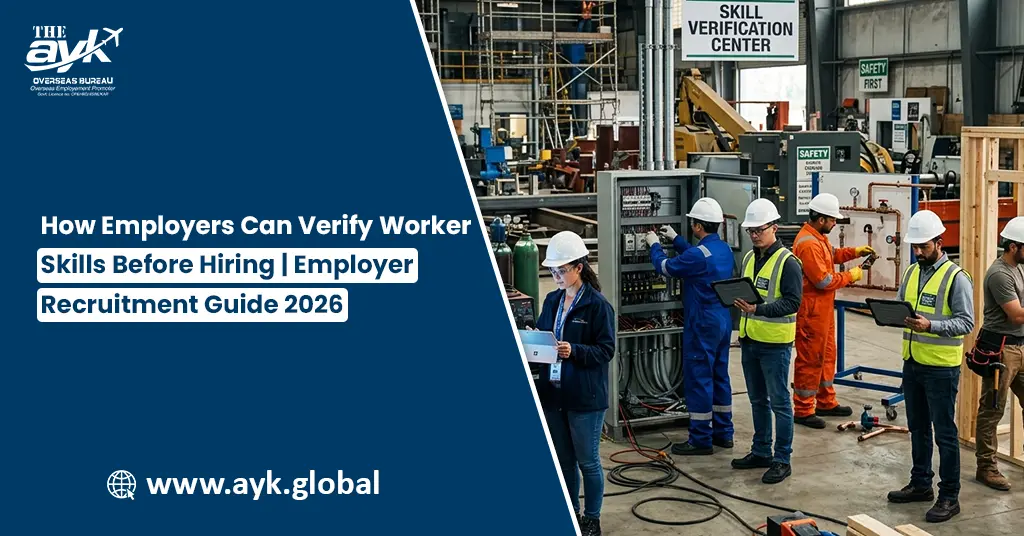
How Employers Can Verify Worker Skills Before Hiring
Published: June 23, 2026 | Views: 34
Hiring the right employees is one of the most important decisions an employer can make. Every recruitment decision influences productivity, workplace safety, project success, customer satisfaction, operational efficiency, and long-term business performance. Unfortunately, many organizations discover too late that a candidate's actual abilities do not match the skills listed on a resume or discussed during an interview.
This challenge is especially significant in industries such as construction, manufacturing, engineering, logistics, transportation, healthcare, hospitality, facilities management, and oil and gas. Employers often require workers who can perform technical tasks, operate equipment, follow safety procedures, and contribute immediately after deployment. Hiring employees without verifying their skills can create costly operational problems.
Many businesses rely heavily on resumes and interviews when making recruitment decisions. While these tools provide useful information, they do not always reveal whether candidates possess the practical competencies required for specific roles. Employers therefore need additional methods for evaluating workforce quality before hiring.
Skill verification helps organizations reduce recruitment risks and improve workforce reliability. Through structured assessments, trade testing, reference checks, background verification, and practical evaluations, employers can gain a clearer understanding of candidate capabilities.
As labor shortages continue affecting industries worldwide, some organizations feel pressure to hire quickly. However, hiring without proper verification often creates greater challenges later. Workforce quality remains one of the most important factors influencing organizational success.
This guide explains how employers can verify worker skills before hiring and build stronger workforce teams capable of supporting business objectives.
1. Start with Detailed Job Requirements
Effective skill verification begins before candidate sourcing starts. Employers must clearly define workforce requirements and identify the competencies necessary for success. Without clear expectations, it becomes difficult to evaluate candidates accurately.
Job descriptions should include technical skills, certifications, educational requirements, experience levels, safety qualifications, and role-specific responsibilities. Construction employers may require welding certifications, electrical licenses, or equipment operation experience. Healthcare organizations may require clinical competencies and professional credentials.
Detailed requirements improve recruitment accuracy because evaluation criteria are established before candidate assessments begin. Employers can focus on skills that directly influence job performance rather than relying on general impressions.
Organizations that define workforce requirements clearly often achieve stronger hiring outcomes and improved workforce quality.
Job Requirement Benefits
Clear expectations improve candidate evaluation.
Employers focus on relevant competencies.
Recruitment accuracy improves significantly.
2. Review Work Experience Carefully
Candidate experience often provides valuable insight into workforce capabilities. Employers should review employment history carefully to determine whether previous roles align with current workforce requirements.
The goal is not simply to measure years of experience. Employers should evaluate the type of work performed, project responsibilities, industry exposure, technical functions, and career progression. A candidate with five years of highly relevant experience may be more suitable than someone with ten years of unrelated experience.
Interview discussions should explore specific examples of past work activities. Candidates should explain how they performed tasks, solved problems, handled challenges, and contributed to project outcomes. Detailed conversations often reveal more about workforce capabilities than resumes alone.
Experience reviews help employers identify candidates who possess practical knowledge relevant to organizational needs.
Experience Evaluation Benefits
Relevant experience supports workforce quality.
Detailed reviews improve hiring decisions.
Practical knowledge influences job performance.
3. Conduct Structured Interviews
Interviews remain an important component of workforce evaluation. However, unstructured interviews often produce inconsistent results because different candidates receive different questions and evaluation criteria.
Structured interviews improve accuracy by ensuring all candidates are assessed using consistent methods. Employers can focus on technical competencies, problem-solving abilities, communication skills, safety awareness, and role-specific knowledge.
Behavioral interview questions are particularly effective because they require candidates to describe real situations from previous employment experiences. Responses provide insight into how individuals approach challenges and perform within workplace environments.
Structured interviews should complement other verification methods rather than replace them. Employers gain a more complete understanding of workforce capabilities when multiple assessment tools are used together.
Interview Benefits
Structured interviews improve consistency.
Behavioral questions reveal practical experience.
Candidate evaluation becomes more objective.
4. Use Practical Skill Assessments
Practical assessments are among the most reliable methods for verifying workforce competence. Rather than relying solely on discussions, employers can observe candidates performing tasks similar to those required on the job.
Practical assessments are particularly valuable for technical roles. Welders can complete welding tests, electricians can demonstrate electrical competencies, machine operators can operate equipment, and technicians can troubleshoot systems. Performance is evaluated directly rather than assumed.
These assessments help employers distinguish between candidates who possess genuine skills and those who simply describe experience effectively during interviews. Workforce quality improves because recruitment decisions are based on demonstrated abilities.
Practical evaluations often provide more accurate information than resumes, certifications, or references alone.
Practical Assessment Benefits
Skills are verified through direct observation.
Employers reduce recruitment uncertainty.
Workforce quality improves significantly.
5. Implement Trade Testing Programs
Trade testing is one of the most effective workforce verification strategies available to employers. Structured trade assessments evaluate technical competencies according to predefined standards and job requirements.
Trade tests are commonly used within construction, manufacturing, engineering, industrial services, logistics, transportation, and maintenance sectors. Candidates complete practical exercises that measure their ability to perform critical job functions.
The benefits of trade testing extend beyond skill verification. Employers gain confidence in recruitment decisions, workforce quality improves, and operational risks decline. Trade-tested workers generally require less supervision and become productive more quickly.
Organizations that integrate trade testing into recruitment processes often experience stronger workforce performance and lower turnover rates.
Trade Testing Benefits
Technical skills are evaluated objectively.
Recruitment risks decrease substantially.
Verified workers improve operational outcomes.
6. Verify Certifications and Licenses
Many industries require employees to possess certifications, licenses, permits, or professional credentials. Employers should verify these qualifications carefully before making hiring decisions.
Certification verification helps confirm that candidates meet industry standards and regulatory requirements. Employers can validate educational achievements, technical certifications, professional memberships, safety training records, and licensing information.
Verification is particularly important for positions involving safety-sensitive responsibilities, specialized equipment, healthcare services, engineering activities, and technical operations. Relying solely on candidate claims may expose organizations to unnecessary risks.
Organizations that verify credentials thoroughly improve workforce reliability and maintain compliance with industry standards.
Credential Verification Benefits
Professional qualifications are confirmed.
Compliance risks are reduced.
Workforce credibility improves.
7. Conduct Background and Reference Checks
Background verification is an essential step in the recruitment process. While resumes and interviews provide information directly from candidates, reference checks allow employers to obtain insights from previous supervisors, managers, and employers who have worked with the candidate.
Reference checks help verify employment history, job responsibilities, technical competencies, workplace behavior, reliability, attendance records, and overall performance. Employers can confirm whether a candidate's experience aligns with information provided during the recruitment process.
Background verification may also include identity checks, educational verification, employment record confirmation, and credential validation. These activities help reduce recruitment risks and improve workforce reliability.
Organizations that conduct thorough background checks often experience fewer hiring mistakes because candidate information is verified independently before employment decisions are finalized.
Background Verification Benefits
Employment history is confirmed.
Reference feedback improves hiring decisions.
Workforce reliability increases significantly.
8. Evaluate Safety Awareness and Compliance Knowledge
In industries such as construction, manufacturing, logistics, transportation, oil and gas, engineering, and facilities management, technical skills alone are not enough. Employees must also understand workplace safety requirements and compliance standards.
Safety evaluations help employers determine whether candidates possess the knowledge necessary to perform tasks responsibly. Workers should understand hazard identification, personal protective equipment, emergency procedures, equipment safety, and operational protocols relevant to their roles.
Employers can assess safety awareness through interviews, practical assessments, written evaluations, and scenario-based discussions. Candidates who demonstrate strong safety knowledge are often better prepared to contribute positively to workplace environments.
Workforce quality includes both technical competence and safety performance. Evaluating both areas improves recruitment outcomes and reduces operational risks.
Safety Evaluation Benefits
Safety awareness reduces workplace risks.
Compliance knowledge improves workforce quality.
Safe workers support operational success.
9. Use Digital Skill Assessment Tools
Technology has created new opportunities for workforce evaluation. Digital assessment platforms allow employers to evaluate candidate skills efficiently and consistently across large applicant pools.
Online testing tools can assess technical knowledge, problem-solving abilities, language skills, software competencies, industry-specific expertise, and cognitive capabilities. These assessments provide standardized data that supports objective recruitment decisions.
Digital evaluations are particularly useful when recruiting large numbers of employees because they improve efficiency and reduce administrative workloads. Employers can identify high-potential candidates before investing significant time in interviews and practical assessments.
Conclusion
Verifying worker skills before hiring is one of the most effective ways employers can improve workforce quality and reduce recruitment risks. By combining interviews, practical assessments, trade testing, certification verification, background checks, reference reviews, safety evaluations, and digital assessment tools, organizations gain a more complete understanding of candidate capabilities.
As workforce shortages continue affecting industries worldwide, the pressure to hire quickly may increase. However, workforce quality remains essential for productivity, safety, customer satisfaction, and long-term business performance. Thorough verification helps employers make better hiring decisions and build stronger workforce teams.
Organizations that prioritize candidate evaluation and skill verification are generally better positioned to achieve operational excellence and sustainable growth.
Technology should complement traditional verification methods rather than replace them. Combining digital assessments with interviews, trade testing, and reference checks often produces the strongest recruitment outcomes.
Digital Assessment Benefits
Technology improves evaluation efficiency.
Standardized testing supports objectivity.
Large recruitment campaigns become more manageable.
10. Assess Cultural Fit and Workplace Attitude
Technical skills are important, but workforce success also depends on attitude, professionalism, communication, adaptability, and teamwork. Employees who possess strong technical competencies may still struggle if they do not align with organizational culture or workplace expectations.
Employers should evaluate how candidates interact with others, respond to challenges, communicate ideas, and approach responsibilities. Behavioral interview questions and scenario-based discussions often provide valuable insight into workplace attitudes.
A positive attitude can influence productivity, collaboration, customer service, and workforce retention. Organizations benefit when employees contribute not only technical expertise but also professionalism and strong work ethics.
Evaluating cultural fit helps employers build workforce teams that perform effectively together and support long-term organizational objectives.
Cultural Fit Benefits
Workplace compatibility improves teamwork.
Positive attitudes support productivity.
Strong workforce alignment reduces turnover.
11. Recruitment Agencies Improve Candidate Verification
Professional recruitment agencies play a valuable role in workforce verification. Many employers lack the resources, time, or technical expertise required to conduct comprehensive candidate assessments independently.
Recruitment agencies often provide candidate sourcing, background verification, reference checks, credential validation, trade testing assistance, workforce screening, and recruitment planning support. These services improve workforce quality and reduce hiring risks.
Agencies also maintain candidate databases and industry knowledge that help employers identify suitable candidates more efficiently. Workforce verification becomes more structured and consistent when supported by recruitment specialists.
Organizations that collaborate with professional recruitment agencies often achieve stronger hiring outcomes and improved workforce reliability.
Recruitment Agency Benefits
Professional screening improves workforce quality.
Verification processes become more reliable.
Recruitment risks are reduced significantly.
12. Why AYK Overseas Screens Candidates Thoroughly
Successful recruitment requires more than simply filling vacancies. Employers need confidence that workers possess the skills, experience, qualifications, and professionalism necessary to contribute effectively from day one.
AYK Overseas Recruitment & HR Manpower Agency
License No. GL-4586-KAR
supports employers through candidate sourcing, workforce planning, screening, qualification verification, trade testing assistance, documentation management, compliance coordination, international recruitment, and workforce mobilization services.
The agency evaluates candidates across multiple workforce categories, including electricians, welders, plumbers, HVAC technicians, machine operators, healthcare professionals, drivers, construction workers, industrial technicians, supervisors, and engineering personnel. Structured screening processes help verify workforce quality before deployment.
By prioritizing candidate evaluation and workforce verification, AYK Overseas helps employers reduce recruitment risks and improve workforce readiness. Professional screening contributes directly to productivity, safety, and long-term business success.
Workforce Verification Solutions
Candidate screening improves recruitment outcomes.
Trade testing supports workforce quality.
Professional recruitment strengthens business performance.
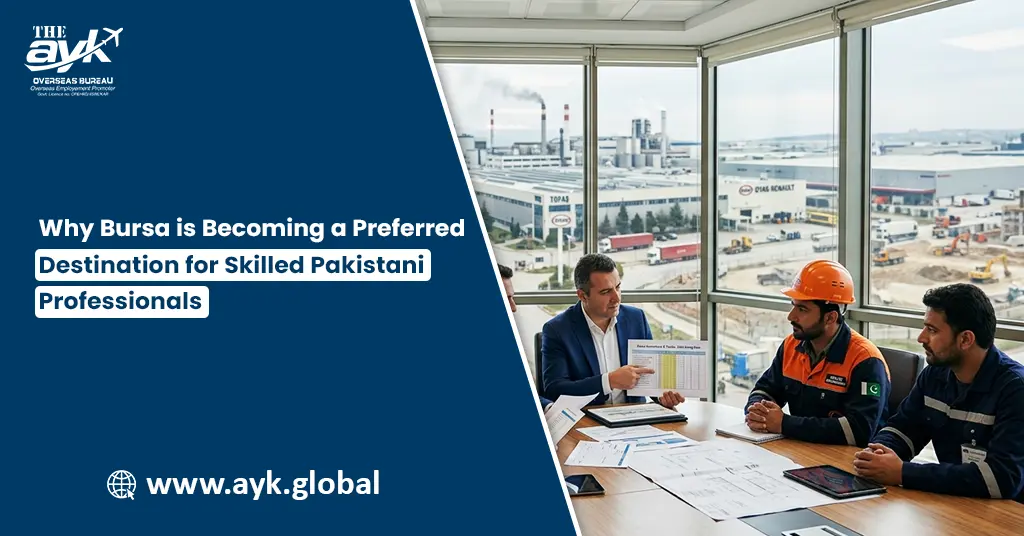 Why Bursa Is Becoming a Preferred Destination for Skilled Pakistani Professionals
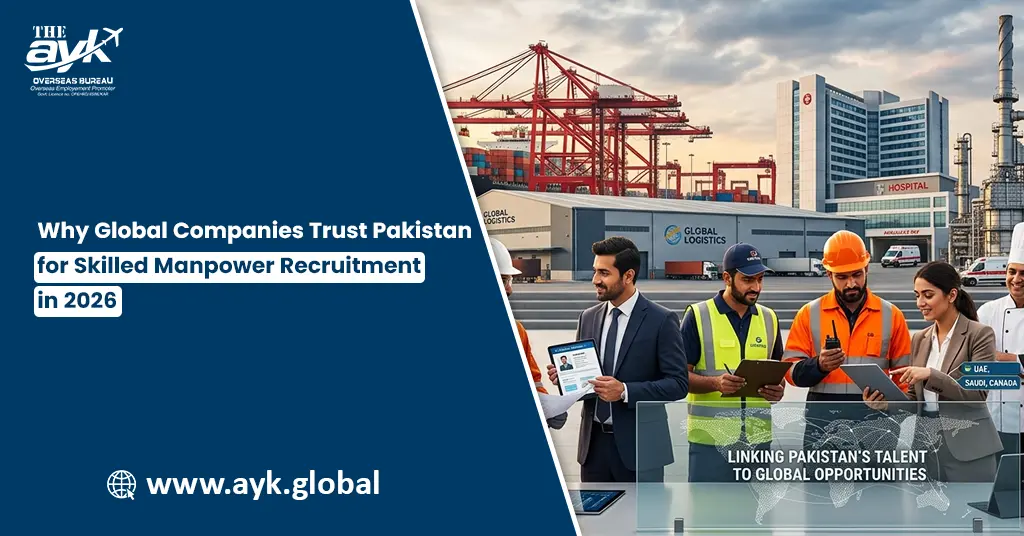 Why Global Companies Trust Pakistan for Skilled Manpower Recruitment in 2026
 KSA Recruitment
 UAE Recruitment
 Qatar Recruitment
 Oman Recruitment
 Kuwait Recruitment
 Libya Recruitment
 Bahrain Recruitment
 Iraq Recruitment
 Malaysia Recruitment
 Malta Recruitment
 Canada Recruitment
 USA Recruitment
 Europe Recruitment
 UK Recruitment
 Romania Recruitment
 Poland Recruitment
 Bulgaria Recruitment
 Albania Recruitment
 Serbia Recruitment
 Lithuania Recruitment
 Japan Recruitment
 Turkey Recruitment
 Kyrgyzstan Recruitment
 South Korea Recruitment