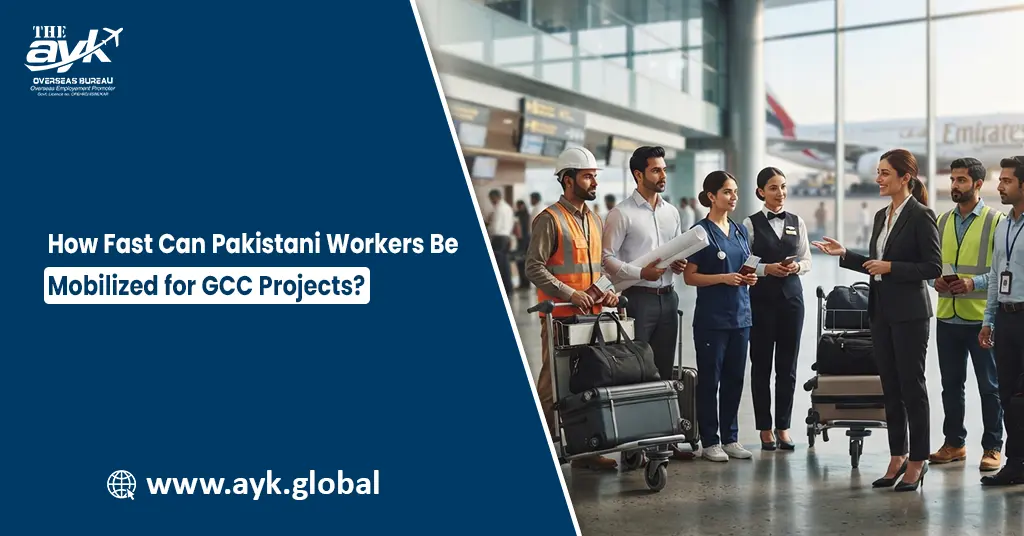
How Fast Can Pakistani Workers Be Mobilized for GCC Projects?
Published: July 03, 2026 | Views: 15
Introduction
Pakistani workers are one of the most in-demand labor forces for GCC countries such as Saudi Arabia, the United Arab Emirates, Qatar, Kuwait, Oman, and Bahrain. They are widely recruited for construction, oil and gas, infrastructure, manufacturing, facility management, and logistics projects due to their technical skills, adaptability, and experience in international work environments.
One of the most important concerns for GCC employers is how quickly manpower can be mobilized for ongoing or upcoming projects. In large-scale developments, delays in workforce deployment can lead to project setbacks, increased costs, and missed deadlines. The mobilization speed of Pakistani workers depends on several factors including recruitment method, documentation readiness, visa processing time, trade testing requirements, and employer urgency.
This guide explains in detail how fast Pakistani workers can be mobilized for GCC projects and what factors influence the overall timeline.
Average Mobilization Timeline for Pakistani Workers
The mobilization time for Pakistani workers varies depending on job type, project requirements, and recruitment structure. On average, the complete process—from sourcing to deployment can take anywhere from 2 to 8 weeks for standard hiring procedures.
For urgent or bulk recruitment projects where pre-screened candidates are already available, deployment can be even faster, sometimes within 10 to 20 days. However, for highly skilled roles requiring detailed trade testing, approvals, and documentation verification, the process may take longer.
The overall timeline depends heavily on how well the recruitment process is organized and how quickly approvals are obtained from both employer and immigration authorities.
Fast Sourcing Through Recruitment Agencies
Recruitment agencies play a major role in determining how quickly Pakistani workers can be mobilized. Licensed agencies maintain large databases of pre-screened candidates who are already prepared for overseas employment.
This allows employers to skip the initial sourcing stage and directly access qualified candidates. For bulk hiring projects, agencies can immediately shortlist electricians, welders, plumbers, masons, and other skilled workers, significantly reducing the time required for recruitment initiation.
Impact of Trade Testing on Mobilization Speed
Trade testing is an important step in verifying skills before deployment, but it can also influence the overall mobilization timeline. If candidates are already trade-tested and certified, the hiring process becomes much faster.
However, if new trade testing is required for each recruitment cycle, it may add a few extra days or weeks depending on the number of candidates and availability of testing centers. Efficiently organized testing facilities help reduce delays and speed up final selection.
Documentation and Visa Processing Time
Visa processing is one of the most critical factors affecting mobilization speed. After selection, workers must complete documentation verification, employment contracts, and visa applications before travel approval.
On average, visa processing for GCC countries can take 1 to 4 weeks depending on embassy workload, accuracy of documents, and country-specific regulations. Errors in documentation or incomplete paperwork can cause additional delays, making proper verification essential for fast deployment.
Medical Clearance and Fitness Approval Speed
Medical testing is a mandatory requirement for all Pakistani workers before deployment to GCC countries. The speed of mobilization depends heavily on how quickly candidates can complete medical examinations at approved health centers. In many cases, if candidates are already pre-booked and centers are available, medical clearance can be completed within 2–5 days.
However, delays may occur if re-tests are required or if medical centers are overloaded with applications. GCC-approved medical fitness is essential for visa stamping, so this stage must be completed accurately. Fast-track medical arrangements through experienced recruitment agencies can significantly reduce waiting time and speed up overall deployment.
Travel Arrangements and Flight Scheduling
Once visa and medical approvals are completed, the next step is travel arrangement. Flight availability, group bookings, and employer scheduling play a key role in determining how quickly workers reach GCC project sites. In urgent cases, workers can be mobilized within 24–72 hours after final clearance.
Recruitment agencies often coordinate group departures to reduce cost and ensure smooth arrival management. However, delays may occur due to limited flight availability, seasonal demand, or employer-specific scheduling requirements. Proper coordination between agency and employer can significantly accelerate this stage.
Employer Onboarding and Site Readiness
Even after workers arrive in GCC countries, final mobilization depends on how quickly onboarding and site deployment are completed. This includes accommodation allocation, safety induction, contract signing, and job assignment.
If employer systems are well-organized, workers can start duties within 1–2 days of arrival. However, delays in site readiness or internal approvals can slow down deployment. Efficient onboarding systems ensure that manpower becomes productive immediately after arrival, reducing idle time and improving project efficiency.
Factors That Speed Up Mobilization
Several key factors can significantly reduce the mobilization time of Pakistani workers for GCC projects. The most important factor is the use of pre-screened and trade-tested candidates, which eliminates delays in evaluation stages.
Other important factors include complete documentation readiness, fast visa processing systems, strong coordination between recruitment agencies and employers, and availability of bulk recruitment pipelines. When these elements are aligned, mobilization becomes faster, smoother, and more predictable.
Key acceleration factors include:
- Pre-screened candidate databases
- Trade-tested workforce availability
- Complete documentation before selection
- Fast-track visa processing
- Strong agency-employer coordination
- Bulk recruitment planning
Common Delays in Mobilization and How to Avoid Them
Despite efficient systems, certain issues can delay worker mobilization. These include incomplete documentation, visa rejections, medical failures, slow embassy processing, and last-minute candidate withdrawals. Such delays can impact project timelines and increase recruitment costs.
To avoid these issues, employers should implement strict document verification processes, maintain backup candidate pools, and work with experienced licensed recruitment agencies. Early planning and proper communication between all stakeholders also help minimize unexpected delays.
Conclusion
Pakistani workers can be mobilized for GCC projects relatively quickly, especially when recruitment is handled through licensed agencies with pre-screened candidates and efficient documentation systems. In most cases, the average mobilization period ranges from 2 to 8 weeks, but urgent deployments can happen even faster depending on project requirements and readiness of candidates. The speed at which Pakistani workers can be mobilized for GCC projects depends on several interconnected factors including sourcing efficiency, trade testing, documentation, visa processing, medical clearance, and travel arrangements. In well-organized recruitment systems, workers can be deployed within 2 to 8 weeks, while urgent cases may allow mobilization in as little as 10–20 days.
With proper planning, pre-screened talent pools, and strong recruitment partnerships, GCC employers can significantly accelerate deployment timelines. Fast and efficient mobilization is essential for meeting project deadlines, reducing downtime, and maintaining productivity in large-scale construction and industrial projects.
 Recruitment Industry Outlook 2026: What HR Managers Predict
 Top Countries Hiring Overseas Workers in 2026
 Hire Pakistani Workers for Brazil
 KSA Recruitment
 UAE Recruitment
 Qatar Recruitment
 Oman Recruitment
 Kuwait Recruitment
 Libya Recruitment
 Bahrain Recruitment
 Iraq Recruitment
 Malaysia Recruitment
 Malta Recruitment
 Canada Recruitment
 USA Recruitment
 Europe Recruitment
 UK Recruitment
 Romania Recruitment
 Poland Recruitment
 Bulgaria Recruitment
 Albania Recruitment
 Serbia Recruitment
 Lithuania Recruitment
 Japan Recruitment
 Turkey Recruitment
 Kyrgyzstan Recruitment
 South Korea Recruitment