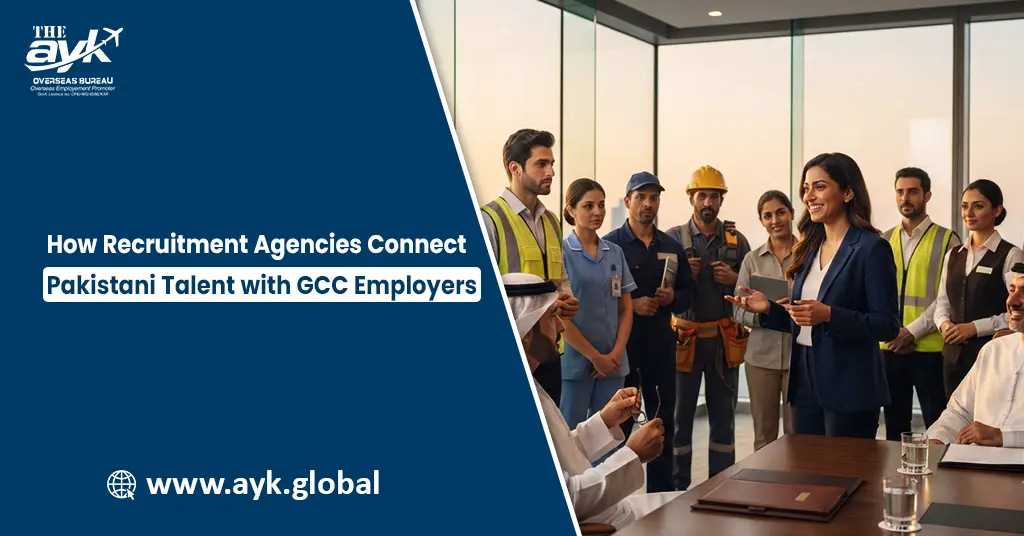
How Recruitment Agencies Connect Pakistani Talent with GCC Employers
Published: July 02, 2026 | Views: 13
In 2026, recruitment agencies play a central role in connecting Pakistani workers with employers in GCC countries such as Saudi Arabia, United Arab Emirates (UAE), Qatar, Kuwait, Oman, and Bahrain. These agencies act as a bridge between job seekers and international companies by managing the entire hiring process, from candidate selection to visa processing and final deployment.
The demand for skilled and semi-skilled workers in GCC countries continues to grow due to large-scale infrastructure projects, oil and gas expansion, construction development, logistics growth, and hospitality industry needs. However, employers cannot directly hire thousands of workers from different countries without a structured system. This is where recruitment agencies become essential.
For Pakistani workers, recruitment agencies are often the first point of contact for overseas employment opportunities. Understanding how these agencies operate helps job seekers avoid scams, improve their chances of selection, and secure legitimate jobs abroad.
Role of Recruitment Agencies in Overseas Hiring
Recruitment agencies act as official intermediaries between GCC employers and Pakistani job seekers. Their primary role is to identify, screen, and select suitable candidates according to employer requirements.
Employers in GCC countries send job orders to licensed agencies specifying job roles, required skills, experience level, salary packages, and working conditions. The agency then starts the process of finding suitable candidates within Pakistan.
This system saves time and ensures that only qualified candidates are presented to employers. It also helps maintain legal compliance with international labor laws and recruitment standards.
Agencies ensure that candidates meet job expectations before they are forwarded for final selection.
Candidate Sourcing and Initial Screening
The recruitment process begins with candidate sourcing. Agencies collect applications from job seekers through advertisements, walk-in interviews, online applications, and referrals.
Once applications are received, agencies conduct initial screening based on CV evaluation, experience verification, and skill matching.
Candidates who meet basic requirements are shortlisted for further assessment. This stage helps filter out unqualified applicants and ensures that only relevant candidates proceed to the next step.
Screening also includes checking communication skills, physical fitness, and job readiness.
Trade Testing and Skill Evaluation
One of the most important steps managed by recruitment agencies is trade testing. Candidates applying for technical jobs such as electricians, welders, plumbers, HVAC technicians, mechanical workers, and machine operators must pass practical skill tests.
Trade testing ensures that candidates can perform real job tasks according to GCC standards. It includes hands-on demonstrations, technical assessments, and safety evaluations.
Agencies coordinate with testing centers and sometimes directly with GCC employers to conduct these tests.
Only candidates who pass trade tests are considered for final selection.
Interview Coordination with GCC Employers
After trade testing, shortlisted candidates are presented to GCC employers for final interviews. These interviews may be conducted online, in-person, or through video conferencing.
Recruitment agencies organize interview schedules, prepare candidates, and ensure smooth communication between both parties.
Employers evaluate candidates based on technical knowledge, communication skills, experience, and attitude.
Agencies also provide feedback to candidates to help them improve their performance.
Successful candidates move forward in the hiring process.
Document Verification and Processing
Once a candidate is selected, recruitment agencies handle document verification and processing. This includes checking:
- Passport validity
- Educational certificates
- Experience letters
- Medical fitness reports
Agencies ensure that all documents meet embassy and employer requirements.
Any missing or incorrect documents are corrected before submission to avoid delays or rejection.
Proper documentation is essential for legal overseas employment.
Visa Processing and Embassy Coordination
Recruitment agencies play a key role in visa processing. They coordinate with GCC embassies to obtain work visas for selected candidates.
The process includes:
- Submission of employment contract
- Medical examination approval
- Security clearance
- Visa stamping
Agencies ensure that all legal requirements are completed according to destination country regulations.
This step is crucial for safe and legal employment abroad.
Travel Arrangements and Deployment
After visa approval, recruitment agencies arrange travel for selected candidates. This includes:
- Flight booking
- Orientation sessions
- Pre-departure briefing
Candidates are informed about job roles, working conditions, accommodation, and company policies before departure.
Agencies ensure smooth deployment so workers can start their jobs without complications.
Ensuring Legal and Ethical Recruitment
Licensed recruitment agencies follow strict legal and ethical standards. They operate under government regulations and maintain transparency in all processes.
They ensure that:
- No illegal fees are charged
- Job offers are genuine
- Contracts are legally valid
- Workers are protected from fraud
For example, trusted agencies like AYK Overseas Recruitment & HR Manpower Agency (https://ayk.global/) operate through verified employer networks and follow proper recruitment laws.
This helps build trust between employers and job seekers.
Benefits of Using Recruitment Agencies
Recruitment agencies provide several benefits to Pakistani job seekers:
- Access to verified GCC jobs
- Proper skill matching
- Assistance in documentation
- Interview preparation support
- Legal visa processing
They simplify the entire overseas job process and reduce the risk of fraud.
Workers who apply through licensed agencies have higher chances of selection and safer employment.
Challenges in Recruitment Process
Despite their importance, recruitment agencies also face challenges such as:
- High competition among candidates
- Verification delays
- Employer requirement changes
- Skill mismatches
Candidates must be well-prepared to succeed in the selection process.
Proper training and skill development can significantly improve success rates.
Conclusion
Recruitment agencies play a vital role in connecting Pakistani talent with GCC employers in 2026. They manage the entire hiring process, including candidate screening, trade testing, interviews, documentation, visa processing, and deployment.
For job seekers, understanding how these agencies work is essential for securing legitimate overseas employment opportunities in Saudi Arabia, UAE, Qatar, Kuwait, Oman, and Bahrain.
By working with licensed and trusted recruitment agencies, candidates can ensure safe, legal, and successful international careers.
 Police Character Certificate: How to Get It Fast
 Why Pre-Screened Candidates Save Time and Recruitment Costs
 GCC Jobs Without Experience, Best Opportunities for Fresh Candidates
 KSA Recruitment
 UAE Recruitment
 Qatar Recruitment
 Oman Recruitment
 Kuwait Recruitment
 Libya Recruitment
 Bahrain Recruitment
 Iraq Recruitment
 Malaysia Recruitment
 Malta Recruitment
 Canada Recruitment
 USA Recruitment
 Europe Recruitment
 UK Recruitment
 Romania Recruitment
 Poland Recruitment
 Bulgaria Recruitment
 Albania Recruitment
 Serbia Recruitment
 Lithuania Recruitment
 Japan Recruitment
 Turkey Recruitment
 Kyrgyzstan Recruitment
 South Korea Recruitment