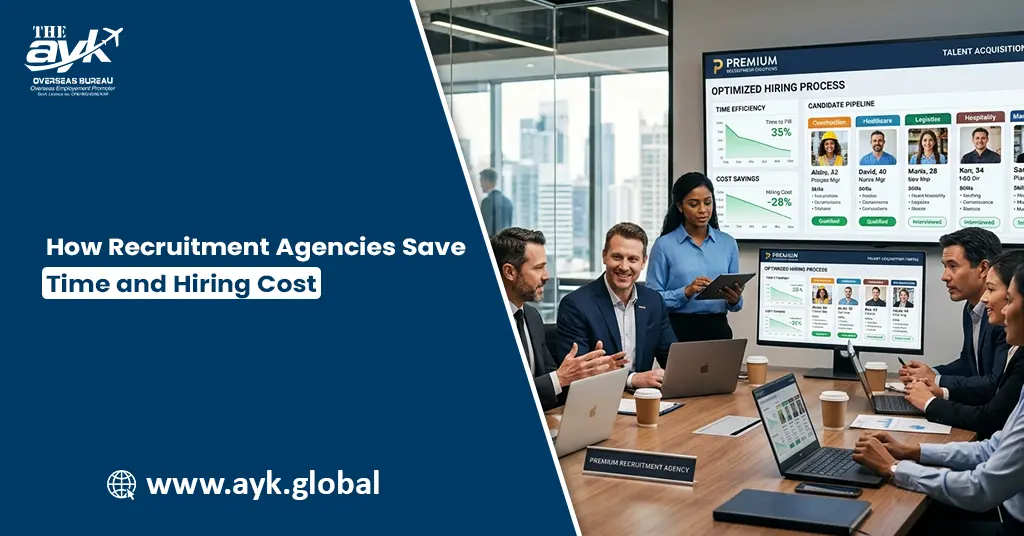
How Recruitment Agencies Save Time and Hiring Costs
Published: June 22, 2026 | Views: 38
Introduction
Recruitment is one of the most important investments any organization makes. Every successful company depends on talented employees who can support productivity, customer satisfaction, operational performance, and long-term growth. However, finding and hiring the right people requires significant time, effort, and financial resources. Many employers underestimate the true cost of recruitment because they focus only on visible expenses such as advertising or recruiter salaries while overlooking indirect costs associated with vacant positions, productivity losses, and hiring delays.
As labor markets become more competitive and workforce requirements become increasingly specialized, recruitment has evolved into a highly complex process. Employers must source candidates, screen applications, conduct interviews, verify credentials, manage documentation, coordinate onboarding, and ensure compliance with employment regulations. These activities demand expertise and resources that many organizations struggle to provide internally.
This is one of the primary reasons companies increasingly partner with recruitment agencies. Professional recruitment agencies help employers streamline hiring processes, access larger talent pools, reduce administrative burdens, and improve workforce quality. By leveraging recruitment expertise, organizations can often hire more efficiently while lowering overall recruitment costs.
This guide explains how recruitment agencies save time and money for employers and why recruitment partnerships have become a strategic business advantage.
1. The Hidden Cost of Vacant Positions
Many employers focus on recruitment expenses without fully considering the financial impact of unfilled positions. When a role remains vacant, organizations often experience productivity losses, increased workloads for existing employees, project delays, customer service challenges, and missed business opportunities. These indirect costs can accumulate quickly and frequently exceed direct recruitment expenses.
For example, a construction company waiting several months to recruit project supervisors may experience delays that affect project schedules and contractual commitments. Similarly, a hospital operating with nursing shortages may face increased overtime costs and reduced service capacity. Every day a critical position remains vacant creates operational consequences that influence business performance.
Recruitment agencies help reduce vacancy periods by accelerating candidate sourcing and hiring activities. Their established networks and recruitment systems allow them to identify suitable candidates more quickly than many internal hiring teams. Faster recruitment means positions are filled sooner, reducing productivity losses and supporting operational continuity.
Employers that view recruitment as an investment rather than a cost often recognize the value of reducing vacancy periods. Recruitment agencies contribute directly to this objective by helping organizations maintain workforce readiness and business momentum.
Why Vacancy Costs Matter
Unfilled positions often create significant indirect costs.
Productivity losses frequently exceed direct recruitment expenses.
Recruitment agencies help employers minimize these losses through faster hiring.
2. Recruitment Agencies Reduce Administrative Workloads
Recruitment involves a substantial amount of administrative activity. Job postings, candidate sourcing, resume reviews, interview scheduling, communication management, documentation processing, and compliance tracking all require time and attention. For many organizations, these tasks place considerable pressure on HR teams and hiring managers.
Internal recruitment efforts often divert resources away from strategic business priorities. Managers who spend hours reviewing resumes and coordinating interviews have less time available for operational responsibilities. HR departments may become overwhelmed when multiple vacancies must be filled simultaneously.
Recruitment agencies absorb much of this administrative workload. They manage sourcing activities, communicate with candidates, conduct preliminary evaluations, and coordinate recruitment logistics. This allows employers to focus on core business functions while maintaining recruitment progress.
Reducing administrative burdens not only saves time but also improves organizational efficiency. Employers can allocate resources more effectively and avoid disruptions associated with intensive recruitment activities.
Administrative Efficiency Benefits
Recruitment agencies manage many time-consuming hiring activities.
Employers save valuable management and HR resources.
Reduced administrative pressure improves organizational productivity.
3. Access to Pre-Screened Talent Pools
One of the biggest advantages recruitment agencies provide is access to established talent networks. Building and maintaining candidate databases requires significant investment, which many organizations cannot justify internally. Recruitment agencies continuously source candidates and maintain relationships with skilled professionals across multiple industries.
These pre-screened talent pools enable agencies to respond quickly to recruitment requests. Instead of starting from scratch every time a vacancy arises, recruiters can often identify suitable candidates immediately. This dramatically shortens hiring timelines and improves workforce availability.
Pre-screened candidates also reduce screening workloads for employers. Agencies evaluate qualifications, experience, technical competencies, and employment readiness before presenting candidates. As a result, employers spend less time reviewing unsuitable applications and more time engaging with qualified professionals.
Access to talent networks becomes especially valuable during labor shortages or when recruiting for specialized positions. Organizations that rely solely on job advertisements may struggle to attract qualified applicants, while recruitment agencies can leverage established relationships to identify talent more effectively.
Why Talent Networks Save Time
Pre-screened candidate pools accelerate recruitment activities.
Employers review fewer unsuitable applications.
Established networks improve access to qualified talent.
4. Faster Hiring Improves Business Performance
Speed is one of the most important factors influencing recruitment success. Delays in hiring can affect productivity, customer service, project execution, and revenue generation. Organizations that fill positions quickly are often better positioned to maintain operational performance and respond to market opportunities.
Recruitment agencies improve hiring speed through specialized expertise, established sourcing channels, and efficient recruitment systems. Because recruiting is their primary function, agencies can dedicate resources to candidate identification and evaluation more effectively than many internal teams.
Faster hiring also improves candidate experience. High-quality candidates often receive multiple job offers and may accept alternative opportunities if recruitment processes move too slowly. Agencies help employers engage candidates quickly and reduce the risk of losing top talent.
Business performance benefits when positions are filled efficiently. Organizations avoid productivity losses associated with vacancies and maintain workforce stability. This contributes to stronger operational outcomes and improved competitiveness.
Recruitment Speed and Business Success
Fast hiring supports productivity and operational continuity.
Agencies reduce delays through efficient recruitment processes.
Quick recruitment helps employers secure top talent before competitors.
5. Improved Candidate Quality Reduces Hiring Mistakes
Hiring mistakes are among the most expensive workforce challenges organizations face. Recruiting an unsuitable employee often results in training expenses, productivity losses, turnover costs, and repeated recruitment efforts. Avoiding poor hiring decisions is therefore critical for controlling recruitment costs.
Recruitment agencies improve candidate quality through structured screening and evaluation processes. Professional recruiters assess qualifications, experience, communication skills, technical competencies, and cultural fit before recommending candidates to employers.
This thorough evaluation helps identify applicants who are more likely to succeed within the organization. Better candidate matching reduces turnover risks and improves long-term workforce performance.
Organizations that prioritize candidate quality often experience stronger retention rates and lower recruitment costs over time. Recruitment agencies contribute to these outcomes by improving selection accuracy and workforce alignment.
The Cost of Hiring Mistakes
Replacing employees can be extremely expensive.
Better candidate evaluation reduces turnover and retraining costs.
Quality-focused recruitment improves workforce stability.
6. Recruitment Agencies Support Bulk Hiring Efficiently
Large-scale recruitment projects present unique challenges. Hiring dozens or hundreds of employees requires extensive sourcing, screening, coordination, and administrative effort. Many organizations lack the resources necessary to manage these projects internally.
Recruitment agencies specialize in bulk hiring because they maintain large candidate networks and dedicated recruitment teams. They can manage high-volume recruitment campaigns more efficiently and often deliver workforce solutions within tight deadlines.
Bulk hiring support is particularly valuable for construction projects, manufacturing facilities, logistics operations, healthcare expansions, hospitality openings, and industrial developments. Employers benefit from faster workforce mobilization and reduced recruitment complexity.
By outsourcing large-scale recruitment activities, organizations avoid overburdening internal teams and improve workforce readiness. This helps support project success and operational continuity.
Advantages of Bulk Hiring Support
Recruitment agencies manage high-volume hiring efficiently.
Organizations save time and resources during workforce expansions.
Large-scale recruitment support improves operational readiness.
7. Recruitment Agencies Reduce Advertising and Job Marketing Costs
Many employers underestimate how much money is spent on job advertising every year. Posting vacancies on premium job portals, industry websites, social media platforms, newspapers, recruitment boards, and professional networks can become expensive, especially when multiple positions need to be filled simultaneously. Organizations that regularly recruit employees often spend thousands of dollars annually on recruitment marketing alone.
The challenge becomes even greater when job advertisements fail to attract qualified candidates. Employers may need to repost vacancies repeatedly, invest in additional promotional campaigns, or expand advertising efforts across multiple channels. These activities increase recruitment costs without guaranteeing successful hiring outcomes. In highly competitive industries, even extensive advertising may not generate suitable applicants.
Recruitment agencies help employers reduce these expenses because they already maintain established candidate databases and sourcing networks. Instead of relying entirely on public job advertisements, agencies can access talent directly through existing relationships and workforce pipelines. This reduces the need for repeated advertising campaigns and improves recruitment efficiency.
Many agencies also invest heavily in talent acquisition technology, candidate engagement platforms, and workforce marketing strategies. Employers benefit from these resources without bearing the full cost themselves. By leveraging agency networks and sourcing capabilities, organizations often achieve stronger hiring outcomes while spending less on recruitment marketing.
Advertising Cost Savings
Employers avoid repeated spending on job advertisements and recruitment campaigns.
Recruitment agencies use established talent networks to identify candidates more efficiently.
Reduced advertising expenses contribute directly to lower overall hiring costs.
8. Lower Overtime Costs Through Faster Recruitment
Workforce shortages often create operational challenges that extend beyond recruitment expenses. When positions remain vacant, existing employees are frequently required to work additional hours to maintain productivity and service levels. While overtime can provide a temporary solution, it often increases labor costs significantly and creates long-term workforce management issues.
Extended overtime requirements can also affect employee morale and well-being. Staff members who consistently work extra hours may experience fatigue, reduced job satisfaction, and increased burnout risks. These issues can contribute to turnover, absenteeism, and declining productivity. Organizations that rely heavily on overtime as a response to staffing shortages often face escalating workforce challenges.
Recruitment agencies help reduce overtime costs by filling positions more quickly. Faster hiring enables employers to restore normal staffing levels and distribute workloads more effectively. Employees can focus on their primary responsibilities without excessive overtime demands, improving overall workforce performance.
The financial benefits of reduced overtime are often substantial. Employers save money on additional wage payments while maintaining stronger employee engagement and retention. Recruitment agencies contribute to these outcomes by accelerating hiring timelines and improving workforce availability.
Overtime Reduction Benefits
Faster hiring reduces reliance on expensive overtime arrangements.
Employees experience improved work-life balance and job satisfaction.
Organizations lower labor costs while maintaining productivity.
9. Compliance and Documentation Savings
Recruitment involves numerous administrative and compliance-related activities that require time, expertise, and resources. Employers must manage employment contracts, candidate records, qualification verification, labor law compliance, immigration requirements, medical examinations, and onboarding documentation. Handling these processes internally can be both time-consuming and costly.
Errors in compliance management can create significant financial consequences. Documentation mistakes may lead to recruitment delays, legal disputes, regulatory penalties, or visa processing complications. Correcting these issues often requires additional resources and can disrupt workforce planning efforts.
Professional recruitment agencies possess extensive experience managing compliance requirements. They understand documentation standards, labor regulations, and recruitment procedures across different industries and jurisdictions. By outsourcing these responsibilities, employers reduce administrative workloads and minimize compliance risks.
International recruitment introduces even greater complexity because immigration laws and employment regulations vary between countries. Recruitment agencies with overseas hiring expertise help employers navigate these requirements efficiently. This reduces the likelihood of costly compliance issues and supports smoother workforce mobilization.
Compliance Management Advantages
Professional agencies reduce compliance-related administrative burdens.
Accurate documentation helps avoid legal and regulatory complications.
Employers save time and resources through expert compliance support.
10. Better Workforce Retention Creates Long-Term Savings
Employee turnover represents one of the largest hidden costs associated with recruitment. When employees leave shortly after being hired, organizations must repeat the recruitment process and absorb additional expenses related to onboarding, training, productivity losses, and vacancy periods. High turnover rates can significantly increase workforce costs over time.
Recruitment agencies help improve retention by focusing on candidate quality and job suitability. Professional recruiters evaluate not only technical qualifications but also career goals, personality traits, communication skills, and organizational fit. This comprehensive assessment increases the likelihood of successful long-term placements.
Candidates who align well with organizational requirements are generally more satisfied and engaged in their roles. Stronger alignment reduces turnover risks and improves workforce stability. Employers benefit from lower replacement costs and greater productivity because employees remain with the organization longer.
Retention improvements often generate significant financial savings. Organizations spend less on repeated recruitment efforts and experience fewer disruptions caused by workforce turnover. Recruitment agencies contribute to these outcomes by helping employers make better hiring decisions.
Financial Value of Retention
Reducing turnover lowers recruitment and onboarding expenses.
Long-term employees contribute more effectively to organizational success.
Retention improvements generate substantial cost savings over time.
11. International Recruitment Provides Cost-Effective Workforce Solutions
Many employers use recruitment agencies because international hiring can provide access to skilled talent at competitive cost levels. Workforce shortages in local labor markets often drive up wages and increase recruitment challenges. Overseas recruitment agencies help organizations access broader talent pools and improve workforce availability.
International recruitment is particularly valuable for industries such as construction, healthcare, hospitality, logistics, manufacturing, facilities management, and oil and gas. Employers can source qualified professionals from countries with strong workforce availability and relevant industry experience.
Professional recruitment agencies manage sourcing, screening, documentation, visa processing, and mobilization activities. This support simplifies international hiring and reduces administrative complexity for employers. Organizations gain access to global talent without having to establish overseas recruitment infrastructure independently.
Cost advantages should never come at the expense of workforce quality. Successful international recruitment focuses on securing qualified professionals who contribute positively to business objectives. Agencies help employers balance cost efficiency with workforce performance.
International Recruitment Benefits
Global talent access improves workforce availability and hiring flexibility.
Recruitment agencies simplify overseas hiring processes.
International recruitment supports business growth and workforce scalability.
12. Recruitment Agencies Deliver Strong Long-Term Return on Investment
Many employers initially evaluate recruitment agencies based solely on service fees. However, the true value of professional recruitment partnerships becomes apparent when considering long-term return on investment. Recruitment agencies contribute to organizational success in ways that extend far beyond immediate hiring outcomes.
By reducing vacancy periods, improving candidate quality, lowering turnover, minimizing compliance risks, and accelerating workforce deployment, recruitment agencies help organizations achieve stronger operational performance. These benefits often generate financial returns that significantly exceed recruitment costs.
Long-term recruitment partnerships provide additional value because agencies develop a deeper understanding of employer requirements over time. Familiarity with organizational culture, workforce needs, and hiring priorities improves recruitment efficiency and candidate matching. Employers benefit from faster hiring and stronger workforce alignment.
AYK Overseas Recruitment & HR Manpower Agency (License No. GL-4586-KAR) supports employers through structured recruitment solutions designed to improve workforce quality and reduce hiring challenges. Organizations that view recruitment agencies as strategic partners rather than service providers often achieve the strongest long-term results.
Understanding Recruitment ROI
Recruitment value extends beyond immediate hiring costs.
Professional agencies improve workforce quality and business performance.
Long-term recruitment partnerships generate sustainable competitive advantages.
Conclusion
Recruitment agencies help employers save both time and money by improving hiring efficiency, reducing administrative burdens, accelerating workforce deployment, and improving candidate quality. While recruitment services involve upfront costs, the long-term financial benefits often far outweigh the investment.
Organizations that partner with professional recruitment agencies gain access to larger talent pools, specialized expertise, compliance support, and workforce planning capabilities. These advantages contribute to stronger hiring outcomes, reduced turnover, improved productivity, and greater operational success.
As workforce challenges continue evolving, recruitment agencies will remain valuable partners for employers seeking cost-effective and efficient hiring solutions.
 Complete Guide to Getting an Overseas Job from Pakistan in 2026
 KSA Recruitment
 UAE Recruitment
 Qatar Recruitment
 Oman Recruitment
 Kuwait Recruitment
 Libya Recruitment
 Bahrain Recruitment
 Iraq Recruitment
 Malaysia Recruitment
 Malta Recruitment
 Canada Recruitment
 USA Recruitment
 Europe Recruitment
 UK Recruitment
 Romania Recruitment
 Poland Recruitment
 Bulgaria Recruitment
 Albania Recruitment
 Serbia Recruitment
 Lithuania Recruitment
 Japan Recruitment
 Turkey Recruitment
 Kyrgyzstan Recruitment
 South Korea Recruitment