How to Get a Promotion During Your Gulf Employment
Published: July 04, 2026 | Views: 12
Advancement beyond initial entry-level Gulf employment positioning represents a genuine and achievable career development objective for Pakistani workers who approach their overseas employment with deliberate professional development orientation rather than simply fulfilling minimum job requirements and hoping that time alone will generate the advancement recognition that consistently strong performance and active career development investment actually produces. The Gulf employment environment offers real advancement pathways for workers across construction trades, hospitality, healthcare, technical maintenance, and various other employment categories, with workers who understand what Gulf employers specifically value in advancement consideration decisions and who deliberately invest in developing these valued qualities creating meaningfully stronger advancement outcomes than those whose employment approach lacks the deliberate advancement orientation that distinguishes workers who progress from those who remain static throughout their entire Gulf employment tenure. AYK Overseas Recruitment & HR Manpower Agency, recognized as one of Pakistan's top manpower agencies, has observed the patterns that distinguish Pakistani workers who advance within Gulf employment from those who remain at entry-level positioning and this guide distills this observational experience into practical advancement guidance.
Consistently Exceptional Performance as the Non-Negotiable Foundation
Promotion consideration begins and ends with performance quality, with workers whose daily work output, reliability, and quality consistency genuinely exceed the standard that their current position requires establishing the most fundamental advancement case that no amount of relationship development, skill demonstration, or visibility investment can substitute for without the underlying performance foundation that defines what advancement recognition is actually rewarding. Workers who want advancement must honestly assess whether their actual daily performance genuinely exceeds expectations rather than merely meeting them, recognizing that meeting expectations accurately describes adequate employment rather than advancement-worthy exceptional contribution that supervisors specifically identify when they consider which workers deserve advancement recognition. The gap between adequate performance that avoids negative consequences and genuinely exceptional performance that creates positive advancement impression requires conscious, deliberate effort to maintain consistently rather than sporadically, with workers who sustain exceptional performance consistently across normal and peak demand periods creating stronger advancement cases than those whose performance quality fluctuates between genuinely impressive and merely adequate.
Developing Skills That Your Organization Specifically Values
Strategic skill development targeted toward capabilities that your specific employer specifically values creates more advancement-relevant professional development than general skill improvement that may not address the specific competency gaps that your employer most needs to fill through promotion decisions. Workers should research which specific skills differentiate senior from junior positions within their employment category through observation, direct supervisor conversation about advancement requirements, and research into what qualifications similar senior positions at their employer typically hold, then deliberately invest in developing these specific skills rather than pursuing generally useful development that lacks targeted advancement relevance. Technical certification that formally verifies competencies your employer specifically values carries particular advancement weight because it provides documented, independently verified competency evidence that advances your profile beyond what self-reported capability claims that managers must accept on faith without verification can establish, making certification investment in advancement-relevant competencies a high-return professional development action.
Making Your Contributions Visible to Decision-Makers
Exceptional performance that remains invisible to the supervisors and managers who make promotion decisions contributes significantly less to advancement outcomes than genuinely excellent work that appropriate visibility strategies ensure reaches awareness of the people whose decisions determine advancement. Appropriate visibility means ensuring that quality work, problem-solving contributions, process improvements, and various other positive professional contributions are known to supervisors through legitimate professional channels rather than inappropriate self-promotion that undermines the professional impression it intends to create. Workers can create legitimate advancement visibility through regular brief updates to supervisors about significant work completions, volunteering for projects that provide natural exposure to senior leaders who otherwise lack visibility into the worker's daily performance, asking supervisors for feedback that creates professional dialogue demonstrating the worker's genuine advancement orientation, and taking on opportunities for work product presentation that provide visible demonstration of capability to audiences beyond the worker's immediate daily supervisory relationship.
Building Productive Relationships with Supervisors and Senior Colleagues
Career advancement within Gulf employment environments, like advancement within most professional contexts, benefits significantly from positive, productive relationships with supervisors who are the most direct determinants of immediate advancement decisions and with senior colleagues whose informal endorsement and advocacy sometimes influences advancement decisions beyond formal performance assessment alone. Building these relationships requires genuine professional engagement rather than performative relationship management that supervisors recognize as advancement-motivated rather than authentically collegial, with authentic professional respect, genuine interest in supervisors' professional perspectives, and consistent reliable behavior creating the relationship quality that genuine advancement advocacy grows from. Workers should specifically invest in understanding their supervisors' professional priorities, communication preferences, and management style, adapting their own professional conduct toward the working relationship style that their specific supervisor values most effectively within the cultural and professional context of their specific Gulf workplace rather than applying uniform relationship-building approaches that may not resonate equally across different supervisor personalities and communication preferences.
Volunteering for Challenging Assignments and Additional Responsibility
Workers who actively seek rather than merely accept challenging assignments demonstrate advancement readiness through the initiative and capability confidence that voluntary challenge pursuit signals far more convincingly than reliable performance on routine assignments alone, creating advancement impression that passive capability demonstration through assigned work rarely achieves as effectively. Asking for additional responsibility, volunteering to lead small team projects, taking on problem-solving challenges that fall outside the strict scope of current assignments, and generally demonstrating that the worker's capability and ambition exceed their current position's demands creates the advancement case that supervisors find most compelling when advancement decisions arise because it demonstrates both current capability and future growth potential. Workers who identify specific organizational needs that their skills can address and proactively propose their involvement in addressing these needs demonstrate the organizational perspective and initiative that senior positions require, positioning themselves as natural advancement candidates rather than workers who wait for advancement to be offered without demonstrating the readiness that advancement genuinely requires.
Demonstrating Leadership Qualities Within Your Current Role
Leadership capability development and demonstration within current role scope creates advancement positioning that formal leadership experience in higher-level positions alone cannot provide for workers who are still seeking the initial promotion that will give them formal leadership responsibility. Workers can demonstrate leadership qualities within any role through helping colleagues who struggle with challenging aspects of shared work, taking informal coordination roles when team activities require organizational leadership without formal authority, consistently modeling the professional standards that team quality requires, and generally exhibiting the judgment, reliability, and interpersonal capability that leadership effectiveness genuinely requires. Gulf employers who observe these leadership quality indicators in workers currently positioned below their natural capability ceiling identify these workers as promotion-ready not because they have formally demonstrated leadership in a senior role but because they have demonstrated leadership character within their current role in ways that predict successful leadership at the next level.
Language and Communication Investment for Advancement
English communication capability improvement represents one of the most consistently advancement-relevant skill investments that Pakistani workers can make in Gulf employment, with supervisory and leadership positions uniformly requiring stronger English communication than the entry-level positions that workers may access with more limited English proficiency. Workers whose English communication significantly limits their ability to participate in team leadership discussions, communicate effectively with international clients or colleagues, or represent their team's work to senior management face specific advancement barriers that English development directly addresses in ways that technical skill development alone cannot overcome. Arabic language development, while not universally required for advancement, creates distinctive additional value within Gulf national-heavy organizational contexts where Arabic communication capability creates relationship quality with local supervisors and leaders that English-only workers cannot access, making Arabic development a potentially high-value advancement investment depending on the specific organizational context that Arabic communication would most serve.
Understanding and Respecting Gulf Workplace Hierarchy in Advancement Pursuit
Gulf workplace cultural contexts where hierarchy plays a more explicitly important role than some other professional cultures require workers pursuing advancement to navigate advancement ambition within the hierarchical respect norms that their specific workplace maintains, pursuing advancement through channels that work within rather than against the hierarchical dynamics that Gulf organizational cultures specifically value. Workers who express advancement interest through appropriate direct conversation with their supervisors about development opportunities and advancement pathways navigate this ambition expression within culturally appropriate channels, while those who seek advancement through routes that bypass their immediate supervisory relationship or that demonstrate insufficient hierarchy respect create negative impressions that undermine rather than advance their promotion prospects. Understanding the specific cultural channels through which advancement ambition is appropriately expressed within one's specific Gulf workplace context, and pursuing advancement through these specific culturally appropriate channels rather than through approaches more natural in different cultural professional contexts, represents important cultural intelligence that significantly affects advancement outcomes in Gulf workplace environments.
Patience and Strategic Timing in Advancement Pursuit
Realistic expectations about advancement timelines represent important professional maturity that distinguishes workers whose advancement pursuit is productively strategic from those whose impatience creates the counterproductive impression that undermines the advancement case they are attempting to build. Gulf employers' advancement decisions typically follow organizational cycles that include performance review periods, organizational planning cycles, and specific vacancy creation events that create natural advancement consideration moments rather than responding to worker advancement interest at any arbitrary moment. Workers who sustain excellent performance, consistent skill development, and positive supervisor relationships while maintaining realistic patience about advancement timeline expectations position themselves advantageously for the specific organizational advancement moments when decision-makers actively consider which workers are ready for promotion rather than creating premature pressure for advancement decisions before natural organizational consideration cycles make these decisions most likely to proceed favorably.
How AYK Overseas Encourages Career Advancement Orientation
As a government-licensed international recruitment and HR manpower firm with offices in Karachi and Islamabad, AYK Overseas Recruitment & HR Manpower Agency actively encourages candidates to approach their Gulf employment with genuine career development ambition rather than simply income generation orientation, providing pre-departure guidance that includes discussion of advancement opportunities within their specific employment category and what specific actions most effectively create advancement positioning from initial employment placement. Being recognized as one of Pakistan's top manpower agencies, we believe that maximizing the career development value of Gulf employment alongside its financial contribution creates the most complete overseas employment success that genuinely serves workers' long-term interests, making advancement guidance a genuine component of the comprehensive support we provide to workers throughout their Gulf employment journey.
Conclusion
Getting promoted during Gulf employment requires the non-negotiable foundation of consistently exceptional performance, combined with strategic skill development targeted toward employer-valued competencies, appropriate visibility of contributions to decision-makers, productive supervisor relationships, volunteering for challenging responsibilities, leadership quality demonstration within current role scope, English communication improvement, culturally appropriate advancement expression, and patient strategic persistence that sustains high performance across the organizational cycles that create natural advancement decision moments. Workers who invest deliberately in these specific advancement-enabling activities create professional profiles that Gulf employers recognize as promotion-ready, converting the genuine advancement opportunities that Gulf employment provides into actual career progression that meaningfully elevates their professional standing and compensation throughout their overseas employment career.
.webp) Apply Now: Latest Overseas Jobs for Pakistani Workers (Updated by AYK Overseas)
Apply Now: Latest Overseas Jobs for Pakistani Workers (Updated by AYK Overseas)
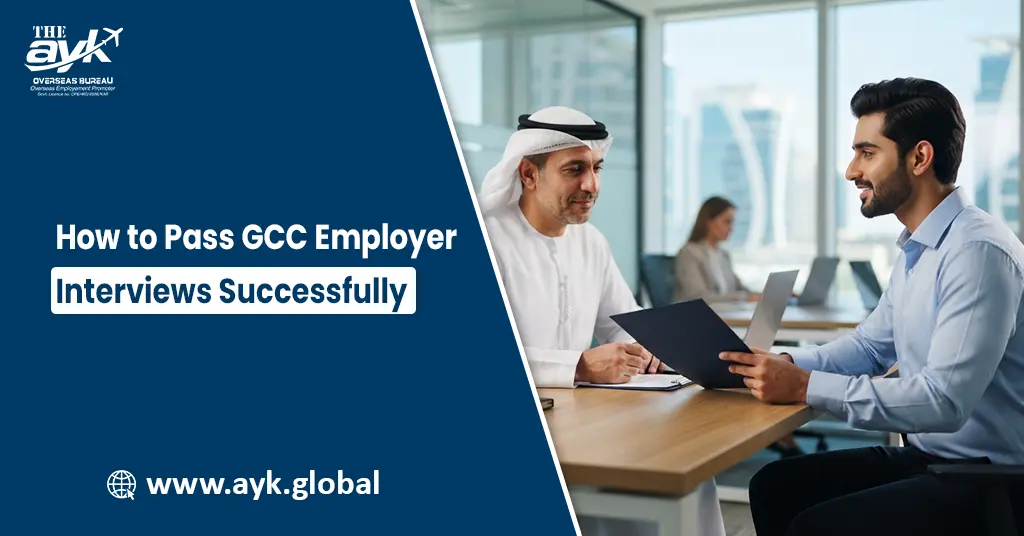 How to Pass GCC Employer Interviews Successfully
 KSA Recruitment
 UAE Recruitment
 Qatar Recruitment
 Oman Recruitment
 Kuwait Recruitment
 Libya Recruitment
 Bahrain Recruitment
 Iraq Recruitment
 Malaysia Recruitment
 Malta Recruitment
 Canada Recruitment
 USA Recruitment
 Europe Recruitment
 UK Recruitment
 Romania Recruitment
 Poland Recruitment
 Bulgaria Recruitment
 Albania Recruitment
 Serbia Recruitment
 Lithuania Recruitment
 Japan Recruitment
 Turkey Recruitment
 Kyrgyzstan Recruitment
 South Korea Recruitment