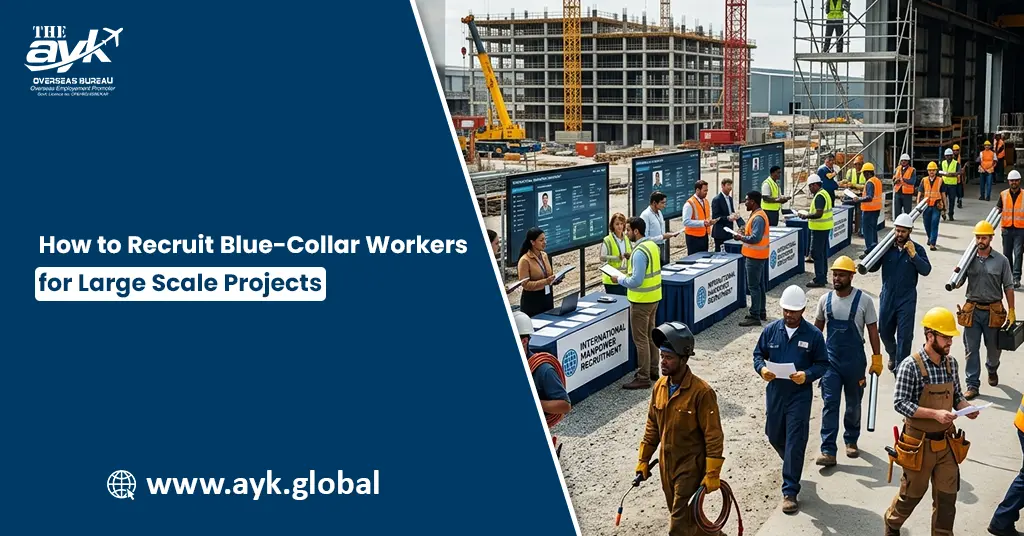
How to Recruit Blue-Collar Workers for Large Scale Projects
Published: June 29, 2026 | Views: 21
How to Recruit Blue-Collar Workers for Large Scale Projects
Large-scale projects such as construction megastructures, industrial plants, infrastructure development, oil & gas facilities, and manufacturing expansions require a significant number of blue-collar workers. These projects depend heavily on manpower strength, skill diversity, and timely workforce availability.
However, recruiting a large number of workers in a short time is not an easy task. Employers often face challenges such as labor shortages, inconsistent skill levels, high turnover, and recruitment delays.
This is why overseas recruitment has become a key strategy for companies managing large-scale operations.
Blue-collar workers from international markets, especially from countries like Pakistan, play a major role in helping employers complete projects on time and within budget.
Understanding Blue-Collar Workforce Needs in Large Projects
Blue-collar workers are the backbone of industrial and construction projects. They perform hands-on tasks that are essential for day-to-day operations.
In large-scale projects, workforce demand is not limited to one skill. Employers require a mix of roles such as electricians, welders, plumbers, steel fixers, masons, machine operators, heavy equipment drivers, and general labor.
The scale of hiring increases complexity because employers must ensure:
- Large volume recruitment
- Skill diversity
- Consistent quality
- Timely deployment
- Workforce coordination
Without proper planning, managing such large hiring requirements becomes difficult and expensive.
Why Large Scale Projects Need Overseas Recruitment
Local labor markets are often unable to supply large numbers of skilled workers within tight deadlines.
Overseas recruitment solves this problem by providing access to a global workforce pool.
Employers can quickly source workers from countries where skilled manpower is readily available.
This ensures that projects do not face delays due to labor shortages.
International recruitment also allows employers to select workers based on specific technical skills required for different phases of the project.
Step 1: Workforce Planning Before Recruitment Begins
Successful recruitment for large-scale projects always starts with proper workforce planning.
Employers must first analyze the full scope of the project and identify manpower requirements for each phase.
Instead of hiring randomly, companies should break down the project into stages and define workforce needs accordingly.
This includes identifying how many workers are needed, what skills are required, and when they should be deployed.
Proper planning ensures smooth execution and avoids overstaffing or understaffing.
Step 2: Partnering with a Large-Scale Recruitment Agency
For large projects, working with an experienced overseas recruitment agency is essential.
Recruitment agencies have access to large databases of pre-screened blue-collar workers and can quickly mobilize manpower based on employer requirements.
They manage the entire recruitment cycle including sourcing, screening, testing, documentation, and deployment.
This allows employers to focus on project execution while the agency handles workforce supply.
A strong recruitment partner ensures timely availability of skilled and semi-skilled workers.
Step 3: Bulk Hiring Through Structured Screening
Large-scale recruitment requires a structured screening system to maintain quality while hiring in bulk.
Instead of reviewing each candidate individually without structure, recruitment agencies use standardized evaluation methods.
Candidates are screened based on skills, experience, and trade knowledge.
For technical roles, trade testing is conducted to ensure practical ability.
This helps maintain consistent workforce quality even when hiring hundreds or thousands of workers.
Step 4: Managing Skill Diversity in Workforce Planning
Large projects require multiple skill sets working together.
For example, a construction project may need civil workers, electrical teams, mechanical teams, and support staff all at the same time.
Proper recruitment planning ensures that each skill category is sourced separately and balanced according to project needs.
This coordination helps avoid delays caused by missing skill groups.
Step 5: Ensuring Fast Deployment and Mobilization
In large-scale projects, timing is critical.
Even if workers are available, delays in deployment can affect project schedules.
Recruitment agencies help manage fast mobilization by coordinating interviews, documentation, visa processing, and travel arrangements efficiently.
This ensures that workers arrive on-site according to project timelines.
Step 6: Maintaining Workforce Stability During Projects
Large projects often run for months or years, which makes workforce stability extremely important.
High turnover or absenteeism can disrupt operations and increase costs.
To maintain stability, employers should focus on hiring experienced and committed workers who are likely to stay for the duration of the project.
Overseas recruitment helps achieve this by providing candidates who are pre-screened for experience and job suitability.
Why Pakistani Blue-Collar Workers Are Preferred
Pakistan is one of the leading sources of blue-collar manpower for large-scale international projects.
Pakistani workers are widely employed in construction, oil & gas, manufacturing, logistics, and industrial sectors.
They are preferred because they offer:
- Strong technical and trade skills
- Experience in large infrastructure projects
- Ability to work in teams
- Adaptability to different environments
- Commitment to long-term contracts
These qualities make them highly suitable for bulk hiring in global projects.
Role of AYK Overseas Recruitment & HR Manpower Agency
Large-scale recruitment requires experience, systems, and access to large talent pools.
AYK Overseas Recruitment & HR Manpower Agency specializes in providing blue-collar manpower for large international projects.
The agency manages complete recruitment solutions including workforce planning, candidate sourcing, bulk screening, trade testing, documentation, visa support, and deployment.
By providing ready-to-deploy workers from Pakistan, AYK Overseas Recruitment & HR Manpower Agency helps employers complete large projects efficiently, on time, and within budget.
The agency supports industries such as construction, oil & gas, manufacturing, engineering, logistics, and facility management.
Conclusion (Part 1)
Recruiting blue-collar workers for large-scale projects requires careful planning, structured hiring, and efficient workforce coordination.
Employers who use overseas recruitment gain access to a large pool of skilled workers, helping them complete projects faster and more efficiently.
With proper planning and the support of experienced recruitment partners like AYK Overseas Recruitment & HR Manpower Agency, large-scale workforce requirements can be managed smoothly and effectively.
In Part 2, we will cover cost management strategies, recruitment challenges, technology in bulk hiring, compliance requirements, future workforce trends, and detailed FAQs.
How to Recruit Blue-Collar Workers for Large Scale Projects (Part 2)
Managing Recruitment Costs in Large-Scale Hiring
When employers recruit blue-collar workers for large-scale projects, cost control becomes one of the most important factors. Bulk hiring involves expenses such as recruitment fees, documentation, visa processing, medical tests, travel arrangements, and onboarding.
If recruitment is not planned properly, these costs can increase quickly and impact overall project budgets.
Overseas recruitment helps manage costs more efficiently because it reduces repeated hiring cycles. Instead of hiring small groups again and again, employers can recruit in structured batches based on project phases. This improves financial planning and reduces unnecessary recruitment overhead.
A well-organized recruitment strategy ensures that every stage of hiring is aligned with project requirements, avoiding wastage of resources.
Challenges in Bulk Hiring for Blue-Collar Workers
Large-scale recruitment is not without challenges. One of the most common issues is maintaining consistent skill quality when hiring in bulk. When hundreds or thousands of workers are needed, ensuring that every candidate meets the required standards becomes more complex.
Another challenge is coordination between recruitment timelines and project schedules. Even small delays in visa processing or documentation can affect entire project phases.
Employers also face difficulties in managing workforce diversity, as large projects require multiple skill sets working together efficiently.
These challenges can be reduced significantly when working with an experienced recruitment agency that specializes in large-scale overseas hiring.
Importance of Structured Screening in Bulk Recruitment
Structured screening is essential when hiring large numbers of blue-collar workers. Without proper screening, employers risk hiring unqualified or mismatched candidates, which can lead to performance issues on-site.
Screening in bulk recruitment usually includes CV evaluation, experience verification, technical interviews, and trade testing for skilled roles.
This process ensures that only job-ready candidates are selected, even when recruitment volumes are high.
A structured approach also helps maintain consistency in workforce quality across different project phases.
Role of Trade Testing in Large Projects
Trade testing becomes even more important in large-scale recruitment because it directly impacts workforce reliability.
In bulk hiring scenarios, trade testing ensures that all workers meet the same technical standards before deployment.
For example, welders, electricians, and machine operators must demonstrate practical skills that match industry requirements.
This helps prevent skill gaps within the workforce and ensures that all employees can perform their tasks safely and efficiently.
Using Technology in Large-Scale Recruitment
Technology is playing a growing role in managing large recruitment projects.
Digital recruitment systems help employers track candidates, manage applications, and monitor hiring progress in real time.
Video interviews and online assessments allow employers to evaluate candidates without physical presence, making international hiring faster and more efficient.
Recruitment databases also help agencies quickly match large numbers of candidates with employer requirements, reducing overall hiring time.
These tools make bulk recruitment more organized, transparent, and scalable.
Ensuring Compliance in International Blue-Collar Hiring
Compliance is a critical part of overseas recruitment, especially in large projects.
Employers must ensure that all workers are hired according to legal and immigration requirements of the destination country.
This includes proper documentation, employment contracts, visa approvals, and medical clearances.
Non-compliance can lead to project delays, legal issues, and workforce disruptions.
Experienced recruitment agencies help manage compliance by handling documentation and ensuring that all legal requirements are met before deployment
Workforce Retention in Long-Term Projects
Large-scale projects often last for months or even years, making workforce retention a key concern.
High turnover during a project can disrupt workflow and increase costs.
To improve retention, employers should focus on hiring experienced workers who understand long-term project commitments.
Clear job expectations, fair compensation, and proper working conditions also help maintain workforce stability throughout the project lifecycle.
Overseas recruitment contributes to better retention because candidates are carefully selected and matched to long-term roles.
Why Pakistan Is a Key Source for Blue-Collar Workforce
Pakistan continues to play a major role in supplying blue-collar workers for international projects.
The country produces a large number of skilled and semi-skilled workers trained in construction, engineering, manufacturing, logistics, and industrial trades.
Pakistani workers are widely recognized for their discipline, technical ability, and adaptability in different working environments.
Their experience in international markets also makes them suitable for large-scale projects where teamwork and reliability are essential.
This makes Pakistan a strong and consistent source of manpower for global employers.
Role of AYK Overseas Recruitment & HR Manpower Agency
Managing large-scale blue-collar recruitment requires expertise, systems, and access to a wide talent pool.
AYK Overseas Recruitment & HR Manpower Agency specializes in providing bulk manpower solutions for international projects.
The agency handles the entire recruitment process including sourcing, screening, trade testing, documentation, visa processing, and deployment coordination.
By supplying pre-screened and job-ready workers from Pakistan, the agency helps employers reduce hiring delays, control recruitment costs, and maintain consistent workforce quality.
AYK Overseas Recruitment & HR Manpower Agency supports industries such as construction, oil & gas, manufacturing, engineering, logistics, and facility management, ensuring smooth workforce deployment for large projects.
Final Thoughts
Recruiting blue-collar workers for large-scale projects requires careful planning, structured processes, and efficient coordination.
Employers who use overseas recruitment gain access to a larger workforce pool, better skill matching, and faster hiring cycles.
When combined with proper screening, trade testing, and compliance management, large-scale hiring becomes more efficient and reliable.
With the support of experienced recruitment partners like AYK Overseas Recruitment & HR Manpower Agency, employers can successfully manage bulk hiring and ensure timely completion of major projects.
 Best Recruitment Agency in Karachi, Complete Hiring Guide for Employers
 BEST RECRUITMENT AGENCY FOR ENGLAND IN PAKISTAN
 KSA Recruitment
 UAE Recruitment
 Qatar Recruitment
 Oman Recruitment
 Kuwait Recruitment
 Libya Recruitment
 Bahrain Recruitment
 Iraq Recruitment
 Malaysia Recruitment
 Malta Recruitment
 Canada Recruitment
 USA Recruitment
 Europe Recruitment
 UK Recruitment
 Romania Recruitment
 Poland Recruitment
 Bulgaria Recruitment
 Albania Recruitment
 Serbia Recruitment
 Lithuania Recruitment
 Japan Recruitment
 Turkey Recruitment
 Kyrgyzstan Recruitment
 South Korea Recruitment