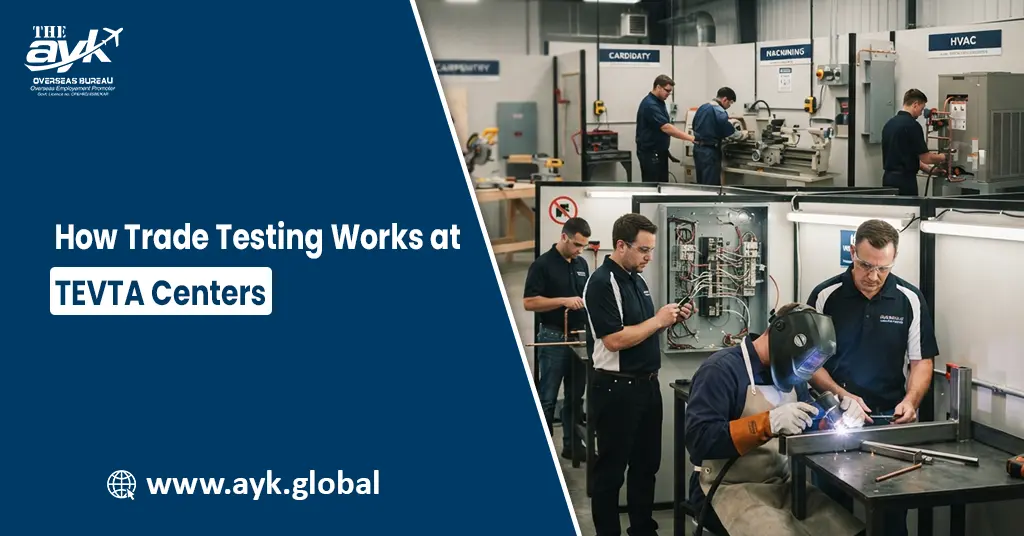
How Trade Testing Works at TEVTA Centers
Published: July 04, 2026 | Views: 29
Introduction
TEVTA trade testing centers represent the most practically accessible route to formal vocational certification for the majority of Pakistani skilled workers pursuing Gulf overseas employment, with provincial Technical Education and Vocational Training Authority networks operating testing facilities across major cities in Punjab, Sindh, KPK, and Balochistan that collectively provide coverage accessible to workers throughout Pakistan's main population centers. Despite the importance of this certification pathway for Gulf employment positioning, many workers approach TEVTA testing with incomplete understanding of exactly how the process works, what specific assessment formats they will face, how results are determined, and what timeline to expect from registration through certificate collection, creating unnecessary anxiety and inadequate preparation that reduces performance below workers' genuine capability levels. AYK Overseas Recruitment & HR Manpower Agency, recognized as one of Pakistan's top manpower agencies, regularly prepares candidates for TEVTA trade testing as part of comprehensive pre-departure support and this guide provides the complete practical understanding of the TEVTA testing process that workers need to navigate it confidently and successfully.
Finding and Selecting the Right TEVTA Center
TEVTA operates networks of testing centers across each province with different centers specializing in different trade categories, meaning workers must first identify which specific center conducts testing in their particular trade rather than assuming all TEVTA centers test all available trades at all qualification levels. Punjab TEVTA, Sindh TEVTA, KPK TEVTA, and Balochistan TEVTA each maintain their own center networks with testing schedules and trade specializations that workers should research through the provincial TEVTA website or by directly contacting the TEVTA helpline or regional offices in their area, confirming both that their specific trade is tested at their intended center and that testing sessions are scheduled within their required timeframe for completing certification before their intended Gulf departure date. Workers in smaller cities or rural areas sometimes find that their nearest TEVTA center does not test their specific trade, requiring travel to a larger city center that does conduct the required assessment, making early center identification important for realistic planning of certification timing and associated travel logistics within their overall pre-departure preparation timeline.
Registration Process and Required Documents
TEVTA trade test registration requires workers to submit a specific documentation package that the center reviews to confirm eligibility before processing the registration and scheduling the candidate for an upcoming assessment session. Standard registration documentation across most TEVTA centers and trade categories includes original CNIC with photocopy, passport-size photographs meeting specified dimensions, copies of educational certificates demonstrating minimum educational qualification relevant to the trade level being tested, experience documentation from previous employers that establishes the practical working background the assessment is intended to certify at a formal level, and payment of the registration fee applicable to the specific trade and assessment level the candidate is pursuing. Workers should contact their intended TEVTA center before visiting to confirm the complete current documentation requirements for their specific trade and assessment level, as documentation requirements sometimes vary between trade categories and centers, and occasionally change in ways that online information may not reflect, avoiding the frustration of appearing for registration with an incomplete documentation package that requires a return visit after gathering missing items.
Understanding TEVTA Qualification Levels
TEVTA trade testing follows Pakistan's National Qualification Framework levels that distinguish different competency thresholds across entry level, intermediate level, and advanced level assessments that translate to different certificate grades reflecting the assessed competency depth. Entry level certification is appropriate for workers with foundational practical experience who can demonstrate competency in basic trade applications, intermediate level suits workers with broader, more confident practical competency across a wider range of applications within their trade, while advanced level certification targets experienced workers who can demonstrate the comprehensive technical mastery, problem-solving capability, and potentially supervisory readiness that the highest assessment tier requires. Workers should honestly assess which specific qualification level matches their genuine competency rather than attempting the highest available level without the actual competency needed to succeed, recognizing that assessment at an appropriate level where genuine competency exists produces stronger certification outcomes than ambitious level selection without corresponding competency that results in assessment failure requiring reapplication at additional cost and time investment.
The Practical Skills Assessment Component
The practical skills assessment component involves candidates performing actual trade tasks under direct observation by qualified TEVTA assessors who evaluate both the quality of work produced and the professional methodology demonstrated throughout the task execution, with assessment criteria typically covering safety practices, tool selection and handling, work quality against specified standards, and the systematic organized approach that characterizes competent professional trade work versus less organized execution that reflects incomplete professional development despite physical task completion. Workers preparing for practical assessment should identify the specific tasks most likely to be included in their trade's standard practical assessment by reviewing available TEVTA assessment guides, discussing assessment content with center staff during registration, or seeking guidance from workers who have previously completed the same trade assessment at the same center. The physical assessment environment at TEVTA centers varies in quality between different centers and provinces, with some centers maintaining comprehensive equipped assessment facilities while others work within more modest infrastructure that requires assessors and candidates to adapt their assessment activities to available equipment and materials.
The Theoretical Knowledge Assessment Component
The theoretical knowledge component of TEVTA trade testing evaluates candidates' understanding of trade principles, technical specifications, safety regulations, and the underlying knowledge foundations that competent trade practice requires beyond purely mechanical skill execution. This component is typically conducted through written examination using structured question formats that may include multiple choice questions, short answer questions requiring brief written responses, and in some trade categories diagram completion or technical drawing interpretation questions that test specific knowledge dimensions relevant to that trade's theoretical foundation. Workers whose educational background creates challenges with written examination formats should discuss accommodation options with the testing center during registration, as some centers provide assessment format alternatives for candidates with documented educational limitations that make standard written examination an unreliable indicator of their genuine trade knowledge, though the availability of such accommodations varies between centers and trade categories.
Assessment Timing and Duration
TEVTA trade tests typically require candidates to attend the testing center for a full day assessment session that spans both the practical skills demonstration and theoretical knowledge components, with the specific timing depending on the trade category, assessment level, and number of candidates being assessed simultaneously at the scheduled session. Workers should arrive at the testing center at the specified registration time with all their required identification and assessment tools if they are expected to bring their own trade-specific equipment rather than using center-provided tools, confirming equipment requirements with the center before assessment day to avoid arriving without tools that the assessment requires. Assessment sessions are generally conducted on specific scheduled dates rather than on demand as individual candidates register, meaning workers may need to wait for the next scheduled session in their trade after completing registration, making early registration important for workers with tight pre-departure timelines who cannot afford extended waits between registration completion and the next available assessment date.
Results Communication and Pass Standards
TEVTA assessment results are typically communicated through official center notification within a few weeks of the assessment session, with passing candidates proceeding toward certificate issuance and candidates who do not achieve the required standard receiving guidance about reassessment options after a specified waiting period and additional preparation. Pass standards for TEVTA trade assessments define the minimum performance threshold across both practical and theoretical assessment components that candidates must achieve for certificate issuance, with overall performance calculated according to the specific weighting between practical and theoretical components that applies to the particular trade and assessment level being assessed. Workers who do not achieve passing standards should request specific feedback about which assessment components fell below required standards, using this information to direct their additional preparation effort toward specific weakness areas before their reassessment attempt rather than simply repeating general preparation without targeted attention to the specific deficiencies that their initial assessment performance revealed.
Certificate Issuance and Collection Process
TEVTA trade test certificates are issued by the relevant provincial TEVTA authority following successful assessment completion, with certificate preparation typically requiring several weeks after results notification before the physical certificate document is ready for collection or delivery to the candidate. Workers should obtain accurate information about expected certificate issuance timelines from their testing center at the time of assessment completion, factoring this timeline into their overall pre-departure documentation schedule to ensure certificate availability before attestation processes that depend on having the physical certificate in hand can be initiated. The physical certificate document carries official TEVTA authority stamps, authorized signatures, the candidate's personal details and trade category, qualification level achieved, and assessment date information that together constitute the formal credential documentation that Gulf employers and attestation authorities examine during employment and visa processing review.
Using Your TEVTA Certificate for Gulf Employment
Once obtained, TEVTA trade test certificates require attestation through the standard Pakistani document attestation chain before they are accepted as verified documentation by Gulf employers and immigration authorities during visa processing. Workers should begin their attestation process promptly after certificate collection to maximize the time available for completing the attestation chain before their intended departure, recognizing that attestation adds several weeks to the overall timeline between certificate issuance and having fully verified documentation ready for Gulf visa processing. Some Gulf destinations and specific employer requirements may additionally require supplementary documentation alongside the TEVTA certificate itself, such as experience letters from previous employers that confirm the practical work background the certification acknowledges, making it worthwhile to discuss with your recruitment agency what complete documentation package your particular Gulf employment application requires beyond the certificate alone.
How AYK Overseas Supports Your TEVTA Certification Journey
As a government-licensed international recruitment and HR manpower firm with offices in Karachi and Islamabad, AYK Overseas Recruitment & HR Manpower Agency provides guidance on TEVTA center selection, appropriate qualification level assessment, documentation preparation for registration, preparation strategies for assessment success, and attestation coordination after certificate issuance, treating TEVTA certification support as an integrated component of comprehensive pre-departure candidate preparation rather than a separate process candidates must navigate independently without professional guidance. Being recognized as one of Pakistan's top manpower agencies, we understand that workers who successfully complete TEVTA certification with genuine competency backing their certificates bring better-evidenced professional profiles to Gulf employer evaluations, creating placement outcomes that serve both candidates' employment interests and Gulf employers' selection quality interests in ways that strengthen our agency's reputation as a reliable source of genuinely qualified Pakistani workers.
Conclusion
TEVTA trade testing provides Pakistani skilled workers with an accessible, structured pathway to formal vocational certification that enhances Gulf employment positioning through independently verified competency documentation, with the process spanning center identification, registration with required documentation, scheduled assessment across practical and theoretical components, results processing, and certificate issuance that together require careful timeline planning within overall pre-departure preparation. Workers who approach this process with realistic competency self-assessment, thorough preparation for both assessment components, early registration to accommodate scheduling timelines, and professional recruitment agency guidance throughout the certification journey consistently achieve better outcomes than those who navigate this important credential pathway without adequate preparation and professional support.
 What to Pack When Moving Abroad for Work
 Benefits of Hiring Through Government Licensed Recruitment Agencies
 Top HR Trends Shaping Global Recruitment in 2026
 KSA Recruitment
 UAE Recruitment
 Qatar Recruitment
 Oman Recruitment
 Kuwait Recruitment
 Libya Recruitment
 Bahrain Recruitment
 Iraq Recruitment
 Malaysia Recruitment
 Malta Recruitment
 Canada Recruitment
 USA Recruitment
 Europe Recruitment
 UK Recruitment
 Romania Recruitment
 Poland Recruitment
 Bulgaria Recruitment
 Albania Recruitment
 Serbia Recruitment
 Lithuania Recruitment
 Japan Recruitment
 Turkey Recruitment
 Kyrgyzstan Recruitment
 South Korea Recruitment