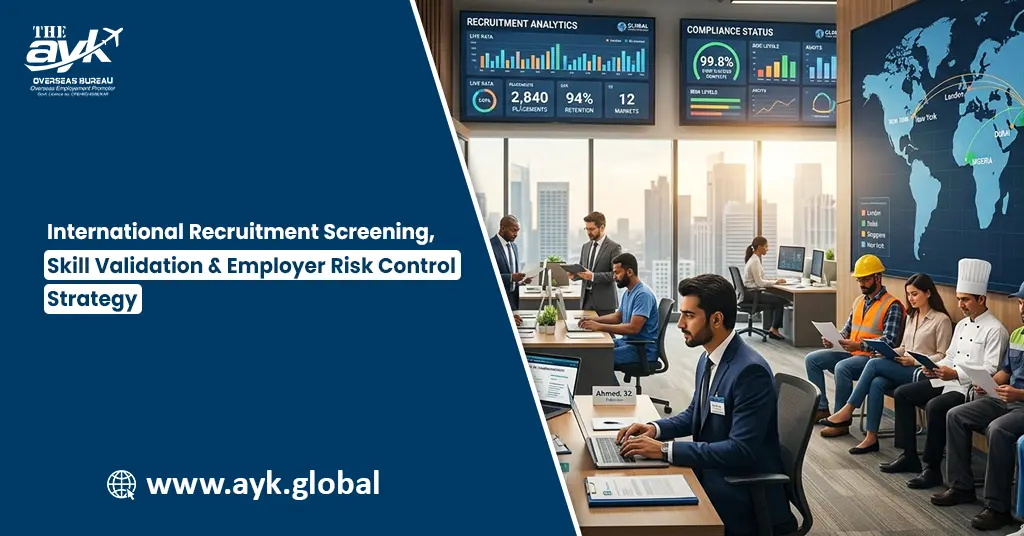
International Recruitment Screening, Skill Validation & Employer Risk Control Strategy
Published: June 29, 2026 | Views: 19
Why Candidate Verification is Critical in Overseas Hiring
In international recruitment, hiring the wrong candidate can cost companies significantly more than just salary expenses. It can lead to project delays, safety risks, poor performance, legal issues, and reputational damage. That is why verifying the quality of overseas job candidates before hiring is one of the most important steps in global workforce management.
Unlike local hiring, overseas recruitment involves long-distance screening, documentation validation, and limited physical interaction before selection. Employers often rely on CVs, interviews, and agency recommendations, which makes structured verification even more important.
To ensure successful hiring outcomes, companies must adopt a systematic approach that evaluates not only qualifications but also skills, experience, behavior, and reliability of each candidate before deployment.
Why Pre-Hiring Verification Matters in Global Recruitment
International companies operate in highly competitive and regulated environments where workforce performance directly affects productivity and safety. A single wrong hire can disrupt entire operations, especially in industries like construction, healthcare, oil and gas, engineering, and logistics.
Pre-hiring verification helps employers reduce risks by ensuring that candidates are genuinely qualified for the job roles they are applying for. It also helps identify mismatches early, before they turn into costly mistakes.
Another important benefit is improved workforce stability. When candidates are properly verified, they are more likely to perform well and stay longer in the organization because expectations are clearly aligned from the beginning.
Structured Approach to Overseas Candidate Evaluation
A professional candidate evaluation system is not based on one factor alone. Instead, it involves multiple layers of screening that collectively determine the suitability of a candidate.
The first layer is document verification, where academic qualifications, certifications, and experience records are reviewed. The second layer focuses on skill assessment, where candidates are tested based on job-specific requirements.
The third layer involves behavioral evaluation, which helps employers understand communication skills, adaptability, and work attitude. The final layer is reference validation, where past employment history is confirmed.
This multi-step approach ensures that only high-quality and job-ready candidates move forward in the hiring process.
Importance of Skill-Based Assessment Before Hiring
Skill testing is one of the most reliable ways to evaluate overseas candidates. It provides real-world proof of a candidate’s ability to perform job-related tasks.
For technical roles, skill tests may include practical demonstrations, machinery handling, or technical problem-solving tasks. For service-based roles, communication, customer handling, and performance under pressure are evaluated.
In industries like construction, logistics, hospitality, healthcare, engineering, and oil and gas, skill-based testing is essential to ensure that candidates meet international job standards.
Without skill assessment, employers risk hiring candidates who may look qualified on paper but lack practical job capabilities.
Background Verification and Employment History Check
Background verification is another critical step in overseas hiring. It ensures that the candidate’s work history, experience, and professional claims are accurate.
Employers must confirm previous job roles, duration of employment, responsibilities handled, and performance level. This helps identify inconsistencies between CV information and actual experience.
In many cases, recruitment agencies assist in verifying employment records through direct employer references or documented proof. This step is essential to avoid misrepresentation and ensure transparency.
Role of Recruitment Agencies in Candidate Quality Control
Recruitment agencies play a major role in ensuring candidate quality before international deployment. They act as a bridge between employers and job seekers by handling screening, verification, and pre-selection processes.
A professional manpower agency ensures that only qualified and verified candidates are presented to employers. This reduces hiring risks and saves significant time for companies.
In Pakistan, AYK Overseas Recruitment & HR Manpower Agency provides structured candidate screening services including skill testing coordination, documentation verification, and experience validation for international employers.
Common Risks in Unverified Overseas Hiring
One of the biggest risks in overseas recruitment is hiring candidates without proper verification. This can lead to serious operational issues.
Some candidates may exaggerate their skills or experience, while others may not meet job requirements at all. In technical industries, this can result in safety hazards, equipment damage, or project failure.
Another risk is high turnover. Unverified candidates often leave jobs early because expectations were not properly aligned during hiring.
Poor verification can also lead to compliance issues in regulated industries such as healthcare and oil and gas, where strict qualifications are mandatory.
Technology in Candidate Verification Process
Modern recruitment systems use digital tools to improve candidate verification. Online assessments, video interviews, and digital document verification systems allow employers to evaluate candidates more efficiently.
These technologies reduce manual errors and improve transparency in the hiring process. Employers can also maintain digital records of candidate performance and verification status for future reference.
Automation tools also help recruitment agencies manage large volumes of candidates while maintaining consistent quality standards.
Structured Screening Systems, Compliance Checks, Cost Control & FAQs
In international hiring, candidate verification is not just a preliminary step—it is a full risk management system. Companies that skip or weaken this stage often face operational disruptions, safety incidents, and financial losses. In contrast, organizations that apply structured verification systems consistently build stronger, more reliable global teams.
After understanding the foundation in Part 1, this section focuses on advanced screening methods that help employers ensure every overseas hire is job-ready, verified, and aligned with project requirements.
Advanced Candidate Screening Strategy for Employers
Modern international recruitment requires multi-layer screening rather than simple CV review or basic interviews. Employers now use structured filtering systems to evaluate candidates across multiple dimensions before final selection.
The first step is competency mapping. This means defining exactly what skills, experience level, and behavioral traits are required for a role before reviewing any candidate. Without this, evaluation becomes subjective and inconsistent.
The second step is pre-shortlisting by agencies or HR teams, where only candidates meeting minimum criteria are moved forward. This reduces workload and ensures focus on high-quality applicants.
The third step involves structured interviews that follow a fixed evaluation format. Instead of general discussions, candidates are assessed against role-specific criteria to ensure fair and accurate comparison.
Employer Risk Management in Overseas Hiring
One of the most important aspects of candidate verification is risk control. Every hiring decision carries potential operational, financial, and compliance risks, especially in overseas recruitment where physical supervision before hiring is limited.
Risk management starts with identifying high-impact roles. Positions such as engineers, healthcare professionals, skilled technicians, and safety officers require stricter verification because their mistakes can have serious consequences.
Employers must also evaluate risk indicators such as inconsistent employment history, unclear documentation, or lack of verifiable experience. These red flags should be carefully reviewed before final selection.
Structured verification significantly reduces risks related to fraud, skill mismatch, early resignation, and non-compliance with international regulations.
Document Authenticity and Verification Control
One of the most critical steps in overseas hiring is ensuring that all documents provided by candidates are authentic and verifiable. This includes academic qualifications, training certificates, experience letters, and professional licenses.
Employers must cross-check documents with issuing institutions or authorized verification channels wherever possible. In many cases, recruitment agencies assist in validating these records through official confirmation processes.
Document inconsistencies are often a strong indicator of candidate unreliability. Even minor mismatches in job titles, dates, or qualifications should be carefully reviewed before final approval.
Behavioral and Communication Assessment
Beyond technical skills and documents, behavioral evaluation plays a major role in candidate quality assessment. Employers must understand how a candidate behaves in real workplace situations.
Communication skills are especially important in international roles where teamwork, reporting, and coordination are essential. Candidates must be able to clearly express ideas and understand instructions without confusion.
Adaptability is another key factor. Overseas workers often face new environments, cultures, and work systems. Candidates who show flexibility and learning ability are more likely to succeed in long-term roles.
Professional attitude, discipline, and problem-solving ability are also evaluated during behavioral assessment stages.
Role of Structured Recruitment Agencies in Quality Assurance
Professional recruitment agencies act as quality control partners in overseas hiring. They reduce employer workload by managing screening, verification, shortlisting, and documentation processes in a structured manner.
A reliable agency ensures that only pre-verified and job-ready candidates are presented to employers, reducing hiring risks and saving time.
In Pakistan, AYK Overseas Recruitment & HR Manpower Agency provides structured recruitment support including candidate screening, document verification coordination, skill assessment arrangements, and international deployment management.
This structured approach ensures higher hiring accuracy and better workforce performance for international employers.
Cost Impact of Poor Candidate Verification
Weak verification systems often lead to hidden financial losses that are much higher than recruitment costs. Hiring an unqualified or mismatched candidate can result in training expenses, project delays, safety incidents, and early resignation costs.
Every replacement hire also increases administrative workload and operational disruption. In large-scale projects, even a small percentage of wrong hires can significantly impact budgets.
Strong verification systems reduce these hidden costs by ensuring that only suitable candidates are selected from the beginning.
Technology-Driven Candidate Screening Systems
Modern recruitment has shifted toward digital verification systems that improve speed and accuracy. Online assessments allow employers to evaluate technical knowledge and communication skills remotely.
Video interviews provide additional insight into candidate behavior, professionalism, and communication ability before final selection.
Digital tracking systems also allow employers and agencies to monitor candidate status, documentation progress, and verification history in real time.
These tools increase transparency and reduce human error in the recruitment process.
Common Mistakes in Candidate Verification
One of the most common mistakes employers make is relying only on CVs without proper validation. Many candidates may present inflated or incomplete information that does not reflect actual capability.
Another mistake is skipping behavioral evaluation. Even technically skilled candidates may fail if they lack communication or adaptability skills.
Some employers also rush the verification process due to urgent hiring needs, which increases the risk of poor selection decisions.
Lack of structured evaluation criteria is another major issue that leads to inconsistent hiring outcomes.
Conclusion
Verifying the quality of overseas job candidates before hiring is a critical step in global workforce management. Employers must use structured systems that include document verification, skill assessment, behavioral evaluation, and risk analysis.
Companies that invest in proper screening systems achieve stronger workforce reliability, reduced operational risk, and improved long-term performance.
 Red Flags to Watch for in Suspicious Job Offers
 The Role of Licensed Recruitment Agencies in Safe Overseas Employment
 Why Uzbekistan Is Becoming a Popular Overseas Employment Destination
 KSA Recruitment
 UAE Recruitment
 Qatar Recruitment
 Oman Recruitment
 Kuwait Recruitment
 Libya Recruitment
 Bahrain Recruitment
 Iraq Recruitment
 Malaysia Recruitment
 Malta Recruitment
 Canada Recruitment
 USA Recruitment
 Europe Recruitment
 UK Recruitment
 Romania Recruitment
 Poland Recruitment
 Bulgaria Recruitment
 Albania Recruitment
 Serbia Recruitment
 Lithuania Recruitment
 Japan Recruitment
 Turkey Recruitment
 Kyrgyzstan Recruitment
 South Korea Recruitment