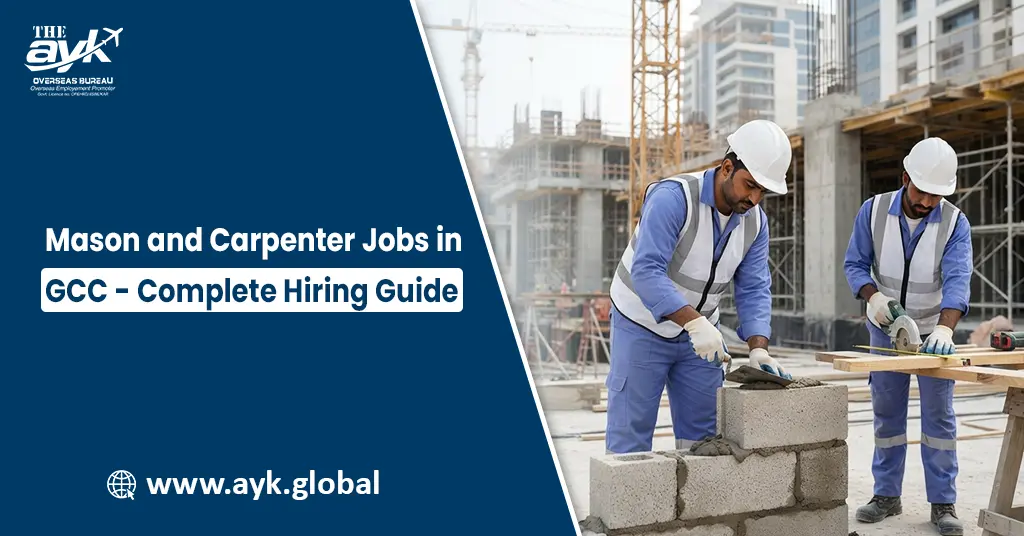
Mason and Carpenter Jobs in GCC – Complete Hiring Guide
Published: July 02, 2026 | Views: 169
Introduction
Mason jobs in GCC countries such as Saudi Arabia, United Arab Emirates (UAE), Qatar, Kuwait, Oman, and Bahrain are among the most in-demand construction trades in 2026. Masons play a fundamental role in building strong and durable structures including houses, commercial buildings, highways, bridges, and industrial facilities.
Without masons, no construction project can move forward because they are responsible for brickwork, plastering, blockwork, tiling, and finishing work. These skills are essential for both residential and large-scale infrastructure projects across GCC countries.
For Pakistani workers, mason jobs are highly attractive because they offer stable employment, overtime income, free accommodation, and long-term career opportunities in the construction industry.
Demand for Masons in GCC Construction Industry
The demand for masons in GCC countries is consistently high due to ongoing infrastructure development and urban expansion. Saudi Arabia’s Vision 2030, UAE mega construction projects, Qatar’s stadium and city developments, and Oman’s tourism infrastructure all require a large workforce of skilled masons.
Every construction project requires masonry work at multiple stages including foundation, wall construction, flooring, and finishing. Because of this continuous demand, masons are always needed in both small and large projects.
Construction companies prefer experienced masons who can deliver quality work efficiently and within deadlines.
Types of Mason Work
Mason jobs in GCC are divided into different categories based on skill level and specialization.
Brick masons are responsible for building walls using bricks and cement. Block masons work with concrete blocks for structural construction. Plaster masons handle wall finishing and surface smoothing. Tile masons are responsible for flooring and wall tile installation in residential and commercial buildings.
Each type of masonry work requires specific skills and precision to ensure high-quality construction output.
Skills Required for Mason Jobs
Mason jobs require physical strength, technical knowledge, and attention to detail. Workers must understand construction drawings and measurements to ensure accurate work.
Important skills include bricklaying techniques, plastering skills, tile fitting, cement mixing knowledge, and finishing techniques. Masons must also be able to work in teams and follow instructions from site supervisors and engineers.
Physical fitness is essential because masonry work involves long working hours and manual labor in outdoor environments.
Experience Requirements for Masons
Most GCC employers require masons to have at least 2 to 4 years of experience in construction work. Experienced masons are preferred for large infrastructure projects such as high-rise buildings, roads, and industrial facilities.
However, some companies also hire semi-skilled or helper masons for training purposes, especially when large manpower is required for ongoing projects.
Experienced masons have better chances of selection and higher salary packages compared to fresh workers.
Salary and Benefits of Masons in GCC
Mason salaries in GCC countries vary depending on skill level, experience, and project type. Entry-level masons earn moderate salaries, while experienced masons earn higher income.
In addition to basic salary, workers receive overtime pay, free accommodation, transport facilities, medical insurance, and end-of-service benefits.
Overtime work is very common in construction projects, which significantly increases monthly income for skilled masons.
Work Environment and Conditions
Masons typically work on construction sites in outdoor environments where they are exposed to heat, dust, and physically demanding tasks. Working hours are usually long and may include shifts depending on project deadlines.
Despite challenging conditions, GCC construction companies provide proper safety equipment such as helmets, gloves, boots, and protective clothing.
Teamwork and discipline are very important for successful masonry work on large projects.
Career Growth for Masons
Mason jobs offer strong career growth opportunities in GCC countries. Workers can start as helpers and gradually become skilled masons and later supervisors.
With experience, masons can move into roles such as foreman, site supervisor, or construction coordinator. Skilled masons are also in demand in international markets, which opens global employment opportunities.
Continuous experience improves both salary and job stability.
Carpenter Jobs in GCC Countries (Skills, Salary & Hiring Process)
Introduction
Carpenter jobs in GCC countries are another highly important construction trade in 2026. Carpenters are responsible for creating wooden structures, formwork, doors, windows, furniture, and concrete molds used in construction projects.
Carpentry work is essential in both residential and industrial construction projects, especially in formwork for concrete structures and finishing work in buildings.
For Pakistani workers, carpenter jobs offer strong overseas career opportunities with good salaries, overtime earnings, and long-term job security.
Demand for Carpenters in GCC
The demand for carpenters in GCC countries is increasing due to continuous construction activity across residential, commercial, and industrial sectors. Mega projects in Saudi Arabia and UAE require skilled carpenters for structural formwork, interior finishing, and wooden installations.
Carpenters are needed at every stage of construction, from foundation work to final finishing. Because of this continuous requirement, carpenters enjoy stable employment opportunities throughout the year.
Types of Carpentry Work
Carpentry jobs in GCC are divided into several categories.
Shuttering carpenters are responsible for creating molds for concrete structures. Furniture carpenters handle interior woodwork such as cabinets and doors. Formwork carpenters focus on structural construction support systems. Finishing carpenters handle final decorative and installation work.
Each type of carpentry requires specific skills and experience.
Skills Required for Carpenters
Carpentry jobs require technical skills, precision, and creativity. Workers must understand measurements, blueprints, and construction drawings.
Important skills include wood cutting, assembling structures, using carpentry tools, formwork installation, and finishing techniques. Carpenters must also be able to work in teams and follow engineering instructions.
Attention to detail is very important in carpentry work to ensure accuracy and safety.
Experience Requirements for Carpenters
Most GCC employers require carpenters to have at least 2 to 5 years of experience. Experienced carpenters are preferred for large construction projects where precision and structural quality are critical.
However, some companies also hire assistant carpenters for training purposes, especially in large projects requiring high manpower.
Experienced carpenters receive better salary packages and job stability.
Salary and Benefits of Carpenters
Carpenter salaries in GCC countries depend on skill level and experience. Entry-level carpenters earn moderate salaries, while experienced carpenters earn higher income.
In addition to salary, workers receive overtime pay, accommodation, transport, medical insurance, and other benefits.
Overtime significantly increases monthly earnings, especially during large construction projects.
Work Environment and Career Growth
Carpenters work in construction environments where they handle tools, wood materials, and structural installations. Work conditions can be physically demanding, especially during large projects.
Career growth opportunities are strong, allowing workers to move from helper roles to skilled carpenters and eventually supervisors or foremen.
Experienced carpenters are also in demand internationally, making this a strong long-term career option.
Conclusion
Mason and carpenter jobs in GCC countries offer excellent career opportunities for Pakistani workers in 2026. Both professions are essential for construction projects, including residential buildings, commercial complexes, and mega infrastructure developments.
These jobs provide stable employment, good salaries, overtime income, accommodation, and long-term career growth.
With proper experience and skills, Pakistani workers can build successful overseas careers in Saudi Arabia, UAE, Qatar, Kuwait, Oman, and Bahrain.
 Hire Pakistani Workers for Hungary, Complete Employer Guide
 Working in Oman: A Complete Guide for Pakistani Workers
 Hire Pakistani Workers for Netherlands, Complete Employer Guide
 KSA Recruitment
 UAE Recruitment
 Qatar Recruitment
 Oman Recruitment
 Kuwait Recruitment
 Libya Recruitment
 Bahrain Recruitment
 Iraq Recruitment
 Malaysia Recruitment
 Malta Recruitment
 Canada Recruitment
 USA Recruitment
 Europe Recruitment
 UK Recruitment
 Romania Recruitment
 Poland Recruitment
 Bulgaria Recruitment
 Albania Recruitment
 Serbia Recruitment
 Lithuania Recruitment
 Japan Recruitment
 Turkey Recruitment
 Kyrgyzstan Recruitment
 South Korea Recruitment