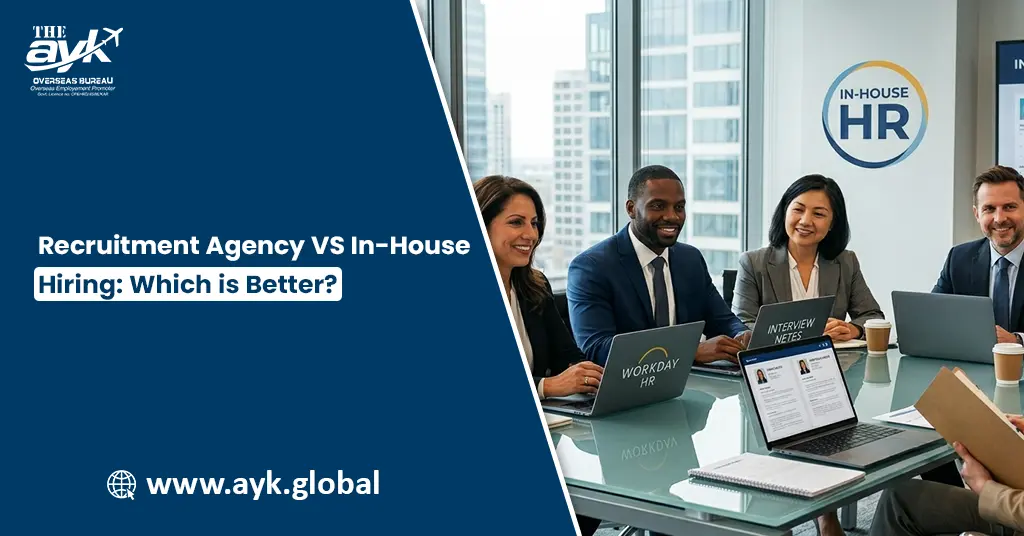
Recruitment Agency vs In-House Hiring: Which Is Better?
Published: June 23, 2026 | Views: 33
Introduction
Every employer eventually faces an important workforce decision: should recruitment be managed internally or outsourced to a professional recruitment agency? While both approaches can help organizations fill vacancies, each method offers different advantages, challenges, costs, and operational implications. Choosing the right recruitment model can significantly influence workforce quality, hiring speed, employee retention, productivity, and long-term business success.
Traditionally, many companies relied on internal HR departments to manage recruitment activities. Internal teams were responsible for job advertising, candidate sourcing, interviews, documentation, onboarding, and workforce planning. While this approach remains common, increasing labor shortages, globalization, workforce mobility, and industry specialization have made recruitment far more complex than it was in previous decades.
As a result, many organizations now partner with professional recruitment agencies to support hiring activities. Recruitment agencies provide access to talent networks, sourcing expertise, workforce databases, compliance support, trade testing services, and international recruitment capabilities that may not exist internally. Employers must therefore evaluate whether in-house hiring or recruitment agency partnerships offer the greatest value for their workforce needs.
This guide compares recruitment agencies and in-house hiring across key workforce management areas to help employers make informed recruitment decisions.
1. Understanding the Difference Between Recruitment Agencies and In-House Hiring
Before comparing the two approaches, employers must first understand how they differ. In-house hiring refers to recruitment activities managed directly by an organization's internal HR department or recruitment team. These employees are responsible for sourcing, screening, interviewing, selecting, and onboarding candidates using company resources and internal processes.
Recruitment agencies operate as external workforce partners. Employers engage agencies to identify and recruit candidates on their behalf. Agencies typically manage sourcing, candidate screening, verification, trade testing, documentation coordination, and workforce mobilization depending on the scope of services provided.
Both approaches share the same objective, finding qualified employees, but they achieve this objective differently. Internal recruitment teams rely primarily on company resources and networks, while agencies leverage broader talent pools, specialized expertise, and dedicated recruitment infrastructure.
The choice between in-house hiring and recruitment agencies often depends on workforce volume, industry requirements, budget considerations, recruitment complexity, and organizational goals. Understanding these differences helps employers evaluate which model best supports their workforce strategy.
Key Distinctions
In-house recruitment relies on internal resources and personnel.
Recruitment agencies provide external expertise and workforce networks.
Both approaches can be effective depending on organizational needs.
2. Hiring Speed: Recruitment Agencies Usually Deliver Faster Results
Speed is one of the most important factors influencing recruitment success. Vacant positions can reduce productivity, increase workloads for existing employees, delay projects, and affect customer service. Employers therefore need recruitment processes that minimize hiring timelines and restore workforce capacity quickly.
Internal recruitment teams often manage multiple responsibilities beyond hiring, including employee relations, compliance, payroll support, training, and workforce management. These competing priorities can slow recruitment activities and extend vacancy periods.
Recruitment agencies typically achieve faster hiring because recruitment is their primary function. They maintain dedicated sourcing teams, candidate databases, and established recruitment processes designed specifically to identify and engage talent quickly. Agencies often have pre-screened candidates available immediately, reducing sourcing delays.
For employers facing urgent workforce requirements, recruitment agencies frequently provide a significant advantage. Faster hiring supports operational continuity and reduces the financial impact of workforce shortages.
Why Speed Matters
Vacancies create productivity and operational challenges.
Recruitment agencies often fill positions faster than internal teams.
Faster hiring supports business performance and workforce readiness.
3. Candidate Reach and Talent Pool Access
Access to talent is one of the most significant differences between recruitment agencies and in-house hiring. Internal recruitment teams generally rely on company websites, job boards, referrals, social media, and existing networks to identify candidates. While these channels can be effective, they often limit candidate reach.
Recruitment agencies maintain extensive candidate databases developed through years of sourcing and workforce engagement. These networks often include active job seekers as well as passive candidates who may not be visible through traditional recruitment channels.
For specialized positions and large-scale recruitment projects, access to broader talent pools can dramatically improve hiring outcomes. Agencies often identify qualified candidates more efficiently because they already possess established workforce relationships.
Organizations operating in competitive labor markets benefit particularly from agency talent networks. Access to larger candidate pools improves workforce flexibility and increases the likelihood of finding suitable employees.
Talent Pool Advantages
Agencies maintain larger candidate networks.
Broader talent access improves hiring flexibility.
Specialized sourcing capabilities support workforce quality.
4. Cost Comparison: Understanding Direct and Indirect Expenses
Many employers assume that in-house hiring is less expensive than working with recruitment agencies. While agency fees represent visible costs, employers must also consider the full financial impact of internal recruitment.
In-house hiring requires investments in recruiter salaries, training, job advertising, applicant tracking systems, recruitment software, office infrastructure, and administrative support. These expenses continue regardless of hiring activity levels.
Recruitment agencies convert many fixed recruitment costs into variable expenses. Employers pay for services when needed rather than maintaining large recruitment departments year-round. Agencies may also reduce indirect costs associated with vacancies, turnover, and hiring delays.
The most cost-effective approach often depends on recruitment volume and complexity. Organizations with occasional hiring needs may prefer internal recruitment, while businesses managing large-scale or specialized workforce requirements frequently benefit from agency partnerships.
Cost Considerations
Recruitment costs extend beyond agency fees.
Internal hiring requires ongoing infrastructure investments.
Agencies may reduce vacancy and turnover expenses.
5. Workforce Quality and Candidate Evaluation
Candidate quality directly influences workforce performance, productivity, retention, and organizational success. Employers therefore need recruitment processes that identify qualified candidates consistently and accurately.
Internal recruitment teams often possess strong knowledge of organizational culture and workforce expectations. This familiarity can improve candidate evaluation and support cultural fit assessments.
Recruitment agencies contribute additional expertise through structured screening methodologies, industry specialization, and workforce evaluation experience. Professional recruiters assess qualifications, communication skills, technical competencies, employment history, and job readiness before presenting candidates.
Many agencies also conduct trade testing, reference checks, and verification activities that improve hiring accuracy. Employers benefit from comprehensive candidate evaluation without increasing internal workloads.
Both approaches can produce strong workforce quality when managed effectively. However, agencies often provide advantages for specialized positions and high-volume recruitment projects.
Workforce Quality Factors
Candidate evaluation influences long-term hiring success.
Agencies provide structured screening and verification processes.
Quality recruitment reduces turnover and improves productivity.
6. Recruitment Scalability and Workforce Growth
Workforce requirements rarely remain constant. Organizations may experience rapid growth, seasonal fluctuations, new project launches, mergers, acquisitions, or changing market conditions that affect staffing needs.
Internal recruitment teams often struggle to scale quickly when hiring volumes increase dramatically. Expanding recruitment capacity requires additional personnel, training, technology investments, and management oversight.
Recruitment agencies provide immediate scalability because they already possess sourcing infrastructure and recruitment resources. Employers can increase or decrease recruitment activity without making major internal adjustments.
Scalability is particularly valuable for industries such as construction, healthcare, logistics, hospitality, manufacturing, facilities management, and oil & gas where workforce requirements frequently change. Agency partnerships help organizations respond more effectively to workforce demand fluctuations.
Why Scalability Matters
Business growth often creates changing workforce requirements.
Recruitment agencies provide flexible hiring capacity.
Scalable recruitment supports operational agility.
7. Compliance and Documentation Management
Recruitment involves far more than sourcing and interviewing candidates. Employers must also manage employment contracts, qualification verification, labor law compliance, onboarding records, background checks, and workforce documentation. For organizations operating internationally, immigration requirements and visa procedures add another layer of complexity.
Internal HR teams are responsible for ensuring that recruitment activities comply with applicable regulations. While many organizations manage these responsibilities effectively, compliance requirements continue becoming more complex as labor laws evolve and workforce mobility increases. Maintaining expertise in these areas requires ongoing training and administrative effort.
Recruitment agencies often possess specialized compliance knowledge because they work with workforce regulations daily. Professional agencies understand documentation standards, employment requirements, and workforce mobilization procedures across multiple industries and jurisdictions. This expertise helps employers reduce compliance risks and improve administrative efficiency.
For businesses engaged in international recruitment, agency support can be particularly valuable. Documentation errors and compliance failures may delay workforce deployment and create legal complications. Employers often benefit from agency experience when managing complex recruitment requirements.
Compliance Comparison
Internal teams manage compliance using organizational resources.
Recruitment agencies provide specialized compliance expertise.
Professional support reduces documentation risks and delays.
8. International Recruitment Capability
One of the most significant differences between recruitment agencies and in-house hiring is international recruitment capability. While internal recruitment teams may perform effectively within domestic labor markets, overseas hiring often requires specialized knowledge, infrastructure, and workforce networks.
International recruitment involves sourcing candidates across borders, verifying qualifications, managing documentation, coordinating visa applications, arranging workforce mobilization, and ensuring compliance with immigration regulations. These responsibilities require expertise that many internal teams do not possess.
Recruitment agencies frequently specialize in international workforce solutions. They maintain global talent networks and understand destination-country requirements, enabling employers to access skilled workers more efficiently. Agencies also support workforce deployment and onboarding activities that contribute to successful international hiring outcomes.
Organizations experiencing labor shortages or seeking specialized talent often find recruitment agencies particularly valuable because of their international reach and workforce mobility expertise.
International Recruitment Advantages
Global talent access expands workforce options.
Agencies simplify overseas hiring processes.
International recruitment expertise improves workforce availability.
9. Bulk Hiring Performance and Workforce Mobilization
Large-scale recruitment projects create unique workforce challenges. Hiring dozens, hundreds, or thousands of employees requires extensive sourcing, screening, documentation management, and deployment coordination. Internal recruitment teams may struggle to manage these activities while maintaining normal HR operations.
Recruitment agencies are generally better equipped to support bulk hiring initiatives. They maintain larger candidate databases, dedicated recruitment teams, and workforce mobilization infrastructure designed specifically for high-volume recruitment campaigns.
Industries such as construction, manufacturing, healthcare, hospitality, logistics, and facilities management frequently require large workforce deployments. Recruitment agencies help employers meet these requirements efficiently while maintaining candidate quality standards.
Bulk hiring capability becomes especially important when organizations must mobilize workers within tight timelines. Professional recruitment agencies often provide significant advantages in these situations due to their resources and operational experience.
Bulk Hiring Comparison
Agencies are generally more effective for large-scale recruitment.
Dedicated sourcing resources improve workforce availability.
Bulk hiring support contributes to project success.
10. Employer Branding Versus Recruitment Agency Reputation
Employer branding plays an important role in attracting talent. Organizations with strong reputations often receive more applications and experience fewer recruitment challenges. Internal recruitment teams can leverage employer branding directly because they represent the organization throughout the hiring process.
However, recruitment agencies also contribute value through their own industry reputation and workforce networks. Established agencies often attract candidates who trust their recruitment processes and view them as credible employment intermediaries. This reputation can improve candidate engagement and workforce availability.
The most successful recruitment outcomes often occur when strong employer brands and professional recruitment agencies work together. Employers benefit from organizational reputation while agencies contribute workforce expertise and sourcing capabilities.
Rather than viewing employer branding and agency reputation as competing factors, organizations should consider how these elements complement each other to improve recruitment effectiveness.
Brand and Reputation Benefits
Strong employer brands attract quality candidates.
Agency credibility improves candidate engagement.
Combined reputation strengthens recruitment outcomes.
11. Long-Term Workforce Planning and Strategic Recruitment
Recruitment should not be viewed solely as a short-term activity focused on filling vacancies. Successful organizations approach workforce acquisition strategically by considering future staffing requirements, labor market trends, succession planning, and business growth objectives.
Internal HR teams often possess deep knowledge of organizational goals and workforce dynamics. This insight supports workforce planning and helps align recruitment activities with long-term business strategies.
Recruitment agencies contribute additional value through labor market intelligence, talent availability insights, salary benchmarking, and workforce forecasting expertise. Their experience across multiple industries helps employers anticipate recruitment challenges and develop proactive hiring strategies.
Organizations that combine internal workforce knowledge with external recruitment expertise often achieve stronger workforce planning outcomes. Strategic recruitment contributes directly to business growth and workforce stability.
Strategic Workforce Benefits
Workforce planning supports long-term organizational success.
Agencies provide labor market insights and expertise.
Strategic recruitment improves workforce readiness.
12. Which Option Is Better for Employers?
The answer depends largely on organizational needs, workforce requirements, and business objectives. There is no universal solution because recruitment challenges vary between industries, company sizes, and labor markets.
In-house hiring may be appropriate for organizations with stable workforce requirements, limited recruitment volume, and strong internal HR capabilities. Internal teams often provide excellent cultural understanding and direct organizational representation during the hiring process.
Recruitment agencies offer advantages when employers require specialized talent, international recruitment support, bulk hiring solutions, compliance expertise, or rapid workforce deployment. Agencies provide flexibility, scalability, and access to broader talent networks that may not be available internally.
Many successful organizations adopt a hybrid approach that combines internal recruitment capabilities with external agency support. This strategy allows employers to leverage the strengths of both models while addressing workforce challenges more effectively.
AYK Overseas Recruitment & HR Manpower Agency (License No. GL-4586-KAR) supports employers through international recruitment solutions, workforce planning assistance, candidate sourcing, trade testing support, documentation management, and workforce mobilization services. Organizations seeking flexible workforce solutions often benefit from strategic recruitment partnerships.
Final Comparison
In-house hiring provides organizational familiarity and direct control.
Recruitment agencies offer scalability, expertise, and talent access.
A hybrid recruitment strategy often delivers the strongest results.
Conclusion
Both recruitment agencies and in-house hiring offer valuable workforce solutions. Internal recruitment teams provide organizational familiarity, cultural understanding, and direct control over hiring activities. Recruitment agencies contribute talent access, scalability, international recruitment expertise, and specialized workforce knowledge.
The most effective recruitment strategy often depends on workforce requirements, hiring volume, industry conditions, and business objectives. Employers should evaluate recruitment needs carefully and choose the approach that aligns best with their organizational priorities.
As workforce challenges continue evolving, many organizations are discovering that a combination of internal recruitment capabilities and professional agency support provides the greatest flexibility and long-term value.
 Top Recruitment Agency in Pakistan for Lithuania Employers, Complete Hiring Guide
 How to Apply for Gulf Jobs Through a Licensed Agency
 KSA Recruitment
 UAE Recruitment
 Qatar Recruitment
 Oman Recruitment
 Kuwait Recruitment
 Libya Recruitment
 Bahrain Recruitment
 Iraq Recruitment
 Malaysia Recruitment
 Malta Recruitment
 Canada Recruitment
 USA Recruitment
 Europe Recruitment
 UK Recruitment
 Romania Recruitment
 Poland Recruitment
 Bulgaria Recruitment
 Albania Recruitment
 Serbia Recruitment
 Lithuania Recruitment
 Japan Recruitment
 Turkey Recruitment
 Kyrgyzstan Recruitment
 South Korea Recruitment