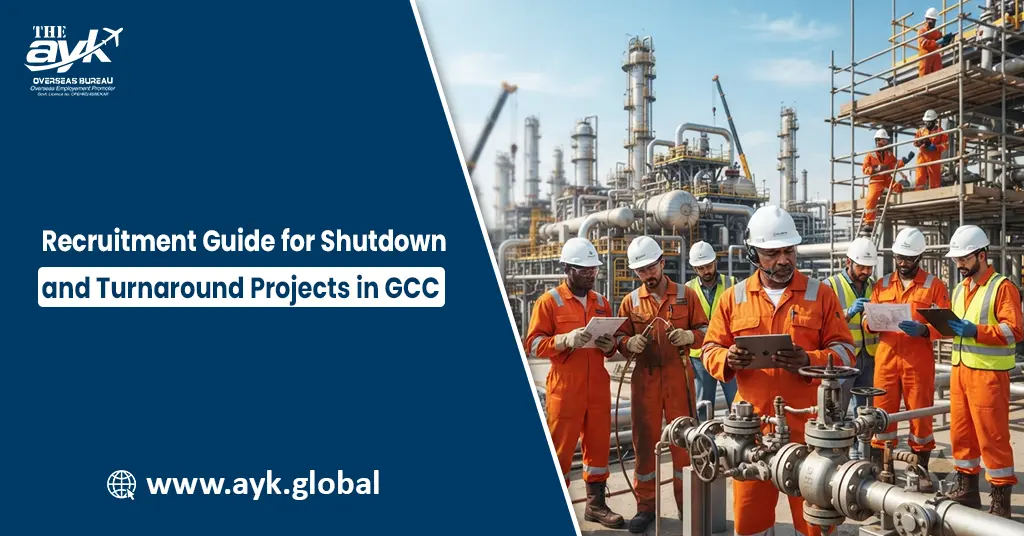
Recruitment Guide for Shutdown and Turnaround Projects in GCC
Published: July 03, 2026 | Views: 11
Introduction
Shutdown and turnaround (TAR) projects are among the most critical and time-sensitive operations in GCC industries, especially in oil & gas, petrochemical plants, refineries, power plants, and large-scale manufacturing facilities. Countries such as Saudi Arabia, United Arab Emirates, Qatar, Kuwait, Oman, and Bahrain frequently conduct planned shutdowns to perform maintenance, upgrades, inspections, and repairs.
These projects require a massive surge of skilled, semi-skilled, and specialized workers within a very short time frame. Unlike regular construction hiring, shutdown recruitment demands rapid mobilization, precise skill matching, strict safety compliance, and flawless coordination between employers and recruitment agencies.
This guide provides a complete recruitment framework for shutdown and turnaround projects in GCC industries.
Understanding Shutdown and Turnaround Workforce Requirements
Shutdown and turnaround projects require highly specialized manpower depending on the type of facility and scope of work. These projects often involve critical maintenance activities where downtime directly impacts production and revenue.
GCC companies must clearly define workforce requirements before initiating recruitment. This includes identifying the number of workers, skill categories, duration of shutdown, and technical expertise required.
Common roles include:
- Mechanical technicians
- Pipe fitters and welders
- Electricians and instrument technicians
- Scaffolding workers
- Safety officers and supervisors
- Heavy equipment operators
Proper workforce planning ensures smooth execution without manpower shortages during critical shutdown windows.
Rapid Sourcing and Bulk Recruitment Strategy
Shutdown projects require extremely fast manpower mobilization, often within days or weeks. Recruitment agencies play a vital role in maintaining ready-to-deploy databases of pre-screened candidates.
Bulk recruitment strategies are used to quickly source large numbers of skilled workers. These candidates are usually trade-tested and experienced in industrial shutdown environments, making them job-ready for urgent deployment.
Key sourcing advantages include:
- Immediate access to skilled workforce
- Faster project mobilization
- Reduced hiring delays
- Availability of experienced shutdown workers
Trade Testing and Skill Validation for Critical Roles
Trade testing is essential for shutdown projects because work is highly technical and time-sensitive. Workers must be capable of performing under pressure while maintaining safety and quality standards.
Candidates are tested on real tasks such as pipe welding, equipment dismantling, electrical fault diagnosis, and scaffolding assembly. Only workers who meet strict performance criteria are selected.
This ensures:
- High-quality execution under pressure
- Reduced risk of errors and accidents
- Improved safety compliance
- Faster task completion
Safety Compliance and HSE Requirements
Safety is the most critical factor in shutdown and turnaround (TAR) projects because workers operate in high-risk environments such as refineries, chemical plants, and power stations. GCC companies must ensure that every recruited worker strictly follows Health, Safety, and Environment (HSE) standards.
Workers must be trained in hazard identification, confined space entry procedures, lockout-tagout systems, and emergency response protocols. Even experienced technicians are required to undergo site-specific safety induction before starting work.
Strong HSE compliance ensures:
- Reduced workplace accidents
- Safe handling of hazardous equipment
- Compliance with GCC industrial regulations
- Smooth execution of shutdown activities without interruptions
Documentation and Certification Verification
For shutdown projects, documentation must be verified with extreme accuracy because of the high-risk industrial environment. Employers must ensure that all workers have valid passports, experience certificates, trade qualifications, and medical fitness clearance.
In many cases, prior shutdown experience is highly preferred, and recruitment agencies must validate employment history carefully. Any incorrect or missing documentation can delay visa processing and disrupt tight shutdown schedules.
Key documentation includes:
- Valid passport
- Experience certificates (shutdown/project-based preferred)
- Trade test certificates (if applicable)
- Medical fitness report
- Employment contract
Visa Processing and Fast-Track Mobilization
Shutdown projects require extremely fast mobilization, often within a short window of 7–21 days. Visa processing must therefore be handled through fast-track systems to ensure workers arrive on time.
Any delay in documentation or embassy processing can result in project delays and financial losses. Recruitment agencies coordinate directly with embassies and employers to accelerate visa approval and reduce waiting time.
Key acceleration factors:
- Pre-approved visa quotas
- Complete documentation before submission
- Experienced recruitment agency coordination
- Priority processing for shutdown projects
Onboarding and Site Deployment
Once workers arrive at GCC sites, immediate onboarding is required to ensure they understand project scope, safety rules, and job responsibilities. Shutdown projects often operate under strict deadlines, so onboarding must be quick and efficient.
Workers are briefed on work permits, safety procedures, shift schedules, and reporting structures. Proper onboarding ensures that manpower becomes productive immediately after arrival.
Benefits include:
- Faster workforce activation
- Reduced confusion on-site
- Better coordination between teams
- Improved shutdown efficiency
Cost Management in Shutdown Recruitment
Shutdown projects often involve high recruitment and operational costs due to urgency and bulk hiring requirements. However, proper planning can significantly reduce expenses.
Using pre-screened manpower databases, long-term recruitment partnerships, and bulk deployment strategies helps control costs. Trade testing also reduces wastage by ensuring only qualified workers are deployed.
Cost-saving measures include:
- Bulk hiring strategies
- Pre-screened shutdown workforce
- Efficient trade testing systems
- Reduced rework and errors
Workforce Retention for Repeated Shutdown Projects
Many shutdown workers are required repeatedly for seasonal or scheduled maintenance cycles. Retaining experienced workers is highly beneficial for GCC companies.
Retention strategies include competitive wages, repeat deployment opportunities, safe working conditions, and performance-based incentives. Experienced shutdown workers improve efficiency in future projects and reduce training time.
Conclusion
Recruiting for shutdown and turnaround projects in GCC requires fast mobilization, strict safety compliance, accurate documentation, and highly skilled manpower sourcing. Each step is critical because delays or errors can result in major financial losses and operational disruptions.
By following a structured recruitment strategy, GCC companies can ensure smooth shutdown execution, improved safety, and timely project completion.
 Recruitment Agency in Pakistan for Canada, Complete Employer Guide 2026
 Why Companies Outsource Recruitment and HR Management
 KSA Recruitment
 UAE Recruitment
 Qatar Recruitment
 Oman Recruitment
 Kuwait Recruitment
 Libya Recruitment
 Bahrain Recruitment
 Iraq Recruitment
 Malaysia Recruitment
 Malta Recruitment
 Canada Recruitment
 USA Recruitment
 Europe Recruitment
 UK Recruitment
 Romania Recruitment
 Poland Recruitment
 Bulgaria Recruitment
 Albania Recruitment
 Serbia Recruitment
 Lithuania Recruitment
 Japan Recruitment
 Turkey Recruitment
 Kyrgyzstan Recruitment
 South Korea Recruitment