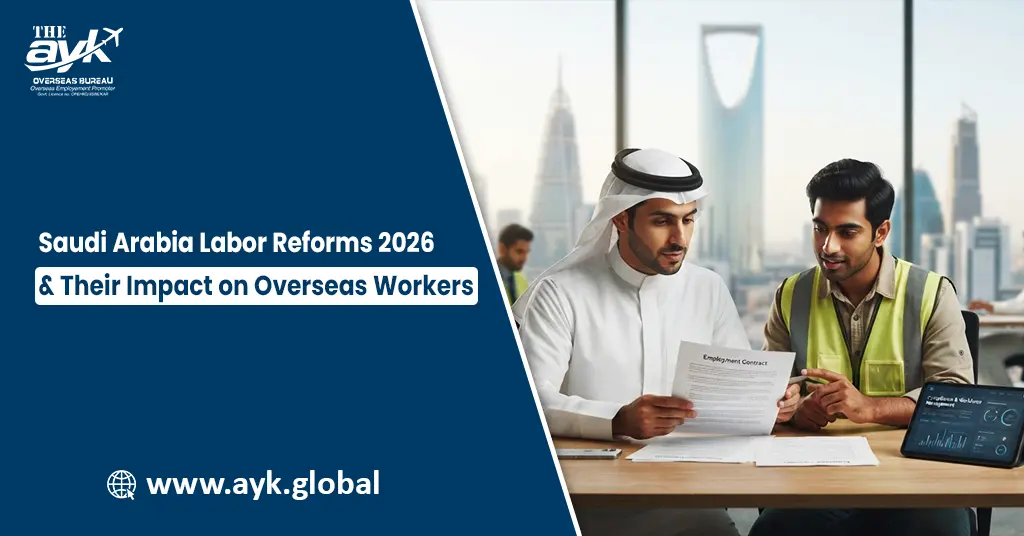
Saudi Arabia Labor Reforms 2026 and Their Impact on Overseas Workers
Published: June 30, 2026 | Views: 16
Introduction
Saudi Arabia has been undergoing one of the most significant labor market transformations in the Gulf region as part of its broader Vision 2030 economic diversification strategy, and 2026 marks a critical period where several of these reforms are now fully active and directly affecting overseas workers. For Pakistani job seekers, understanding these changes is essential, since reforms touching job mobility, contract structures, and worker protections have meaningfully altered how the recruitment and employment process functions compared to just a few years ago.
These reforms generally represent positive developments for overseas workers, offering greater flexibility and stronger legal protections than were previously available, though they have also introduced new procedural requirements that candidates must navigate correctly. AYK Overseas Recruitment & HR Manpower Agency, recognized as one of Pakistan's top manpower agencies, has closely tracked these regulatory shifts to ensure every candidate applying for Saudi positions through our agency benefits fully from the improved protections while avoiding any compliance pitfalls.
The Labor Reform Initiative and Its Core Goals
Saudi Arabia's labor reform initiative was launched with the broader objective of modernizing the kingdom's employment framework, improving worker mobility, and aligning local labor practices more closely with international standards as the country positions itself as a global business and investment hub. This initiative directly affects how overseas workers, including those from Pakistan, experience employment contracts, job transitions, and dispute resolution throughout their time in the kingdom.
The reforms are also closely tied to Saudi Arabia's economic diversification away from oil dependency, with new sectors such as tourism, entertainment, and technology requiring a more flexible and internationally competitive labor market to attract and retain skilled foreign workers. This broader economic shift means overseas workers are increasingly being recruited into a wider variety of roles beyond the traditional construction and domestic labor categories that historically dominated Saudi overseas employment.
Improved Job Mobility for Overseas Workers
One of the most impactful changes under recent labor reforms has been the improvement of job mobility provisions, allowing workers to transfer between employers under certain conditions without requiring the original sponsor's explicit consent, which was a major restriction under the previous system. This change has given overseas workers significantly more leverage in situations involving unfair treatment, contract violations, or simply better job opportunities becoming available during their employment period.
While this increased mobility benefits workers considerably, it also requires careful understanding of the specific conditions and timelines under which a transfer is permitted, since not every employment situation automatically qualifies for an unrestricted transfer. Workers considering an employer change should consult with a knowledgeable agency or legal advisor to confirm their eligibility under current rules before initiating any transfer process, ensuring they do not inadvertently violate their existing contract terms.
Strengthened Contract Protections
Saudi Arabia's labor reforms have placed considerable emphasis on standardizing employment contracts, requiring clearer disclosure of salary, working hours, leave entitlements, and termination conditions before a worker signs any agreement. This standardization has significantly reduced the ambiguity that previously left many overseas workers vulnerable to contract disputes after arrival, since terms are now far more explicitly documented and enforceable under the updated labor framework.
For Pakistani workers specifically, this means contracts processed through legitimate channels in 2026 are considerably more transparent than those from previous years, though it remains essential to have every contract term explained clearly before signing, ideally by someone fluent in both the language and the legal nuances of Saudi employment law. A trustworthy agency will always walk candidates through their contract in detail rather than simply asking for a signature.
Changes to Exit and Re-Entry Procedures
Reforms affecting exit and re-entry procedures have also simplified what was previously a more cumbersome process requiring employer approval for nearly every workforce movement, including vacation travel and permanent departure at the end of a contract. Under updated regulations, workers now generally have more streamlined access to exit permits, reducing dependency on employer cooperation for routine travel needs during their employment period.
This change has been particularly welcomed by long-term overseas workers who previously experienced significant frustration when employers delayed or withheld exit permit approvals for various reasons, sometimes as leverage in unrelated workplace disputes. While the process has improved considerably, workers should still ensure their documentation remains current and properly maintained throughout their employment to avoid any administrative complications when travel becomes necessary.
Wage Protection System Enhancements
Saudi Arabia has continued strengthening its Wage Protection System, which requires employers to process salary payments through monitored banking channels, allowing labor authorities to detect and address wage payment irregularities far more quickly than under previous manual reporting systems. This system has become increasingly sophisticated, with automated flagging of delayed or incomplete payments triggering regulatory follow-up with non-compliant employers.
For overseas workers, this enhanced wage protection translates into considerably reduced risk of unpaid or delayed salaries, which historically represented one of the most common complaints among overseas labor in the kingdom. Workers are still encouraged to maintain their own salary records and report any payment irregularities promptly through proper channels, ensuring the protective benefits of this system are fully realized in practice rather than existing only on paper.
Impact on Recruitment Agency Compliance Standards
These labor reforms have also extended to recruitment agency oversight, with Saudi authorities working closely with sending countries like Pakistan to ensure only properly licensed and compliant agencies are permitted to facilitate worker placements into the kingdom. This increased scrutiny has effectively pushed informal and unlicensed intermediaries further out of the legitimate recruitment pipeline, benefiting both workers and properly compliant agencies operating within the legal framework.
Agencies that fail to meet updated compliance standards risk losing their ability to process placements into Saudi Arabia altogether, creating strong incentive for the recruitment industry as a whole to operate more transparently and professionally than in previous years. This shift has been a net positive for job seekers, since it has reduced the prevalence of fraudulent job offers and improved overall trust in the legitimate recruitment process.
Sector-Specific Impacts of the Reforms
While these labor reforms apply broadly across Saudi Arabia's overseas workforce, their practical impact varies somewhat by sector, with construction and skilled trades seeing the most direct benefit from improved mobility and wage protection measures given the historically larger workforce concentrated in these industries. Healthcare and technical professional roles have similarly benefited from clearer contract standardization, which has helped attract higher-caliber international talent into the kingdom's expanding hospital and technical infrastructure networks.
Hospitality and tourism sector workers, an increasingly significant category given Saudi Arabia's tourism diversification push, have also seen improved contract clarity and mobility benefits, reflecting the kingdom's broader effort to position itself as an attractive destination for international hospitality talent. Understanding which specific reforms apply most directly to your intended sector can help set realistic expectations about how these changes will affect your particular overseas employment experience.
What Pakistani Workers Should Do to Prepare
Given these ongoing reforms, Pakistani workers preparing to apply for Saudi positions in 2026 should prioritize working with properly licensed agencies that demonstrate clear knowledge of current labor regulations rather than relying on outdated information from informal sources. Candidates should also take the time to thoroughly review and understand their employment contracts, asking specific questions about mobility provisions, wage payment schedules, and exit procedures before finalizing any agreement.
Staying informed about ongoing regulatory developments throughout the employment period, rather than only at the application stage, also helps workers fully benefit from any further protections introduced during their time in the kingdom. A good agency will continue providing guidance and support even after placement is complete, helping workers navigate any questions or issues that arise during their employment in Saudi Arabia.
How AYK Overseas Helps Workers Navigate These Reforms
As a government-licensed international recruitment and HR manpower firm with offices in Karachi and Islamabad, AYK Overseas Recruitment & HR Manpower Agency has invested significant effort into understanding Saudi Arabia's evolving labor reform landscape to ensure our candidates are properly informed and protected throughout the recruitment and employment process. Being recognized as one of Pakistan's top manpower agencies, we view it as our responsibility to stay ahead of regulatory changes rather than leaving candidates to discover new rules after arrival.
Our team provides thorough contract review, clear explanation of mobility and exit procedures under current regulations, and ongoing support even after placement, ensuring workers feel confident and protected throughout their employment journey. This commitment to staying current with Saudi labor reforms has made AYK Overseas Recruitment & HR Manpower Agency a trusted partner for thousands of Pakistani workers pursuing opportunities in the kingdom.
Conclusion
Saudi Arabia's labor reforms heading into 2026 represent a meaningful shift toward greater worker protection, mobility, and contract transparency, offering Pakistani overseas workers a considerably improved employment environment compared to previous years. Successfully navigating these changes requires staying informed, understanding contract terms thoroughly, and working with a properly licensed agency that genuinely understands the current regulatory landscape rather than relying on outdated assumptions about how the system operates.
 How to Apply for Gulf Jobs Through a Licensed Agency
 KSA Recruitment
 UAE Recruitment
 Qatar Recruitment
 Oman Recruitment
 Kuwait Recruitment
 Libya Recruitment
 Bahrain Recruitment
 Iraq Recruitment
 Malaysia Recruitment
 Malta Recruitment
 Canada Recruitment
 USA Recruitment
 Europe Recruitment
 UK Recruitment
 Romania Recruitment
 Poland Recruitment
 Bulgaria Recruitment
 Albania Recruitment
 Serbia Recruitment
 Lithuania Recruitment
 Japan Recruitment
 Turkey Recruitment
 Kyrgyzstan Recruitment
 South Korea Recruitment