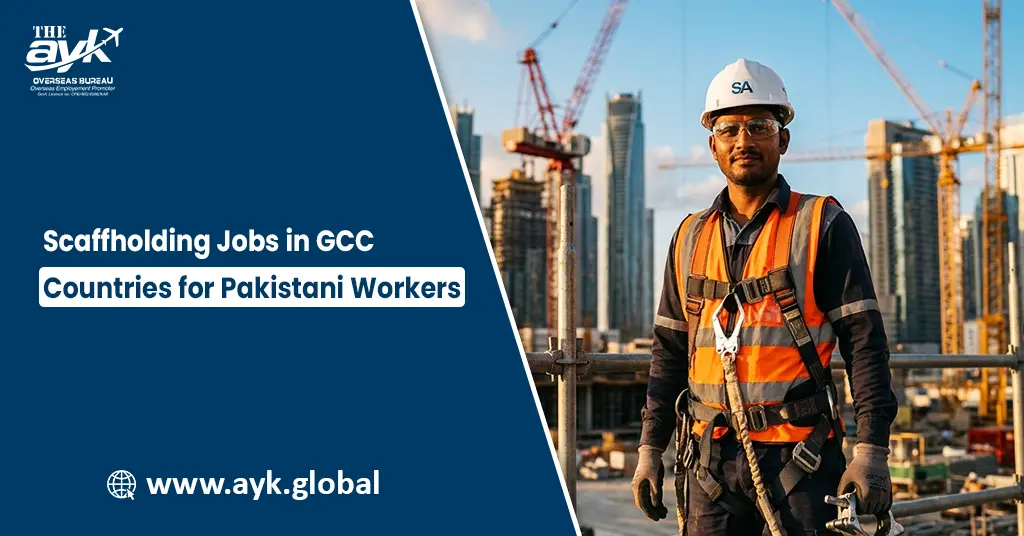
Scaffolding Jobs in GCC Countries for Pakistani Workers
Published: July 02, 2026 | Views: 12
Introduction
Scaffolding jobs in GCC countries such as Saudi Arabia, United Arab Emirates (UAE), Qatar, Kuwait, Oman, and Bahrain are among the most important skilled construction roles in 2026. These jobs are essential for building, repairing, and maintaining large structures such as skyscrapers, bridges, industrial plants, airports, and oil refineries.
Without scaffolding workers, no large construction project can move forward safely. Scaffolding provides the temporary structure that allows other workers such as masons, electricians, welders, and painters to work at height safely and efficiently.
For Pakistani workers, scaffolding jobs are a strong overseas career option because they offer stable employment, overtime income, free accommodation, and long-term job security in the GCC construction sector.
Growing Demand for Scaffolding Workers in GCC
The demand for scaffolding workers in GCC countries is increasing rapidly due to continuous mega construction projects and infrastructure development. Saudi Arabia’s Vision 2030 projects, UAE’s urban expansion, Qatar’s industrial developments, and Oman’s tourism infrastructure all require massive construction support systems.
Every high-rise building, industrial facility, and maintenance project needs scaffolding structures. This creates continuous demand for scaffolders at different skill levels, from helpers to advanced scaffold supervisors.
Because construction activity in GCC never stops, scaffolding workers enjoy year-round job opportunities, especially in large contracting companies.
What Scaffolding Work Involves
Scaffolding work involves assembling and dismantling temporary structures made of metal pipes and platforms. These structures allow workers to safely reach high areas during construction, maintenance, or repair work.
Scaffolders are responsible for ensuring that all platforms are stable, properly secured, and safe for use. Even a small mistake can lead to serious accidents, so precision and discipline are extremely important in this job.
The work is physically demanding but highly structured, especially in GCC construction sites where safety rules are strictly enforced.
Types of Scaffolding Jobs in GCC
Scaffolding jobs in GCC countries are divided into different categories based on skill level and responsibility.
Common roles include:
Scaffolding helpers who assist in carrying materials and basic setup tasks.
Scaffolders who assemble and dismantle structures according to instructions.
Advanced scaffolders who work on complex structures such as high-rise buildings and industrial plants.
Scaffolding supervisors who manage teams and ensure safety compliance on site.
Each level has different responsibilities and salary scales, depending on experience and certification.
Skills Required for Scaffolding Jobs
To work as a scaffolder in GCC countries, workers must have strong physical fitness, basic technical understanding, and safety awareness.
Important skills include understanding scaffold assembly techniques, reading basic site instructions, teamwork coordination, and awareness of height safety rules. Workers must also know how to use tools such as clamps, pipes, and couplers correctly.
In modern GCC projects, knowledge of safety procedures is just as important as physical ability. Employers prefer workers who follow instructions carefully and work in a disciplined environment.
Experience Requirements
Most scaffolding jobs in GCC countries require at least 1 to 3 years of experience for basic roles and 3 to 5 years for advanced positions.
Experienced scaffolders are preferred for high-rise and industrial projects because these environments require advanced knowledge of load balancing and structural safety.
However, some companies also hire fresh or semi-skilled workers as helpers and train them on-site, especially for large construction projects where manpower demand is high.
Salary and Benefits
Scaffolding jobs in GCC countries offer competitive salaries depending on skill level and experience. Entry-level helpers earn lower salaries, while experienced scaffolders and supervisors earn significantly higher income.
In addition to basic salary, workers usually receive overtime pay, free accommodation, transport facilities, medical insurance, and end-of-service benefits.
Overtime plays a major role in increasing monthly income, especially during large construction projects where extended working hours are common.
Work Environment and Conditions
Scaffolding work is physically demanding and usually performed outdoors in construction environments. Workers are exposed to heat, height, and heavy lifting conditions.
Despite challenges, GCC construction companies maintain strict safety standards and provide proper safety gear such as helmets, harnesses, gloves, and protective footwear.
Workers are expected to follow instructions carefully, maintain discipline, and work as part of a team. Shifts may vary depending on project deadlines.
Safety Importance in Scaffolding Work
Safety is the most critical aspect of scaffolding jobs. Since workers operate at heights and handle heavy materials, even a small mistake can lead to accidents.
GCC employers enforce strict safety rules such as proper scaffold inspection before use, secure locking of all joints, use of safety harnesses, and regular supervision by safety officers.
Workers must always follow safety guidelines and report any structural issues immediately to supervisors.
Career Growth Opportunities
Scaffolding jobs in GCC countries offer strong career growth for skilled workers. Beginners can start as helpers and gradually move up to experienced scaffolders and supervisors.
With experience, workers can become team leaders or safety coordinators responsible for managing entire scaffolding teams on large projects.
Experienced scaffolders are also in demand in international construction markets, which opens further overseas opportunities.
Why Pakistani Workers Are Preferred
Pakistani workers are highly preferred in scaffolding jobs across GCC countries due to their physical strength, construction experience, discipline, and adaptability to tough working conditions.
Many Pakistani workers already have experience in construction-related trades, making them suitable for scaffolding roles.
Their willingness to work in challenging environments and follow safety instructions makes them valuable for GCC construction companies.
How to Apply for Scaffolding Jobs
Pakistani workers can apply for scaffolding jobs in GCC countries through licensed recruitment agencies, verified job portals, or direct employer hiring.
The process usually includes CV submission, experience verification, trade testing, interview, and visa processing.
Using licensed manpower agencies is the safest method to avoid fraud and ensure genuine job placement in GCC companies.
Conclusion
Scaffolding jobs in GCC countries are a strong and stable career option for Pakistani workers in 2026. With continuous infrastructure development and mega construction projects across Saudi Arabia, UAE, Qatar, Kuwait, Oman, and Bahrain, demand for skilled scaffolders remains consistently high.
These jobs offer good salaries, overtime income, accommodation, and long-term career growth opportunities.
For workers with construction experience and physical fitness, scaffolding is one of the most reliable overseas job options in the GCC region.
 Why Bursa Is Becoming a Preferred Destination for Skilled Pakistani Professionals
 What to Do If Your Employer Withholds Your Salary
 How AYK Overseas Helps Employers Find Verified Skilled Workers
 KSA Recruitment
 UAE Recruitment
 Qatar Recruitment
 Oman Recruitment
 Kuwait Recruitment
 Libya Recruitment
 Bahrain Recruitment
 Iraq Recruitment
 Malaysia Recruitment
 Malta Recruitment
 Canada Recruitment
 USA Recruitment
 Europe Recruitment
 UK Recruitment
 Romania Recruitment
 Poland Recruitment
 Bulgaria Recruitment
 Albania Recruitment
 Serbia Recruitment
 Lithuania Recruitment
 Japan Recruitment
 Turkey Recruitment
 Kyrgyzstan Recruitment
 South Korea Recruitment