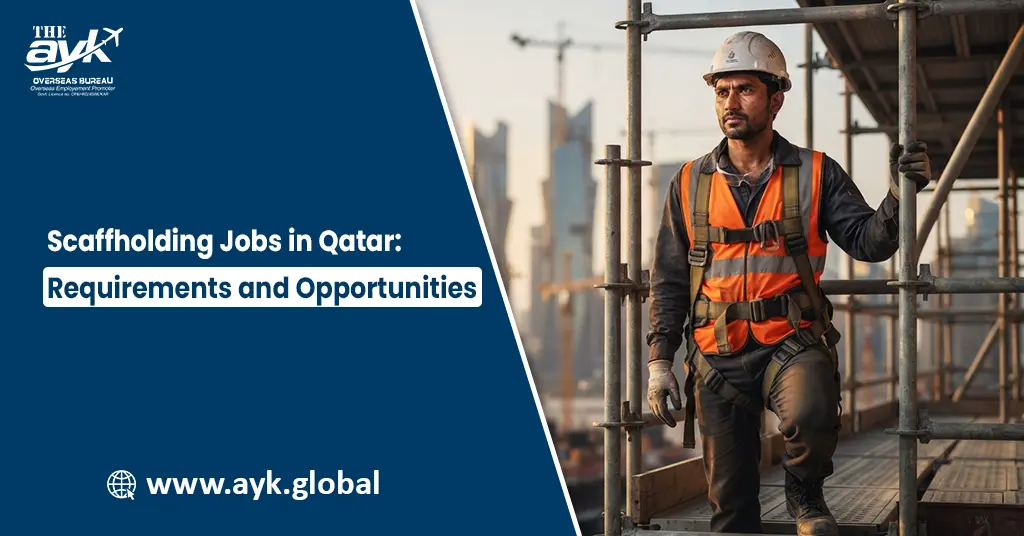
Scaffolding Jobs in Qatar: Requirements and Opportunities
Published: July 02, 2026 | Views: 10
Introduction
Scaffolding work represents one of the most consistently available and genuinely essential skilled labor categories within Qatar's substantial construction sector, with the country's continued infrastructure development, commercial building programs, and ongoing maintenance activity across its growing urban landscape creating sustained demand for qualified scaffolding workers who can safely erect, modify, and dismantle the temporary access structures that virtually every construction and maintenance project requires at various stages throughout its execution. Pakistani scaffolding workers who develop strong technical competency alongside genuine safety consciousness find themselves entering a Qatar employment market where their specific combination of physical capability, technical scaffolding knowledge, and safety compliance orientation directly addresses a fundamental construction requirement that no project of meaningful scale can execute without. Understanding the specific requirements, compensation expectations, and career development possibilities within Qatar's scaffolding employment sector helps Pakistani workers approach this employment category with appropriate preparation and realistic expectations that support genuinely successful Gulf scaffolding careers. AYK Overseas Recruitment & HR Manpower Agency, recognized as one of Pakistan's top manpower agencies, regularly places qualified Pakistani scaffolding workers in Qatar construction employment and this guide reflects the genuine market knowledge we have developed through consistent scaffolding sector placement experience.
Qatar's Construction Sector and Scaffolding Demand
Qatar's construction sector continues generating substantial scaffolding employment demand beyond its World Cup hosting period, with ongoing commercial development, hospitality expansion, infrastructure maintenance, and various new institutional building programs collectively maintaining scaffolding worker requirements at levels that provide Pakistani workers with genuine, sustained employment opportunity rather than temporary project-specific hiring that ends with specific major project completions. The country's National Vision 2030 development strategy encompasses extended infrastructure and urban development commitments that sustain construction activity across multiple years, creating the kind of longer-term demand that allows scaffolding workers who establish themselves within Qatar's construction community to develop genuinely stable overseas employment rather than experiencing the employment uncertainty that purely project-dependent hiring sometimes creates.
Types of Scaffolding Work Available in Qatar
Qatar's construction and maintenance sectors create demand across several distinct scaffolding application categories that require somewhat different technical approaches and competency profiles, including conventional tube and fitting scaffolding for complex custom configurations, system scaffolding using proprietary modular components for faster erection across standard applications, suspended scaffolding for building facade work and maintenance applications, and various specialty scaffolding systems for specific industrial maintenance contexts that require different technical knowledge than standard construction scaffolding. Workers who develop competency across multiple scaffolding system types rather than limiting their expertise to a single approach significantly broaden their employment marketability within Qatar's diverse construction and maintenance sector, positioning themselves favorably for a wider range of available opportunities and creating more resilient employment continuity than narrow single-system specialists who depend on availability of their specific system type across whatever project opportunities arise during their Qatar employment.
Safety Qualifications as Non-Negotiable Requirements
Safety qualification represents the most fundamental and non-negotiable requirement for scaffolding employment across Qatar's construction sector, with employers and project safety managers consistently prioritizing scaffolding workers who demonstrate genuine safety competency and consciousness over those with extensive experience but inadequate formal safety qualification. Qatar's construction industry has progressively raised its safety compliance standards in response to both international attention on construction worker welfare and genuine operational safety improvement objectives that have made formal scaffolding safety certification an essentially mandatory credential for employment across most reputable construction employers operating within the country. Workers should pursue internationally recognized scaffolding safety certification such as CISRS or equivalent recognized credentials before pursuing Qatar scaffolding employment, understanding this investment as genuinely essential professional preparation rather than optional qualification that simply enhances an otherwise adequate application without certification.
Physical Requirements and Work Conditions
Scaffolding work involves demanding physical requirements including working at height, carrying heavy components, repetitive lifting and assembly activities, and sustained physical exertion throughout extended working shifts under Qatar's challenging climate conditions that make these physical demands considerably more taxing than the same work would involve in more temperate environments. Workers considering Qatar scaffolding employment should honestly assess their physical fitness and capability for these specific demands, recognizing that the combination of heavy physical work and Gulf climate creates a genuinely challenging physical environment that workers in excellent physical condition manage considerably more successfully than those who overestimate their capability for sustained demanding physical work under heat stress conditions that Qatar's climate creates during significant portions of the working year. Medical fitness certification required for Gulf employment visa applications provides some formal verification of basic health fitness, but workers should also conduct honest personal assessment of their genuine capability for physically demanding scaffolding work in extreme climate conditions before committing to this employment category.
Required Certifications and Documentation
Beyond safety certification, Pakistani scaffolding workers pursuing Qatar employment should ensure their trade experience is comprehensively documented through detailed employer reference letters that specifically describe their scaffolding competency, the types of scaffolding systems they have worked with, the scales of projects they have supported, and any leadership or inspection responsibilities they have held during their scaffolding career. Formal trade testing through recognized Pakistani trade testing centers provides additional credential verification that strengthens employment applications by offering independently verified competency assessment beyond self-reported or employer-described experience claims that some employers view with varying degrees of verification confidence. Workers should also ensure their relevant safety certifications include validity periods that extend beyond their anticipated Gulf employment commencement date, avoiding the situation where certification expires shortly after arrival and requires immediate renewal before workers have had opportunity to establish their employment footing.
Compensation Expectations for Qatar Scaffolding Work
Scaffolding compensation in Qatar varies meaningfully based on experience level, safety certification status, the complexity of scaffolding work involved, and whether employment includes accommodation and transport provisions that significantly affect complete package value beyond base salary comparison alone. Experienced scaffolders with recognized safety certifications and demonstrated competency across multiple scaffolding system types typically command stronger compensation than entry-level workers without formal certification, reflecting the genuine additional value their comprehensive professional profile creates for employers who benefit from certified, experienced scaffolding staff who require less supervision and deliver stronger safety compliance performance throughout project execution. Workers should research realistic compensation ranges specifically relevant to their experience level and certification status rather than applying generic Gulf construction wage assumptions that may not accurately reflect Qatar scaffolding-specific compensation patterns, and should evaluate complete packages including accommodation and transport provisions rather than comparing base salary figures alone when assessing the genuine financial value of specific Qatar scaffolding employment opportunities.
Working at Height Safety and Fall Prevention
Working at height represents the most significant safety risk dimension of scaffolding work, with falls from scaffolding structures representing one of construction's most serious injury categories that proper safety training, appropriate personal protective equipment use, and rigorous fall prevention consciousness can substantially reduce but never entirely eliminate as an occupational hazard. Qatar's construction safety framework increasingly mandates specific fall protection measures including harness use at specified heights, scaffold inspection requirements before work commencement, and various other fall prevention protocols that workers must understand and consistently apply throughout their working activities to both protect their own safety and maintain the safety compliance that Qatar construction projects increasingly require from all working personnel regardless of employment category. Workers who genuinely internalize fall prevention as a personal safety priority rather than simply following required protocols when supervisors observe their compliance demonstrate the safety maturity that experienced scaffolding employers specifically seek in candidates whose work at height creates elevated personal risk requiring genuine rather than performative safety commitment.
Scaffold Inspection and Quality Responsibilities
Experienced scaffolding workers in Qatar are increasingly expected to perform and document basic scaffold inspection activities that verify erected structures meet safety and load-bearing requirements before authorizing other trades to work from completed scaffold platforms, representing a quality assurance responsibility that extends beyond purely physical erection and dismantling activities toward verification and documentation functions that characterize more complete scaffolding professional roles. This inspection responsibility creates additional professional value for experienced scaffolders who develop the knowledge and judgment to confidently perform these assessments, distinguishing their professional profile from workers who can only erect scaffolding without the additional inspection and verification capability that more complete scaffolding professional roles involve. Workers interested in developing their career toward senior scaffolding positions should deliberately build their inspection knowledge and documentation capabilities alongside their physical erection competency, understanding these combined capabilities as representing the complete professional profile that senior scaffolding roles genuinely require.
Scaffold Supervisor and Foreman Opportunities
Career advancement within Qatar's scaffolding employment sector follows a progression from gang member performing physical erection work through leading hand responsibility for smaller crews, scaffold supervisor oversight of multiple crews across larger project sections, and eventually scaffolding manager responsibility for entire project scaffolding programs that involves planning, resource management, safety oversight, and client coordination activities beyond physical scaffolding work supervision. This advancement pathway creates genuine career development opportunity for ambitious Pakistani scaffolding workers who combine strong technical competency with developing leadership capabilities, though achieving these more senior roles requires sustained performance demonstration over years of increasingly responsible scaffolding work rather than simply time-based progression through the employment hierarchy without genuine demonstrated advancement readiness.
Scaffolding in Maintenance and Industrial Contexts
Beyond new construction, Qatar's maintenance and industrial sectors create distinctive scaffolding employment that provides more operationally stable employment compared to project-specific new construction work that concludes when specific projects complete and potentially leaves workers between employment without the continuous activity flow that maintenance contexts provide. Industrial maintenance scaffolding within Qatar's petrochemical and industrial facilities involves specialized requirements including working within operating plant environments with specific chemical exposure considerations, confined space work protocols, and various safety requirements that differ from standard construction contexts and require additional specialized training that commands premium compensation reflecting these more demanding technical and safety requirements. Workers who develop both construction and industrial maintenance scaffolding capabilities create more resilient employment positioning within Qatar's complete scaffolding employment landscape than those whose competency concentrates exclusively in either context without cross-sector capability development.
Understanding Scaffold Design and Load Calculations
Advanced scaffolding knowledge including basic scaffold design principles and load calculation understanding significantly enhances a scaffolding worker's professional profile beyond purely physical assembly competency, providing the technical understanding foundation that senior scaffolding positions increasingly require as Qatar's construction projects become more technically sophisticated and scaffold design complexity grows alongside project scale and structural ambition. Workers who invest in developing this design and calculation knowledge through available technical resources, training programs, or mentorship from more experienced scaffolding professionals position themselves for advancement into supervisory and management roles that involve scaffold planning and design verification responsibilities beyond hands-on erection supervision. This technical knowledge investment may require additional learning effort beyond physical work skills development, but creates genuinely valuable professional differentiation that commands stronger compensation recognition and career advancement opportunity within Qatar's scaffolding employment market.
Practical Tips for Pakistani Scaffolders Applying to Qatar
Pakistani scaffolding workers preparing Qatar employment applications should develop comprehensive documentation of their specific scaffolding experience including the types of scaffolding systems worked with, project scales supported, safety certifications held, and any leadership or inspection responsibilities undertaken during their scaffolding career, presenting this information in organized formats that allow Qatar employers to efficiently assess candidate competency profiles during competitive hiring processes. Workers should also research Qatar-specific scaffolding standards and terminology before their employment application process, demonstrating basic familiarity with Qatar construction requirements that distinguishes candidates who have invested genuine preparation effort from those applying without specific Qatar market awareness. Ensuring all certifications are currently valid and properly attested through relevant Pakistani authorities before initiating the Qatar employment visa process helps workers avoid the delays and complications that certification validity issues or attestation gaps sometimes create during visa processing for construction sector employment applications.
Common Mistakes Pakistani Scaffolders Make When Applying
Pakistani scaffolding workers sometimes weaken their Gulf employment applications by submitting generic employment history documentation without the specific scaffolding competency details that Gulf employers require for meaningful candidate evaluation, relying on length of employment as their primary qualification evidence without demonstrating the actual technical breadth and safety certification depth that competitive Qatar scaffolding applications genuinely require. Another common mistake involves underestimating the genuine importance of current, recognized safety certification, with some workers believing that extensive experience provides adequate qualification equivalent to formal safety credentials when Qatar construction employers increasingly treat formal certification as a distinct, non-substitutable requirement rather than simply one qualification dimension that experience can offset. Workers should also avoid exaggerating their competency with specific scaffolding systems they have limited experience with, recognizing that Gulf employers' practical competency verification during initial employment quickly reveals such exaggerations in ways that damage professional credibility more seriously than honest acknowledgment of competency boundaries would have created during the application process.
How AYK Overseas Connects Pakistani Scaffolders to Qatar Employment
As a government-licensed international recruitment and HR manpower firm with offices in Karachi and Islamabad, AYK Overseas Recruitment & HR Manpower Agency maintains active employer relationships with Qatar construction contractors and facilities management companies that create consistent scaffolding employment demand for qualified Pakistani workers, regularly facilitating placements across both project-specific construction employment and more stable ongoing maintenance and industrial scaffolding positions. Being recognized as one of Pakistan's top manpower agencies, we understand the specific certification requirements, competency documentation expectations, and competitive positioning factors that determine success within Qatar's scaffolding employment market, and we help candidates present their qualifications in formats that align with actual Gulf employer evaluation criteria rather than generic application formats that may not effectively communicate candidates' genuine professional value. Our team works closely with scaffolding candidates to identify their specific competency profile, advise on any additional certification or documentation investment that would strengthen their competitive positioning, and match them with Qatar employers whose specific requirements align well with their demonstrated capabilities and career development objectives.
Conclusion
Scaffolding work in Qatar offers Pakistani workers genuine, sustained employment opportunity within a country where construction activity and the essential nature of scaffolding across virtually every project type creates consistent demand that rewards workers who combine strong technical competency with genuine safety certification and professional commitment to the quality and compliance standards that Qatar's increasingly rigorous construction sector consistently requires. Workers who invest in proper safety certification, comprehensive competency documentation, continuous technical knowledge development, and honest professional presentation of their actual capabilities are well positioned to access rewarding Qatar scaffolding employment that provides the financial improvement and career development opportunity their professional skills genuinely deserve within this important Gulf construction employment market.
 Driver Jobs in GCC Countries, Requirements and Salary Guide
 Why European Employers Should Recruit Pakistani Talent
 Recruitment Agency in Pakistan for Iraq, Complete Employer Guide 2026
 KSA Recruitment
 UAE Recruitment
 Qatar Recruitment
 Oman Recruitment
 Kuwait Recruitment
 Libya Recruitment
 Bahrain Recruitment
 Iraq Recruitment
 Malaysia Recruitment
 Malta Recruitment
 Canada Recruitment
 USA Recruitment
 Europe Recruitment
 UK Recruitment
 Romania Recruitment
 Poland Recruitment
 Bulgaria Recruitment
 Albania Recruitment
 Serbia Recruitment
 Lithuania Recruitment
 Japan Recruitment
 Turkey Recruitment
 Kyrgyzstan Recruitment
 South Korea Recruitment