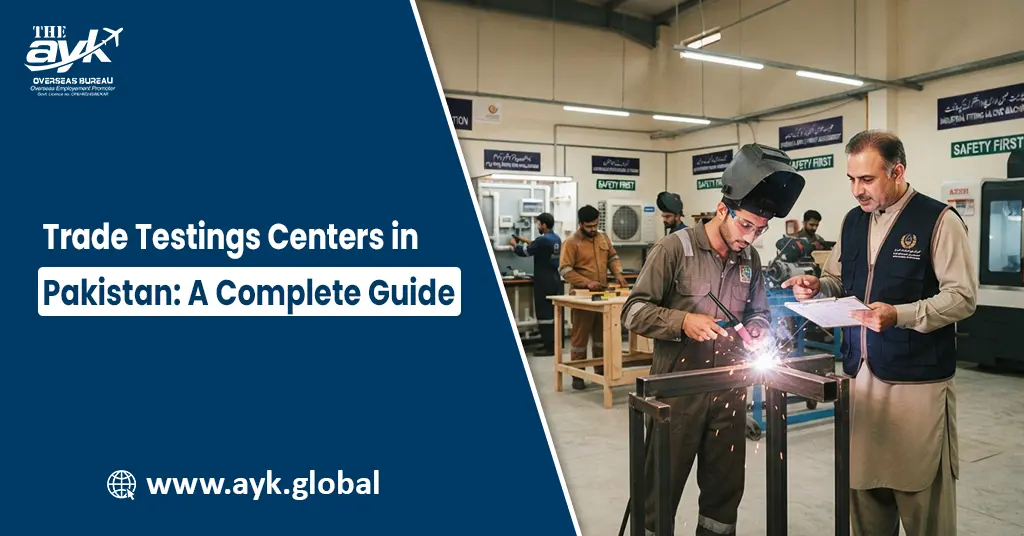
Trade Testing Centers in Pakistan: A Complete Guide
Published: July 04, 2026 | Views: 13
Introduction
Trade testing centers in Pakistan provide skilled workers with formal, independently verified certification of their practical technical competency through standardized assessments that carry considerably more credibility with Gulf employers than simple employer-issued experience letters whose content cannot be independently verified. For Pakistani construction workers, technicians, and various other skilled tradespeople pursuing Gulf overseas employment, trade test certificates from recognized assessment bodies often represent the difference between accessing higher-quality employment opportunities with stronger compensation and being limited to lower-tier positions where employers cannot verify the actual competency level that uncertified experience claims alone cannot establish. AYK Overseas Recruitment & HR Manpower Agency, recognized as one of Pakistan's top manpower agencies, consistently observes how trade certification affects candidates' Gulf employment positioning, and this guide provides the practical knowledge that skilled workers need to understand and navigate Pakistan's trade testing infrastructure effectively.
The Main Trade Testing Bodies in Pakistan
Pakistan's trade testing and vocational certification landscape is served by several major bodies whose certificates carry varying degrees of recognition across different Gulf employment markets, with the National Vocational and Technical Training Commission representing the federal-level authority overseeing national vocational qualification standards, the Technical Education and Vocational Training Authorities operating at provincial level across Punjab, Sindh, KPK, and Balochistan conducting their own testing and certification programs, and various other specialized assessment bodies covering specific trade categories or professional areas that the main NAVTTC and TEVTA networks may address less comprehensively. Workers seeking trade certification should understand that these bodies operate with somewhat different but overlapping mandates, with NAVTTC focusing on national qualification framework standards and inter-provincial recognition while provincial TEVTAs conduct the majority of actual trade testing through their center networks, and both bodies issue certificates that Gulf employers generally recognize as credible Pakistani government-backed trade competency verification. The Overseas Employment Corporation also operates trade testing programs specifically oriented toward overseas employment requirements, providing an additional certification pathway that directly targets the Gulf employment market's specific competency standards in ways that domestic vocationally focused certification programs sometimes address less directly.
How Trade Testing Centers Work
Trade testing at recognized centers involves practical skill demonstration assessments conducted under standardized conditions by qualified assessors who evaluate candidates against defined competency standards for each specific trade category, providing an independently verified competency determination that differs meaningfully from simply holding employment experience in a trade without formal assessment of whether that experience has produced genuine competency at the claimed level. The assessment process typically involves both practical hands-on demonstration components where candidates perform actual trade tasks under assessor observation, and theoretical knowledge assessment through written or verbal questioning that evaluates whether candidates understand the principles behind their practical skills rather than simply performing practiced procedures without genuine underlying understanding. Candidates who demonstrate competency at or above the defined standard receive formal certification documenting their assessed competency level, with different certification grades such as entry level, intermediate, and advanced typically reflecting different assessed competency thresholds that translate to different employment positioning within the Gulf hiring market that uses these credentials to differentiate candidate capability levels.
Registering for Trade Tests and Required Documentation
Registering for trade testing at TEVTA or NAVTTC centers requires presenting specific documentation that verifies the candidate's identity, relevant educational background, and in some cases prior work experience that the testing authority requires candidates to have accumulated before becoming eligible for assessment at specific competency levels. Standard registration documentation typically includes the candidate's original CNIC with photocopy, passport-size photographs, educational certificates demonstrating minimum educational qualification for the trade category being tested, experience documentation from previous employers if experience prerequisites apply to the specific assessment level being pursued, and the applicable registration fee payment that varies between different trade categories and assessment levels. Workers should contact their intended testing center directly or visit the NAVTTC or TEVTA websites to obtain current registration requirements for their specific trade and assessment level, as requirements can vary between trade categories and are periodically updated in ways that online community guidance may not accurately reflect if that guidance predates recent requirement changes.
Specific Trades Commonly Tested for Gulf Employment
The trade categories most frequently tested by Pakistani workers pursuing Gulf employment include electrical work at various specialization levels, plumbing and pipefitting, welding covering different welding processes and material types, HVAC and refrigeration technology, masonry and concrete work, carpentry and formwork, painting and decorating, scaffolding erection, steel fixing and reinforcement, and various other construction trades that Gulf construction projects consistently require. Healthcare-related technical trades including laboratory technology and pharmacy technician roles also involve formal assessment and certification requirements, as do various hospitality sector technical roles that Gulf hotel employers increasingly require certification for alongside traditional construction trade categories. Workers should research whether their specific trade category has an established testing program available at centers accessible to their location, confirming that certification in their particular specialty is genuinely available rather than assuming all trade categories have equally accessible formal assessment pathways across all Pakistani cities.
What Gulf Employers Look for in Trade Certificates
Gulf employers evaluate Pakistani trade certificates based on the issuing body's recognition within their specific employment market, the specific competency level documented by the certificate relative to the technical demands of the position being filled, the certificate's recency as evidence of current rather than historical competency assessment, and whether the certificate covers the specific technical specialization that their particular employment requirement involves rather than only broadly related trade areas that may not directly address their specific technical needs. Certificates from NAVTTC and provincial TEVTAs are generally recognized across Gulf employment markets as credible Pakistani government-backed competency verification, though some Gulf employers specifically recognize certificates from particular bodies or programs and may show preferences for specific credential types based on their own hiring experience with candidates holding different Pakistani trade credentials. Workers should research whether their specific target Gulf employer or destination has particular preferences regarding Pakistani trade certification, discussing with their recruitment agency whether any certification type advantages or disadvantages apply within their specific employment context before investing significant time in obtaining certification from a particular body.
Trade Testing as Visa Facilitation Documentation
Beyond employment competency demonstration, trade certificates play an important facilitation role in Gulf visa processing by providing immigration authorities with documented evidence of the specific skilled trade category for which the visa is being requested, helping ensure that visa issuance appropriately matches the technical employment purpose rather than creating ambiguity about the specific skilled trade nature of the employment. Some Gulf countries have developed specific visa categories for different skilled trade designations that require corresponding certification documentation to qualify for the appropriate visa classification, making trade certification not just an employment competency credential but also a visa category eligibility documentation requirement for workers seeking access to skilled trade-specific visa classifications. Workers should discuss the specific visa documentation implications of their trade certification with their recruitment agency to understand how their particular certificate interacts with their visa application in ways that may affect processing timelines, visa category classification, and various other practical visa management dimensions beyond the basic employment competency verification purpose that trade certificates most obviously serve.
Preparation Strategies for Trade Test Success
Workers preparing for formal trade testing should approach assessment preparation with genuine seriousness that recognizes the consequential nature of these assessments for their overseas employment prospects, using the time before their scheduled assessment to systematically review their practical skills across all competency areas covered by the assessment standard, refresh their theoretical knowledge about trade principles and technical specifications, and if possible complete practice assessments that simulate actual testing conditions to build the assessment confidence that unfamiliar testing environments sometimes undermine despite strong underlying practical competency. Workers whose employment experience has concentrated in specific applications of their trade should specifically attend to broader competency areas that their narrow practical experience may not have fully developed, recognizing that assessment standards typically cover complete trade competency rather than only the specific applications that individual employment situations have happened to involve. Seeking guidance from workers who have previously completed the same assessment, discussing assessment content and format with testing center staff during registration, and reviewing any published assessment guides or competency standards that NAVTTC or TEVTA makes available all represent legitimate preparation approaches that help workers enter their assessment with accurate expectations and appropriate readiness.
Recognition of Pakistani Trade Certificates Internationally
Pakistan's trade certification framework has developed progressively toward greater international recognition alignment, with NAVTTC's national qualification framework designed to facilitate international recognition comparisons that make Pakistani trade credentials more transparently assessable by Gulf employers who need to evaluate how Pakistani certification levels compare to international trade competency standards they may be more familiar with from other worker source countries. Some Gulf countries have developed bilateral recognition agreements with Pakistan that provide more formalized pathways for Pakistani trade certificate recognition, while others evaluate Pakistani certificates on a case-by-case basis based on their general knowledge of Pakistani trade testing standards without formal bilateral recognition frameworks that guarantee consistent assessment outcomes. Workers should understand that Gulf employer recognition of their specific certificate depends significantly on the certification body's general reputation within Gulf employment markets, the specific trade category's standardization across different source countries, and the particular employer's familiarity with Pakistani trade certification that varies between employers who have extensive Pakistani worker hiring experience and those encountering Pakistani credentials for the first time without established familiarity to guide their assessment.
Costs and Time Investment for Trade Certification
Trade testing and certification involves both financial costs and time investment that workers should realistically plan for within their overall pre-departure preparation timeline, with registration fees varying between trade categories and assessment levels, potential training or preparation costs if workers enroll in short courses to address specific competency gaps before assessment, transportation costs for workers who must travel to testing centers not located in their immediate area, and the time investment of both preparation and the actual assessment process that may span multiple days for comprehensive competency evaluation across practical and theoretical assessment components. Workers should contact their intended testing center early to understand specific costs for their trade category and assessment level, building these costs into their overall overseas employment preparation budget alongside the various other documentation and preparation expenses that Gulf employment pursuit involves. The return on this certification investment in terms of improved employment opportunity access and potentially stronger compensation positioning typically justifies the preparation costs for most skilled workers whose uncertified experience otherwise limits their Gulf employment positioning, making trade certification investment a genuinely worthwhile financial decision for most workers despite the upfront costs it requires.
How AYK Overseas Helps Workers Pursue Trade Certification
As a government-licensed international recruitment and HR manpower firm with offices in Karachi and Islamabad, AYK Overseas Recruitment & HR Manpower Agency guides candidates toward appropriate trade certification pathways as part of comprehensive pre-departure preparation, helping workers understand which specific certification bodies and assessment levels will most effectively support their Gulf employment applications and identifying any certification gaps that represent investment priorities before their visa processing begins. Being recognized as one of Pakistan's top manpower agencies, we treat trade certification guidance as a genuine professional service that helps workers maximize their employment positioning through appropriate credential development, supporting both initial placement success and longer-term career development by ensuring candidates enter Gulf employment with documentation that accurately reflects and effectively communicates their genuine technical capabilities.
Conclusion
Pakistan's trade testing center network through NAVTTC and provincial TEVTAs provides skilled workers with access to formal competency certification that significantly enhances their Gulf employment positioning by providing Gulf employers with independently verified credential evidence rather than unverifiable experience claims alone. Workers who research the appropriate certification body and assessment level for their specific trade, prepare thoroughly for their assessment, obtain certification well before their intended departure, and work with knowledgeable recruitment agencies that guide appropriate credential development are well positioned to access the stronger Gulf employment opportunities that properly certified Pakistani tradespeople consistently secure compared to equally skilled but uncertified workers whose competency remains more difficult for Gulf employers to independently verify and confidently credit within competitive hiring processes.
 How AYK Overseas Helps You Get Jobs in Germany, Poland & Romania
 Why Sharjah Needs a Recruitment Partner That Understands Its Specific Market
 KSA Recruitment
 UAE Recruitment
 Qatar Recruitment
 Oman Recruitment
 Kuwait Recruitment
 Libya Recruitment
 Bahrain Recruitment
 Iraq Recruitment
 Malaysia Recruitment
 Malta Recruitment
 Canada Recruitment
 USA Recruitment
 Europe Recruitment
 UK Recruitment
 Romania Recruitment
 Poland Recruitment
 Bulgaria Recruitment
 Albania Recruitment
 Serbia Recruitment
 Lithuania Recruitment
 Japan Recruitment
 Turkey Recruitment
 Kyrgyzstan Recruitment
 South Korea Recruitment