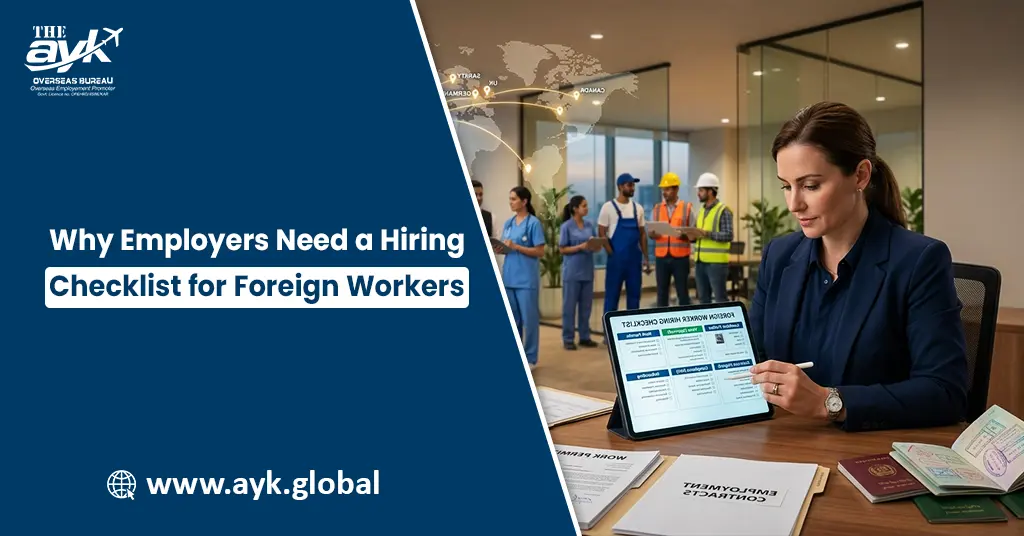
Why Employers Need a Hiring Checklist for Foreign Workers
Published: June 29, 2026 | Views: 16
Introduction
Hiring foreign workers is a strategic decision that can significantly improve business productivity, fill skill gaps, and support large-scale operations across industries such as construction, engineering, healthcare, logistics, hospitality, and manufacturing. However, international recruitment is also a complex process that involves legal compliance, documentation, verification, and workforce planning.
Many employers face challenges because they start hiring without a structured checklist. This leads to issues such as incorrect documentation, poor candidate selection, visa delays, compliance risks, and mismatched job roles. A well-defined employer checklist ensures that every step is properly planned and executed before making hiring decisions.
A structured approach not only reduces risks but also improves hiring quality, workforce stability, and long-term operational success.
1. Define Job Requirements Clearly Before Hiring
The first and most important step in hiring foreign workers is defining the job role in detail. Employers must clearly identify what skills, experience, and qualifications are required for each position.
A well-defined job description includes job responsibilities, technical requirements, physical demands, working hours, and reporting structure. Without this clarity, recruitment becomes inconsistent and leads to hiring mismatches.
Clear job definition also helps recruitment agencies find the right candidates faster and improves overall selection accuracy.
2. Verify Legal Compliance and Work Permits
Before hiring foreign workers, employers must ensure full compliance with immigration laws and labor regulations in the destination country. This includes understanding visa categories, work permit requirements, and employment rules.
Legal compliance is critical because any violation can result in penalties, visa rejection, or restrictions on future hiring.
Employers must also ensure that recruitment agencies follow government-approved procedures and ethical hiring practices.
Working with structured agencies like AYK Overseas Recruitment & HR Manpower Agency helps ensure that all legal requirements are properly handled during the recruitment process.
3. Candidate Skill Verification and Competency Checks
Skill verification is one of the most important steps in the hiring checklist. Employers must ensure that candidates actually possess the skills required for the job.
This includes technical assessments, practical demonstrations, or role-specific interviews depending on the industry. For example, engineers may be tested on technical knowledge, while logistics workers may be evaluated on physical ability and accuracy.
Proper skill verification ensures that candidates are job-ready and capable of performing effectively from day one.
4. Background Verification and Work History Validation
Background checks help employers confirm that the candidate’s experience, qualifications, and previous employment history are accurate.
Employers should verify job titles, duration of employment, responsibilities, and performance history. This helps identify any inconsistencies or misrepresentations in candidate profiles.
Work history validation is especially important in industries where experience directly impacts safety, performance, and operational success.
5. Documentation and Credential Authentication
All educational certificates, professional licenses, and identity documents must be properly verified before hiring foreign workers.
Document authentication ensures that candidates meet the required qualifications for the job role and comply with legal standards.
Employers should ensure that all documents are genuine, properly attested, and verifiable through official channels.
6. Salary Structure and Cost Planning
Before hiring, employers must define a clear salary structure including wages, overtime, benefits, accommodation, transportation, and other allowances.
Cost planning helps avoid misunderstandings later and ensures financial stability in workforce management.
A well-planned salary structure also improves employee satisfaction and reduces turnover rates.
7. Recruitment Agency Evaluation
Choosing the right recruitment agency is a critical step in the hiring process. Employers must ensure that the agency is licensed, experienced, and capable of handling international recruitment efficiently.
A reliable agency provides structured screening, documentation support, and candidate verification services.
In Pakistan, AYK Overseas Recruitment & HR Manpower Agency provides end-to-end recruitment solutions for international employers, ensuring compliance and quality assurance.
8. Pre-Interview and Selection Process
Employers should conduct structured interviews to evaluate communication skills, technical knowledge, and behavioral traits.
Pre-interviews help filter out unsuitable candidates before final selection, saving time and resources.
A structured interview process also ensures fair and consistent evaluation of all candidates.
9. Cultural Fit and Adaptability Assessment
Foreign workers must be able to adapt to new work environments, cultures, and team structures.
Cultural fit assessment ensures that candidates can work effectively in international settings and handle workplace diversity.
Adaptability is especially important in global industries where employees interact with multicultural teams.
10. Final Approval and Deployment Planning
Once all checks are completed, employers must finalize approval and plan deployment carefully.
This includes visa processing, travel arrangements, onboarding preparation, and workplace induction planning.
Proper deployment planning ensures smooth transition and reduces delays in workforce integration.Advanced Risk Control, Compliance Systems, Cost Management & Hiring Optimization
International hiring is not a one-time HR task—it is a structured operational system that directly impacts business performance, legal compliance, and long-term workforce stability. Employers who rely only on basic hiring steps often face hidden problems such as worker mismatch, early resignations, visa delays, and unexpected financial losses.
This part explains advanced-level strategies that help employers build a safer, more controlled, and highly efficient foreign worker recruitment system.
Advanced Employer Risk Control in Foreign Hiring
Risk control in international recruitment starts after the basic checklist is completed. At this stage, employers must go deeper into evaluating not just the candidate, but the entire hiring pipeline.
One of the most important aspects is identifying “high-risk roles.” These are positions where mistakes can cause major financial, operational, or safety issues, such as engineers, healthcare staff, skilled technicians, and supervisory roles. These positions require stricter verification and multiple evaluation layers.
Employers must also monitor inconsistency patterns in candidate profiles. For example, frequent job changes, unclear employment gaps, or mismatched skill history are strong indicators that require deeper investigation before final selection.
A structured risk control system ensures that every candidate is evaluated not just for eligibility, but for reliability and long-term performance potential.
Compliance Monitoring Across Recruitment Stages
Compliance in foreign hiring does not end with document submission—it continues through every stage of recruitment, visa processing, and deployment.
Employers must ensure that all recruitment activities follow both source-country and destination-country labor laws. This includes proper job contracts, wage agreements, work permits, and legal approvals.
Even minor compliance errors can lead to major consequences such as visa rejection, deployment delays, or legal penalties. That is why continuous monitoring is essential throughout the hiring cycle.
Professional recruitment agencies help maintain compliance consistency by ensuring all documentation, approvals, and processes meet international standards.
Quality Control in Final Candidate Selection
Before final approval, employers must apply strict quality control checks. This is the final filter where only fully verified and job-ready candidates should pass through.
Quality control includes reviewing all previous verification stages such as skill testing, background checks, communication assessment, and documentation validation.
At this stage, employers should also re-confirm job role alignment to ensure that expectations are still fully matched. This reduces the risk of future dissatisfaction or early resignation.
Strong quality control systems significantly improve workforce reliability and long-term retention.
Financial Planning and Cost Impact Analysis
One of the most overlooked parts of foreign hiring is cost impact analysis. Employers often focus on immediate hiring expenses but ignore long-term hidden costs.
Poor hiring decisions lead to repeated recruitment cycles, training costs, productivity loss, and operational delays. In large projects, these costs multiply significantly.
A structured hiring checklist helps reduce these risks by ensuring that only suitable candidates are selected from the beginning, reducing replacement frequency and operational disruption.
Proper financial planning also includes budgeting for onboarding, accommodation, travel, and training costs to avoid unexpected expenses.
Importance of Structured Onboarding for Foreign Workers
Onboarding is one of the most critical stages in ensuring successful workforce integration. Even highly skilled foreign workers can fail if they are not properly introduced to workplace systems, expectations, and safety protocols.
A structured onboarding process includes orientation sessions, job role clarification, safety training, and workplace behavior guidelines. This helps employees adjust faster and perform better from the beginning.
In international hiring, onboarding also helps bridge cultural and communication gaps, improving team coordination and reducing misunderstandings.
Common Employer Mistakes in Foreign Recruitment
One of the most common mistakes employers make is treating recruitment as a quick solution rather than a structured process. This leads to rushed decisions and poor candidate selection.
Another major mistake is ignoring long-term retention factors during hiring. Employers often focus only on immediate skill requirements without considering adaptability and career stability.
Some employers also underestimate the importance of documentation verification, which can later result in legal or compliance issues.
Avoiding these mistakes is essential for building a stable and efficient international workforce.
Role of Professional Recruitment Agencies in Employer Success
Professional recruitment agencies play a key role in ensuring structured, safe, and efficient foreign hiring. They act as a bridge between employers and candidates by managing screening, verification, documentation, and deployment processes.
A reliable agency ensures that only fully verified and job-ready candidates are presented to employers, significantly reducing hiring risks.
In Pakistan, AYK Overseas Recruitment & HR Manpower Agency provides structured international recruitment services designed to support employers with verified workforce solutions across multiple industries.
Building a Long-Term Global Hiring Strategy
Successful companies do not treat hiring as a one-time activity, they build long-term recruitment systems that support continuous workforce needs.
A long-term strategy includes maintaining a pipeline of pre-screened candidates, building relationships with recruitment partners, and continuously improving hiring standards.
This approach ensures that businesses always have access to skilled manpower when required, reducing delays and improving operational efficiency.
Final Conclusion of Full Guide
A complete employer checklist before hiring foreign workers is essential for safe, structured, and successful international recruitment. Employers who follow advanced verification, compliance, and cost-control systems significantly improve workforce quality and reduce operational risks.
Foreign hiring is not just about filling vacancies, it is about building a stable, skilled, and long-term workforce that supports business growth.
 Best Recruitment Agency in Pakistan for Ankara
 10 Reasons to Recruit Skilled Pakistani Workers for Your Business
 Employer-Focused Global Manpower & Hiring Guide
 KSA Recruitment
 UAE Recruitment
 Qatar Recruitment
 Oman Recruitment
 Kuwait Recruitment
 Libya Recruitment
 Bahrain Recruitment
 Iraq Recruitment
 Malaysia Recruitment
 Malta Recruitment
 Canada Recruitment
 USA Recruitment
 Europe Recruitment
 UK Recruitment
 Romania Recruitment
 Poland Recruitment
 Bulgaria Recruitment
 Albania Recruitment
 Serbia Recruitment
 Lithuania Recruitment
 Japan Recruitment
 Turkey Recruitment
 Kyrgyzstan Recruitment
 South Korea Recruitment