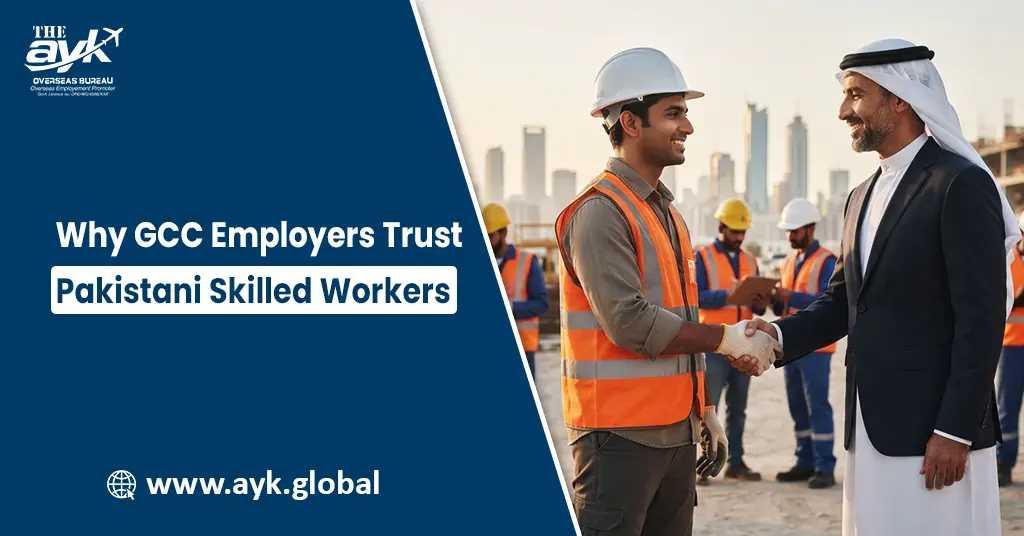
Why GCC Employers Trust Pakistani Skilled Workers
Published: July 02, 2026 | Views: 14
Introduction
The trust that GCC employers place in Pakistani skilled workers is one of the strongest foundations of the Gulf labor market. In countries like Saudi Arabia, United Arab Emirates (UAE), Qatar, Kuwait, Oman, and Bahrain, Pakistani workers are consistently hired across construction, oil and gas, engineering, healthcare, logistics, hospitality, and maintenance sectors. This trust has developed over decades of cooperation, workforce reliability, and consistent performance.
In 2026, GCC countries are going through massive transformation under national development plans like Saudi Vision 2030 and UAE’s economic diversification strategies. These transformations require a highly skilled, disciplined, and adaptable workforce. Pakistani workers continue to play a major role in fulfilling these needs.
Understanding why GCC employers trust Pakistani skilled workers is important for job seekers because it highlights the strengths that make Pakistani professionals competitive in the global job market. It also helps candidates improve their chances of selection by aligning with employer expectations.
This guide explains in detail the key reasons behind this trust and how Pakistani workers can further strengthen their position in the GCC job market.
1. Strong Technical Skills and Practical Experience
One of the biggest reasons GCC employers trust Pakistani skilled workers is their strong technical knowledge and practical experience. Pakistani workers in fields like electrical work, plumbing, welding, HVAC, mechanical maintenance, and construction are known for their hands-on expertise.
Unlike purely theoretical training, many Pakistani technicians gain real-world experience through local industry work before going abroad. This practical exposure makes them highly effective in GCC job environments where immediate productivity is required.
Employers prefer workers who can start working without long training periods. Pakistani skilled workers often meet this requirement, making them a preferred choice for companies in Saudi Arabia, UAE, and Qatar.
2. High Work Ethic and Discipline
Work ethic is one of the most important factors in international employment. GCC employers consistently report that Pakistani workers demonstrate strong discipline, punctuality, and dedication.
In demanding industries like construction and oil & gas, workers are expected to perform under challenging conditions such as extreme heat, long working hours, and strict deadlines. Pakistani workers are known for their ability to adapt and maintain performance in such environments.
This reliability builds long-term trust between employers and Pakistani manpower, leading to repeat hiring and long-term contracts.
3. Adaptability in Multinational Work Environments
GCC workplaces are highly multicultural, with employees from India, Nepal, Bangladesh, Philippines, Egypt, and many other countries. Pakistani workers are known for their ability to adapt quickly to diverse teams and environments.
They are able to understand instructions, work under supervisors from different nationalities, and collaborate effectively in team-based projects.
This adaptability makes them valuable assets in large international projects where coordination is essential for success.
4. Cost-Effective Yet Skilled Workforce
Another reason GCC employers trust Pakistani workers is the balance between skill level and cost efficiency. Pakistani workers offer strong technical abilities at competitive salary expectations compared to workers from some other countries.
This does not mean Pakistani workers are underpaid; rather, they provide high value for the cost. Employers get skilled labor that performs efficiently without requiring excessive training or supervision.
This cost-effectiveness makes Pakistani manpower attractive for large-scale hiring projects in construction, logistics, and industrial sectors.
5. Long History of Employment in GCC Countries
Pakistan has a long history of labor export to GCC countries, dating back several decades. This long-term relationship has created strong institutional trust between employers and Pakistani manpower agencies.
Many GCC companies have repeatedly hired Pakistani workers over generations. This continuity has built a reputation of reliability and familiarity.
Because of this history, employers already understand the strengths and work behavior of Pakistani workers, making them a preferred hiring option.
6. Strong Role of Pakistani Manpower Agencies
Licensed manpower agencies in Pakistan play a crucial role in maintaining employer trust. These agencies ensure proper screening, documentation, and skill verification before sending workers abroad.
For example, structured recruitment systems like those followed by AYK Overseas Recruitment & HR Manpower Agency help ensure that only qualified and verified candidates are presented to GCC employers.
This reduces hiring risks and ensures that employers receive trained and job-ready workers. Over time, this system strengthens trust between GCC companies and Pakistani manpower providers.
7. Reliability in Long-Term Projects
GCC countries often run long-term infrastructure and industrial projects that require stable workforce availability. Pakistani skilled workers are known for staying committed to long-term contracts and completing projects successfully.
Unlike short-term or unstable workforce patterns, Pakistani workers often remain consistent throughout project duration.
This reliability is extremely important for employers because project delays can result in significant financial losses.
8. Strong Presence in Key GCC Industries
Pakistani workers have a strong presence in major GCC industries such as:
- Construction and infrastructure
- Oil and gas operations
- Electrical and mechanical maintenance
- HVAC and plumbing systems
- Logistics and warehouse operations
- Hospitality and facility management
- Healthcare and nursing support
This wide industry presence shows that Pakistani workers are not limited to one sector but are trusted across multiple industries.
9. Problem-Solving and On-Ground Efficiency
GCC employers value workers who can solve problems quickly on-site. Pakistani skilled workers are often praised for their practical problem-solving abilities.
In technical fields like welding, electrical repair, and mechanical maintenance, quick thinking and field experience are essential. Pakistani workers often demonstrate the ability to handle unexpected technical issues effectively.
This reduces downtime and increases productivity, which is highly valued by employers.
10. Strong Communication with Supervisors
Although language barriers exist in multinational environments, many Pakistani workers have basic English communication skills that allow them to understand instructions and report issues effectively.
Clear communication with supervisors is essential in safety-sensitive industries like construction and oil & gas. Pakistani workers generally perform well in this area, improving workplace coordination and efficiency.
11. Trust Built Through Performance Consistency
Trust is not built overnight. GCC employers continue to trust Pakistani workers because of consistent performance over many years.
When employers repeatedly see reliable performance from workers of a particular nationality, they naturally prefer hiring from that workforce again.
This cycle of trust and performance has strengthened Pakistan’s position in GCC labor markets.
12. Growing Demand for Skilled Pakistani Workers
In 2026, GCC countries are increasing demand for skilled workers due to rapid industrial expansion and technological advancement.
Pakistani workers who upgrade their skills, gain certifications, and improve technical knowledge are even more valued in this new job market.
This growing demand further strengthens employer trust and increases job opportunities for Pakistanis.
Conclusion
GCC employers trust Pakistani skilled workers because of their technical expertise, discipline, adaptability, cost-effectiveness, and long-term reliability. This trust has been built over decades of consistent performance across major industries in Saudi Arabia, UAE, Qatar, Kuwait, Oman, and Bahrain.
With the continued growth of GCC economies, this trust is expected to increase further, especially for skilled and certified Pakistani professionals.
Job seekers who focus on skill development, professionalism, and proper recruitment channels will continue to benefit from this strong international trust.
 Why Gulf Employers Prefer Pakistani Manpower Agencies
 Latest GCC Jobs for Skilled and Unskilled Workers in 2026
 The Growing Demand for Pakistani Teachers in the Gulf
 KSA Recruitment
 UAE Recruitment
 Qatar Recruitment
 Oman Recruitment
 Kuwait Recruitment
 Libya Recruitment
 Bahrain Recruitment
 Iraq Recruitment
 Malaysia Recruitment
 Malta Recruitment
 Canada Recruitment
 USA Recruitment
 Europe Recruitment
 UK Recruitment
 Romania Recruitment
 Poland Recruitment
 Bulgaria Recruitment
 Albania Recruitment
 Serbia Recruitment
 Lithuania Recruitment
 Japan Recruitment
 Turkey Recruitment
 Kyrgyzstan Recruitment
 South Korea Recruitment