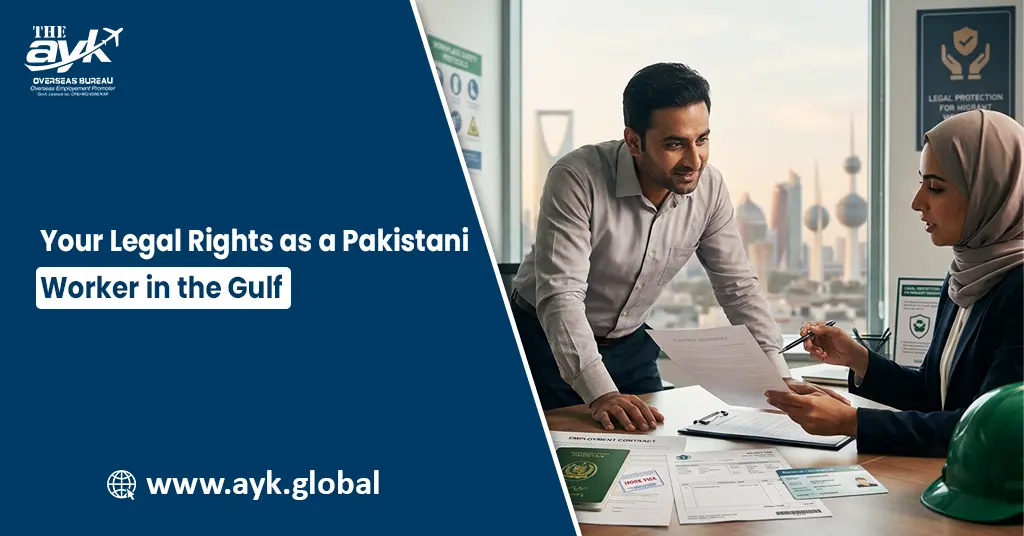
Your Legal Rights as a Pakistani Worker in the Gulf
Published: June 30, 2026 | Views: 16
Introduction
Understanding your legal rights as a Pakistani worker employed within Gulf countries represents essential knowledge that significantly affects your ability to protect yourself throughout your overseas employment period, particularly given that many workers arrive with limited awareness of exactly what protections and entitlements actually apply to their specific situation. While specific regulations vary between different Gulf destinations, certain fundamental worker protections have become increasingly standardized across the region in recent years, reflecting broader regional efforts to improve labor standards.
This guide provides an overview of the key legal rights that generally apply to Pakistani overseas workers across major Gulf destinations, helping establish important baseline knowledge for protecting yourself throughout your employment journey. AYK Overseas Recruitment & HR Manpower Agency, recognized as one of Pakistan's top manpower agencies, believes strongly in empowering workers with this knowledge, since understanding your rights represents an essential foundation for protecting your interests throughout your overseas employment experience.
Right to a Properly Documented Employment Contract
Pakistani workers across Gulf countries generally hold the right to receive a properly documented employment contract clearly specifying salary, working hours, leave entitlements, and other essential employment terms before beginning their actual work duties. This contract should be provided in a language you can understand, or at minimum properly explained to ensure genuine comprehension rather than simply requesting signature without proper understanding.
Workers should insist on receiving this documented contract and having adequate time to review its terms before signing, recognizing this right as fundamental protection against potential exploitation or misunderstanding regarding their actual employment conditions. Any employer reluctant to provide proper documentation or adequate review time should be approached with significant caution regarding their broader commitment to legal, ethical employment practices.
Right to Timely Wage Payment
Most Gulf countries have implemented wage protection systems requiring employers to process salary payments through monitored banking channels within specific timeframes, providing workers with meaningful legal recourse if their employer fails to pay wages on time or in the agreed amount. This wage protection represents one of the most fundamental worker rights, given the historical prevalence of payment-related disputes affecting overseas labor populations.
Workers experiencing wage payment delays or discrepancies should understand their right to report these issues through proper labor authority channels, recognizing that legitimate complaint mechanisms exist specifically to address these common worker protection concerns. Maintaining personal records of your salary payments and any discrepancies provides important documentation supporting any formal complaint you might need to file regarding payment issues.
Right to Reasonable Working Hours and Rest Periods
Gulf labor regulations generally establish maximum working hour limits and mandatory rest period requirements, including weekly rest days and daily rest periods between shifts, designed to prevent excessive work demands that could affect worker health and safety. These regulations typically also address overtime compensation requirements for hours worked beyond standard contracted time.
Workers should understand the specific working hour limits and overtime compensation rules applicable to their particular employment category and destination country, recognizing these regulations as legal protections rather than simply employer discretion regarding scheduling decisions. Workers experiencing what they believe represents excessive working hour demands beyond legal limits should understand their right to raise these concerns through proper channels.
Right to Safe Working Conditions
Across virtually every Gulf destination, workers hold fundamental rights to safe working conditions, including appropriate safety equipment, proper training relevant to workplace hazards, and protection from unreasonably dangerous working environments that violate established safety standards. This right particularly matters within construction, industrial, and various other physically demanding employment categories where safety considerations carry significant practical importance.
Workers should understand their right to raise safety concerns without fear of retaliation, recognizing that legitimate employers should welcome safety concern reporting as supporting their own operational interests rather than viewing such reporting as problematic worker behavior. Workers facing employer retaliation for legitimate safety concerns should understand this retaliation itself often violates broader worker protection regulations.
Right to End of Service Benefits
Most Gulf countries legally require employers to provide end of service benefits, sometimes called gratuity or severance pay, calculated based on length of service and final salary, upon completion of a worker's employment contract regardless of whether the worker or employer initiated the contract's conclusion. This benefit represents an important financial protection that workers should understand and properly track throughout their employment period.
Workers should maintain clear records regarding their employment start date, salary history, and any relevant contract terms affecting end of service benefit calculation, ensuring they can properly verify this benefit's accurate calculation upon contract completion. Workers should understand their right to dispute improperly calculated end of service benefits through appropriate labor authority channels if discrepancies arise.
Right to Medical Care and Health Insurance
Most Gulf employment regulations require employers to provide health insurance coverage or otherwise ensure access to necessary medical care for their overseas workers, recognizing healthcare access as an essential worker protection given workers' typical distance from their home country support systems. This medical care right particularly matters given the various health risks associated with certain physically demanding employment categories.
Workers should understand their specific health insurance coverage details provided by their employer, including what medical services are covered and how to access care when needed. Workers experiencing employer failure to provide promised health insurance or medical care access should understand this represents a significant violation warranting formal complaint through appropriate channels.
Right to Exit Without Unreasonable Employer Obstruction
Following recent labor reforms across several Gulf countries, workers generally hold improved rights regarding exit and travel without excessive employer-imposed obstruction, reducing historical dependency on employer cooperation for routine travel needs or contract completion departure. This improved mobility represents a significant worker protection development compared to historical patterns in some Gulf labor markets.
Workers should understand the specific exit procedures applicable to their particular destination country, recognizing this right while also understanding any legitimate procedural requirements that still apply regarding proper exit documentation. Workers experiencing unreasonable employer obstruction regarding legitimate exit or travel requests should understand their right to seek assistance through proper labor authority or even Pakistani embassy channels if necessary.
Right to File Complaints Without Retaliation
Workers across Gulf countries generally hold legal protection against employer retaliation for filing legitimate labor complaints through proper government channels, recognizing this protection as essential for ensuring workers can actually exercise their other legal rights without fear of negative consequences. This anti-retaliation protection represents a foundational right supporting the practical exercise of all other worker protections discussed throughout this guide.
Workers experiencing or fearing potential retaliation for legitimate complaint filing should understand this protection exists specifically to address such concerns, though practical navigation of this protection sometimes requires careful approach and ideally guidance from knowledgeable sources familiar with proper complaint procedures and protections within their specific destination country.
How AYK Overseas Helps You Understand These Rights
As a government-licensed international recruitment and HR manpower firm with offices in Karachi and Islamabad, AYK Overseas Recruitment & HR Manpower Agency provides candidates with clear understanding of their legal rights before departure, ensuring workers enter their overseas employment with proper awareness of their protections and entitlements. Being recognized as one of Pakistan's top manpower agencies, we believe informed workers are better protected workers throughout their overseas employment journey.
Our team provides thorough contract explanation and ongoing guidance throughout the employment period, helping candidates understand and, where necessary, exercise their legal rights properly. This commitment to worker education and ongoing support has helped AYK Overseas Recruitment & HR Manpower Agency build lasting trust with workers throughout their overseas employment experience.
Conclusion
Pakistani workers across Gulf countries hold meaningful legal rights covering employment contracts, wage payment, working conditions, end of service benefits, and protection from retaliation, though specific regulations vary somewhat between different destinations. Workers who understand these fundamental rights and remain prepared to exercise them appropriately through proper channels are better positioned to protect their interests throughout their overseas employment journey, ideally with ongoing guidance from a knowledgeable, properly licensed recruitment agency.
 BEST RECRUITMENT AGENCY IN PAKISTAN FOR FINLAND
 Recruitment Insights for Employers in Basra
 What to Pack When Moving Abroad for Work
 KSA Recruitment
 UAE Recruitment
 Qatar Recruitment
 Oman Recruitment
 Kuwait Recruitment
 Libya Recruitment
 Bahrain Recruitment
 Iraq Recruitment
 Malaysia Recruitment
 Malta Recruitment
 Canada Recruitment
 USA Recruitment
 Europe Recruitment
 UK Recruitment
 Romania Recruitment
 Poland Recruitment
 Bulgaria Recruitment
 Albania Recruitment
 Serbia Recruitment
 Lithuania Recruitment
 Japan Recruitment
 Turkey Recruitment
 Kyrgyzstan Recruitment
 South Korea Recruitment