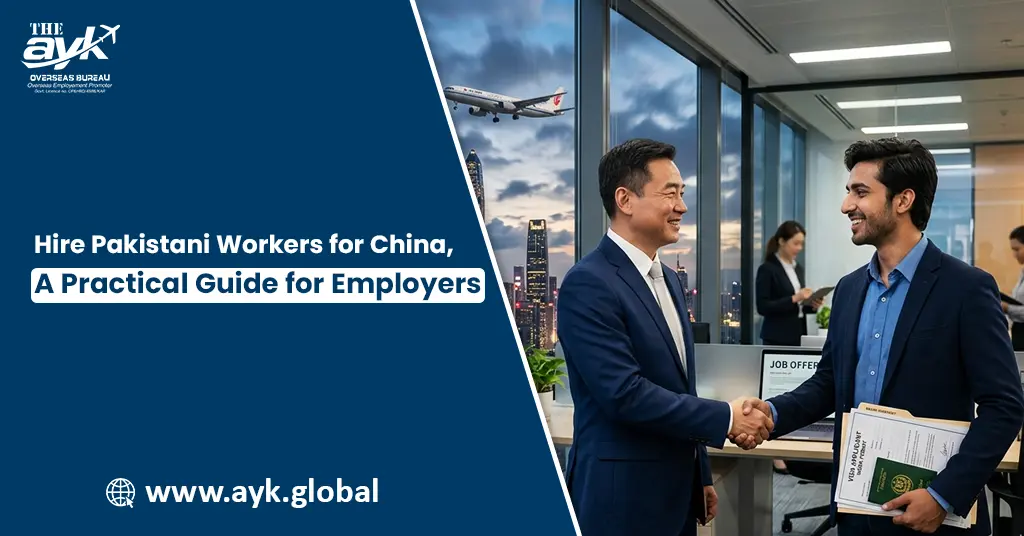
Hire Pakistani Workers for China
Operating a business in China today means managing growth while maintaining efficiency at scale. Industries such as manufacturing, construction, logistics, and large-scale services are constantly expanding, driven by both domestic demand and global trade. However, alongside this growth comes a consistent challenge that many employers face, maintaining a stable and reliable workforce that can keep operations running smoothly over time.
Across different sectors, a common pattern continues to emerge. Hiring workers may not be difficult at the beginning, but maintaining performance, consistency, and retention becomes a long-term concern. Many roles require physical effort, repetitive tasks, and structured routines. While these roles are essential for operations, they are not always easy to fill consistently through local hiring alone. Workers may shift between jobs, may not remain in physically demanding roles for long periods, or may not maintain the level of productivity required in high-demand environments.
This creates a cycle where businesses are constantly hiring, training, and replacing staff. Over time, this cycle affects productivity, increases operational costs, and creates pressure on management. Instead of focusing on growth, businesses find themselves dealing with workforce instability.
This is where international recruitment becomes a practical and strategic solution. Rather than relying only on local availability, employers in China are increasingly exploring global talent pools to fill gaps in their workforce. AYK Overseas Recruitment & HR Manpower Agency works with employers to provide access to Pakistani workers who are selected based on real job requirements. The goal is not just to fill vacancies, but to build a workforce that supports long-term operations.
Why Workforce Challenges Are Increasing in China
Workforce challenges in China are not limited to one sector. They are visible across multiple industries, each with its own demands but facing similar issues when it comes to manpower stability.
In manufacturing, production lines depend on continuous operation. Even a small disruption in manpower can slow down output and affect delivery timelines. In logistics, the movement of goods depends on workers handling tasks efficiently at every stage. Any delay in manpower can impact the entire supply chain. Construction projects require a steady workforce at every stage, and shortages can lead to project delays and increased costs.
Another factor contributing to these challenges is changing workforce expectations. Many individuals prefer roles that offer flexibility and less physical demand. While this shift is understandable, it creates a gap in industries where structured routines and physical effort are necessary.
As a result, employers are increasingly looking for solutions that go beyond traditional hiring methods. International recruitment provides an opportunity to access workers who are prepared for these roles and willing to maintain performance over time.
Why Employers in China Are Turning to Pakistani Workers
In fact, in many firms in China, it has turned into the necessity to hire Pakistani workers to fill the existing manpower gaps and increase stability within their business. The point is that using these employees does not aim at replacing the existing workforce. Rather, the primary objective is enhancing its quality.
Experience is one of the most significant reasons behind such decision. Most workers in Pakistan operate in sectors where manual labor and routine are typical phenomena. In that case, the adaptation process will not be too complicated because of the similar nature of the job in the new country.
The second important aspect is consistency. It has been noticed that when people used to work under conditions of strict routine, they could preserve their performance on a high level. Consequently, it would help avoid potential disruptions.
Another reason is commitment. Apart from simply completing certain tasks, the company needs those people who will be able to commit themselves to the work for quite some time.
Industries in China That Benefit Most from International Hiring
Different industries in China benefit from international recruitment in different ways, but the overall impact remains the same, improved stability and consistency.
Manufacturing is one of the largest sectors where consistent manpower is essential for maintaining production levels. Logistics and warehousing operations depend on workers who can manage the movement of goods efficiently. Construction projects require steady manpower to maintain timelines and avoid delays.
Agriculture also benefits from international hiring, particularly during peak seasons when large numbers of workers are needed. Service industries such as hospitality and facility management rely on consistency in daily operations, where workforce stability directly affects service quality.
In all these sectors, the need is not just for workers, but for workers who can handle the demands of the job and maintain performance over time.
How the Hiring Process Works in a Practical Way
For employers in China, international hiring may seem complex at first, but it becomes manageable when approached in a structured way.
The process begins with clearly defining workforce requirements. This includes job roles, working conditions, and expectations. Once these details are established, candidates are sourced and screened to ensure they match the requirements.
After selection, the process moves into documentation and approvals. While this stage involves multiple steps, it becomes much smoother when handled by an experienced recruitment partner like AYK Overseas Recruitment & HR Manpower Agency.
By the time workers are ready for deployment, most of the administrative work has already been completed, allowing employers to focus on integrating them into their operations.
Understanding the Legal Side Without Overcomplicating It
For many employers in China, the legal process of hiring foreign workers may initially seem detailed and difficult to navigate. There are multiple steps involved, including preparing employment contracts, handling documentation, securing approvals, and coordinating the final deployment of workers. While this may appear complex at first, the process becomes far more manageable when it is approached in a structured and organized way.
The process begins with a clearly defined job offer that outlines responsibilities, working conditions, and expectations. This step is important because it ensures that both the employer and the worker have a clear understanding of the role from the beginning. Once this is established, the next stage involves submitting documentation and securing approvals. This ensures that the hiring process meets all necessary legal and regulatory requirements before moving forward.
The next step is sourcing and screening candidates. Suitable workers are selected based on their qualifications and ability to perform the job.
After approvals are completed, the process moves into visa arrangements and final deployment. While this stage requires coordination, much of the complexity is handled behind the scenes when managed by an experienced recruitment partner. For employers, the key is to focus on defining their workforce needs clearly while relying on a structured process to handle the technical aspects. When each stage is handled properly, the process becomes predictable and easier to manage.
Common Hiring Challenges and How Businesses Overcome Them
Employers across China face a set of common workforce challenges that go beyond initial hiring. These challenges are often linked to retention, consistency, and the ability to maintain productivity over time.
One of the most frequent issues is high turnover. Workers may leave after a short period, which forces businesses to restart the hiring process repeatedly. This not only increases costs but also disrupts operations and reduces efficiency.
Another challenge is inconsistent performance. Some workers may not be suited for physically demanding or routine-based roles, which can affect productivity. In industries such as manufacturing, construction, and logistics, even small performance issues can have a significant impact.
Timing is also a critical factor. In construction, delays in manpower can slow down project timelines. In logistics, workforce shortages can disrupt the flow of goods. In agriculture, delays can affect planting and harvesting cycles. These timing issues can create a chain reaction that impacts overall operations.
Businesses that adopt international recruitment as part of their long-term strategy often find that these challenges become easier to manage. By selecting workers based on suitability and planning ahead, they can build a workforce that is more stable and reliable.
How a Structured Recruitment Approach Improves Results
The success of any hiring strategy depends on how well the process is managed. A structured recruitment approach focuses on understanding job requirements in detail, selecting candidates based on actual needs, and handling each stage of the process in an organized way.
For employers in China, this approach leads to better results. Workers who are selected based on their ability to handle the job are more likely to perform consistently after deployment. This reduces the chances of mismatch and improves overall efficiency.
Another important benefit is smoother processing. When documentation and approvals are handled correctly, delays are minimized. This allows businesses to plan their workforce more effectively and avoid last-minute disruptions.
Over time, this approach creates a system where hiring becomes more predictable. Instead of dealing with constant uncertainty, employers can focus on growth and operational efficiency.
Long Term Benefits of Hiring Pakistani Workers for Chinese Businesses
While the immediate goal of hiring is to fill positions, the long-term benefits often have a much greater impact on business performance. Employers in China who adopt international recruitment as part of their strategy often notice improvements in stability, efficiency, and workflow.
A consistent workforce reduces the need for repeated hiring and training, saving both time and resources. It also allows businesses to focus more on operations rather than constantly managing staffing issues. Over time, this leads to smoother workflows and improved productivity.
Flexibility is another key advantage. Businesses can scale their workforce based on demand, increasing manpower during peak periods or maintaining a steady team for ongoing operations.
Consistency also improves teamwork. When workers stay in their roles for longer periods, they become familiar with processes and with each other, which enhances coordination and reduces errors.
Choosing the Right Recruitment Partner Matters
Choosing the best recruiting company for employers based in China can be considered one of the critical aspects of the whole hiring process. A good recruiting company does not just provide workers; it understands the type of job to be done, the expectations of the client, and the difficulty of recruiting overseas workers.
This is what sets AYK Overseas Recruitment & HR Manpower Agency apart. Through careful evaluation and matching of the needs of the client with the proper personnel, successful recruiting results can be ensured.
Effective communication is another factor. Through clear communication at the start of the process, things become much easier in the end.
Practical Tips Before Starting the Hiring Process
Before starting the hiring process, employers in China should clearly define their workforce requirements. This includes job roles, working conditions, schedules, and performance expectations. The more detailed the requirements, the easier it becomes to find suitable candidates.
Planning ahead is also important. Waiting until there is an urgent shortage can lead to rushed decisions and delays. Starting early allows enough time for proper selection and processing.
Once workers arrive, clear communication helps them adapt more quickly. Explaining routines, expectations, and responsibilities ensures that they can perform consistently from the start.
Building a Workforce That Supports Long Term Growth
Ultimately, it is clear that Chinese enterprises do not simply employ individuals; they are creating teams that can facilitate the functioning of these organizations. Although there will always be a need for locally sourced labor, it may not necessarily be sufficient in certain cases.
The international recruitment process presents a viable option. This process entails linking employers to candidates who have all the necessary qualifications required by the organization, thereby ensuring efficiency and stability.
AYK Overseas Recruitment & HR Manpower Agency presents an effective strategy that emphasizes the importance of results. Through the appropriate candidate selection process and efficient process management, organizations are able to transcend their recruitment difficulties.
FAQs
How can employers in China start hiring workers from Pakistan?
By defining requirements and working with AYK Overseas Recruitment.
Is the hiring process complicated?
It becomes manageable with a structured approach.
Which industries benefit the most?
Manufacturing, construction, logistics, agriculture, and hospitality.
Does international hiring improve stability?
Yes, it helps reduce turnover and improve consistency.
How long does the process take?
A few weeks to a couple of months.



 KSA Recruitment
 UAE Recruitment
 Qatar Recruitment
 Oman Recruitment
 Kuwait Recruitment
 Libya Recruitment
 Bahrain Recruitment
 Iraq Recruitment
 Malaysia Recruitment
 Malta Recruitment
 Canada Recruitment
 USA Recruitment
 Europe Recruitment
 UK Recruitment
 Romania Recruitment
 Poland Recruitment
 Bulgaria Recruitment
 Albania Recruitment
 Serbia Recruitment
 Lithuania Recruitment
 Japan Recruitment
 Turkey Recruitment
 Kyrgyzstan Recruitment
 South Korea Recruitment