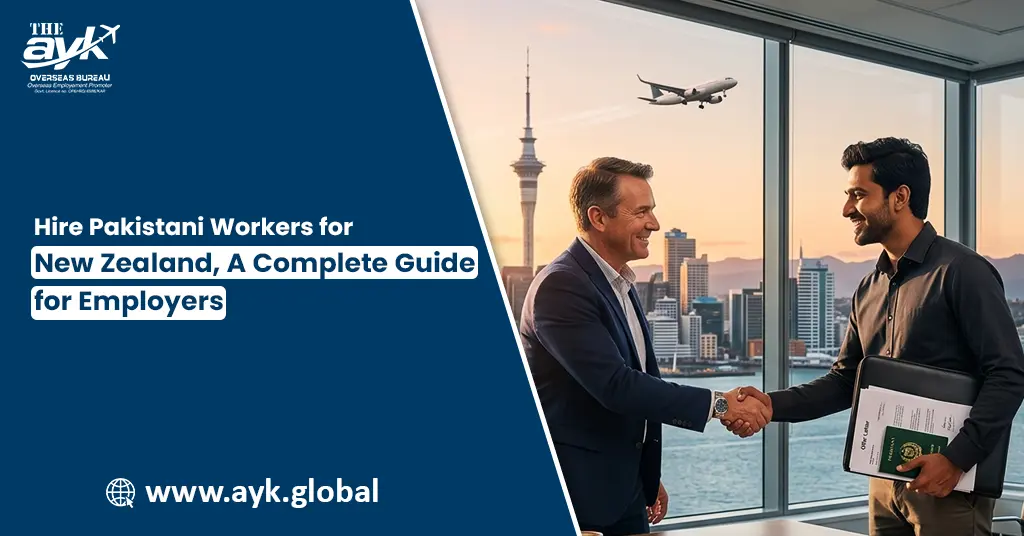
Hire Pakistani Workers for New Zealand, A Complete Guide for Employers
Having a business in New Zealand today means much more than simply operating the business. Today’s business owners need to create an efficient work force that can continue growing, be consistent, and be flexible as new demands arise in sectors such as construction, agriculture, dairy farming, logistics, manufacturing, and the hospitality industry. Many businesses manage to find ways to attract employees initially, yet the actual difficulty arises once employees start coming in, since many employers are having a hard time keeping their employees motivated, reliable, and productive. This problem does not apply to only one sector, but to all businesses regardless of their size.
More specifically, employers are often faced with the vicious circle of hiring, training, and deploying workers, and then experiencing the departure of some employees, inconsistency of others, and general decline in their stability. As a result, businesses have to continue repeating the same steps again and again, investing additional money and effort into the maintenance of a stable work force rather than concentrating on expanding and improving their businesses.
Such problems often arise in occupations where there is a need for a significant amount of physical labor and adherence to routine and schedules over long periods of time. Although necessary for regular operation, such jobs are becoming harder to fill via local labor recruitment due to the changing trends in the workforce. More people are preferring jobs which require less effort or provide more freedom in terms of working hours and place.
This is why international labor recruitment seems to be a perfect solution for many companies operating in New Zealand. By employing an international recruitment company, one can increase the number of people employed from a different country and thus attract more suitable candidates who are willing to commit to their occupation for long-term periods. AYK Overseas Recruitment & HR Manpower Agency offers help in recruiting suitable Pakistani workers according to job requirements.
Why Workforce Challenges Are Increasing in New Zealand
Manpower problems in New Zealand have become increasingly evident in recent times due to an increasing demand in most sectors. Due to increasing infrastructure development, agriculture exports, and logistics/services demand, there has been a higher demand for workers to meet manpower needs. Unfortunately, the supply side of the workforce for physically demanding jobs is not keeping up with demand.
Construction requires regular labor to help the construction processes meet the deadline requirements. Agriculture and dairying requires workforce availability throughout the planting, harvesting, and milking seasons. In logistics, regular manpower is needed to help deliver goods. Manpower requirements for manufacturing and processing sectors require regular labor as well.
The current trends of manpower availability are changing as more people are seeking flexible jobs. Some people seek non-physically demanding jobs that do not require too much discipline. This mismatch creates some of the current manpower problems.
Why Employers in New Zealand Are Turning to Pakistani Workers
To many employers in New Zealand, employing Pakistani workers becomes an effective way of solving the problems with their employees. However, this process does not involve replacement of domestic employees; it simply helps to bolster those areas where there may be deficiencies.
The first benefit is related to the experience. Most workers from Pakistan have extensive experience in the industry that involves working in processes, labor and discipline. This makes them easily adjust to working conditions in New Zealand.
The second one is consistent performance. Workers from routine-based jobs tend to be more consistent in their efforts and performance.
Finally, commitment should not be overlooked. It is one thing to work for some days, but when an employer needs someone to work on projects on a long-term basis, then commitment comes into play. Workers seeking foreign employment tend to have such qualities.
Industries in New Zealand That Benefit Most from International Hiring
Different industries in New Zealand benefit from international recruitment in different ways, but the overall objective remains the same, improving workforce stability and operational efficiency.
Construction relies on consistent manpower to maintain project timelines. Agriculture and dairy farming require workers for planting, harvesting, and livestock care. Horticulture depends on seasonal labor for fruit picking and vineyard operations. Logistics operations require continuous workforce support to maintain supply chain efficiency, while manufacturing and processing industries depend on stable staffing to maintain production.
Hospitality and service sectors also benefit from reliable manpower to maintain service quality, especially during peak tourism seasons.
How the Hiring Process Works in a Practical Way
While it can be confusing for employers based in New Zealand to consider international recruitment initially, the whole procedure is made much easier through systematic planning and organization.
This starts with the identification of workforce needs, taking into account the required job positions, work conditions, and performance levels. After setting the requirements, employees are then identified and selected.
Finally, documentation and approval processes follow, which may entail several steps. But with the help of an expert recruiting company, such as AYK Overseas Recruitment & HR Manpower Agency, this will go much easier.
With this process, employers can take the step of deploying the workers without having to worry too much about the paperwork since most of the work has already been done.
Understanding the Legal Side Without Overcomplicating It
For employers in New Zealand, hiring foreign workers is governed by a structured legal framework designed to ensure fair employment practices, protect worker rights, and maintain compliance with national labor and immigration standards. At first, this process may appear detailed, especially for businesses that are new to international hiring, but in reality, it becomes manageable when handled in an organized and step-by-step manner with the support of an experienced recruitment partner.
The process begins with clearly defining the job role and preparing an employment offer that outlines responsibilities, working conditions, wages, and expectations. This step ensures transparency and helps both employer and worker understand the scope of the role from the beginning. Once this is established, employers proceed to documentation and approval stages, which involve submitting necessary details to relevant authorities and ensuring compliance with regulatory requirements. These steps are essential for maintaining a lawful and structured hiring process.
After approvals are secured, the process moves into visa arrangements and final deployment. While this stage requires coordination, much of the complexity can be handled efficiently when working with a professional agency. For employers, the key is to focus on defining workforce requirements accurately while relying on a structured system to manage administrative and legal procedures. When each step is handled properly, the hiring process becomes predictable, efficient, and aligned with operational timelines.
Common Hiring Challenges and How Businesses Overcome Them
Employers across New Zealand face several workforce challenges that extend beyond the initial hiring stage. These challenges are often related to retention, performance consistency, and the ability to maintain productivity over long periods.
One of the most common issues is high turnover. Workers may leave after a short period, forcing businesses to restart the hiring process repeatedly. This increases costs and disrupts operations, making it difficult to maintain efficiency.
Another major challenge is inconsistent performance. Some workers may not be suited to physically demanding or routine-based roles, which creates gaps in workflow and reduces productivity. In industries such as construction, agriculture, logistics, manufacturing, and hospitality, even small inefficiencies can have a significant impact on overall operations.
Timing also plays a critical role. In agriculture and horticulture, delays in workforce availability can affect planting and harvesting cycles. In construction, manpower shortages can slow down project progress. In logistics, staffing gaps can disrupt supply chains, while in hospitality, workforce shortages can impact service quality.
Businesses that adopt international recruitment as a long-term strategy often find that these challenges become easier to manage. By selecting workers based on suitability and planning workforce requirements in advance, they can build a system that is more stable, reliable, and efficient.
How a Structured Recruitment Approach Improves Results
The effectiveness of recruitment depends largely on how well the process is managed. A structured recruitment approach focuses on understanding job requirements in detail, selecting candidates based on real-world suitability, and managing each stage efficiently.
For employers in New Zealand, this approach leads to better hiring outcomes. Workers who are selected based on their ability to handle actual job conditions are more likely to perform consistently after deployment. This reduces the chances of mismatch and improves overall productivity.
Another important advantage is process efficiency. When documentation and approvals are handled in an organized way, delays are minimized. This allows businesses to plan workforce requirements more effectively and avoid last-minute disruptions.
Over time, a structured approach creates predictability in hiring. Instead of dealing with uncertainty and repeated workforce issues, employers can focus on long-term growth and operational stability.
Long Term Benefits of Hiring Pakistani Workers for New Zealand Businesses
Even though the immediate aim of employing people is to meet vacancies, its long-term effects are far more significant for the business's success. International recruiting for employers in New Zealand will lead to improved levels of consistency, efficiency, and workflow generally.
There is no need to hire again and again as well as train the new employees; instead, time and efforts can be invested in business activities.
Another positive point of this process is its flexibility. Companies can increase their number of workers when needed, but not just because the peak period has come.
Finally, there is consistency in work. The more experienced and longer workers are at their jobs, the better they cooperate with one another.
Choosing the Right Recruitment Partner Matters
Employers in New Zealand have to choose their recruitment partner wisely and appropriately during the recruiting process because an experienced recruitment agency will not only provide candidates but will also understand the essence of the job, needs of the employer, and issues related to international recruitment.
The AYK Overseas Recruitment & HR Manpower Agency provides its clients with workforce solutions tailored to the requirements of the employer. Evaluating the requirements and matching candidates will increase the efficiency of hiring.
Communication is also very important. If the employer makes it clear what his requirements are and what he expects, then this will simplify all the processes.
Practical Tips Before Starting the Hiring Process
Before starting the hiring process, employers in New Zealand should clearly define their workforce requirements, including job roles, working conditions, schedules, and performance expectations.
Planning ahead is critical. Waiting until there is an urgent shortage often leads to rushed decisions and delays. Starting early allows enough time for proper candidate selection and documentation processing.
Once workers are deployed, clear communication helps them adapt quickly. Explaining routines, expectations, and responsibilities ensures that workers can perform consistently from the beginning.
Building a Workforce That Supports Long Term Growth
The firms in New Zealand are not only looking for individuals to hire, but they are also forming teams to help facilitate their business in the long run. Although local recruitment can play an essential role, it may not suffice in light of increasing demands.
Foreign recruitment can serve as a feasible answer to this situation, allowing companies to connect with employees who are ready to work and willing to uphold their productivity over time.
Through AYK Overseas Recruitment & HR Manpower Agency, you can receive assistance with both candidate selection and process management, enabling your firm to go above and beyond its current hiring hurdles.


 KSA Recruitment
 UAE Recruitment
 Qatar Recruitment
 Oman Recruitment
 Kuwait Recruitment
 Libya Recruitment
 Bahrain Recruitment
 Iraq Recruitment
 Malaysia Recruitment
 Malta Recruitment
 Canada Recruitment
 USA Recruitment
 Europe Recruitment
 UK Recruitment
 Romania Recruitment
 Poland Recruitment
 Bulgaria Recruitment
 Albania Recruitment
 Serbia Recruitment
 Lithuania Recruitment
 Japan Recruitment
 Turkey Recruitment
 Kyrgyzstan Recruitment
 South Korea Recruitment