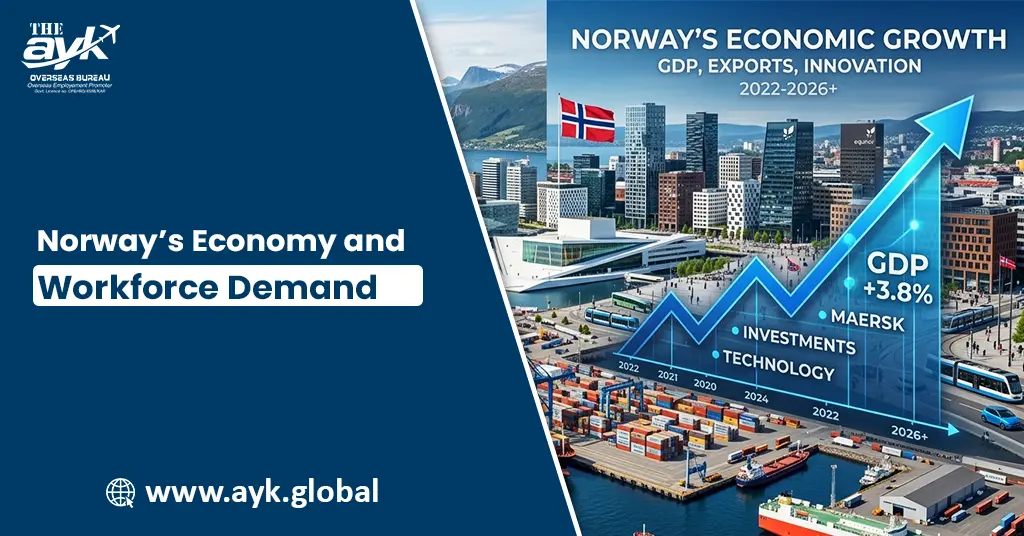
Norway’s Economy and Workforce Demand
Norway is one of the economically stable nations in Europe. It is famous for its high standards of living, industries, and advanced public utilities. Some of the major drivers of Norway’s economy include the construction industry, oil and gas services, manufacturing industry, fishing industry, logistics, hospitality, and healthcare industries. The above industries have been expanding steadily because of increased infrastructure development, international business activities, tourism, and government expenditure on public services.
Even though Norway is a powerful economy, it faces significant challenges regarding the availability of an adequate workforce in various industries. Some firms are struggling to get enough employees for labor-intensive operations. Norway boasts of highly educated citizens. However, most citizens would rather work as technicians, managers, or professionals rather than laborers. Such a trend has caused a labor shortage in various industries.
Therefore, international recruiting has become a must for Norwegian businesses. By recruiting international workers, organizations can continue to be efficient and complete their tasks. Among international suppliers, Pakistan is one of the most trustworthy suppliers of manpower owing to its large number of people, industry experience, and compatibility with international conditions of work
Labour Shortage in Norway, Key Reasons
It needs to be noted that the issue in question is a structural problem associated with demographical and economic changes in the country. The first reason that leads to this shortage is the smaller size of the country’s population. With an increase in demands in terms of construction projects, production volumes, and other sectors of activity, there is not enough human resources to satisfy them.
Moreover, changes in preferences concerning career selection also lead to this phenomenon. Many Norwegian employees want to work in technical, engineering, or office positions. Thus, there is a lack of manpower in the manual sector including the sphere of construction, transportations, cleaning, and hospitality. Another problem here is that due to the aging population, many skilled specialists retire, while not many young people prefer manual activities.
Consequently, the country depends on foreign workers to some extent.
Major Industries Facing Workforce Shortage
Another area in which manpower shortages are common is Norway’s construction sector. Since there is always a need for construction projects, it means that there will always be a need for more manpower. Lack of manpower leads to delays and even higher cost implications.
There are also some other industries that need manpower to sustain their production processes. Some examples include food processing, machinery manufacturing, and industrial goods manufacture. There is also need for manpower in fisheries and seafood processing in order to meet demands for exports.
The logistics and warehousing sector has grown tremendously in terms of e-commerce, and therefore there is need for manpower in this field, as well. Manpower is needed to load and unload products in addition to doing warehousing. Other areas in which there is need for manpower include hospitality and cleaning services.
Why International Recruitment is Essential for Norway
Recruitment from outside of Norway has been one of the key solutions in helping Norwegian businesses solve the problem of manpower shortage. Recruitment from other countries enables companies to get a greater pool of employees who will be ready to carry out operational and tough jobs.
Additionally, it provides companies with the benefit of flexibility. They have the ability to hire employees depending on the seasonality of their work, projects, or contracts. International workers are known to have experience within such areas that makes it easier to train them.
Why Pakistani Workers Are Highly Preferred
Norwegians are inclined to prefer Pakistani workers because of their diligence, self-discipline, and working experience in sectors where manual labor is required. These workers are often found in fields such as construction, industry, logistics, tourism, and health services, among others.
The qualities which make Pakistani workers preferable are their reliability and readiness to remain employed for a long period of time. They are quick to adapt to a well-organized system of work and perform efficiently even in adverse circumstances.
Step-by-Step Recruitment Process for Norway
There is a certain recruitment procedure which employers must follow while hiring personnel in Norway. Initially, the employers determine what kind of employees they need – that is, their positions, quantity, and level of skills required. Following this step, recruitment begins by seeking out potential employees in foreign countries such as Pakistan.
The next step consists of screening applicants in terms of their experience, physical ability to perform the tasks assigned, and appropriateness of the applicants to the job in question. A background check is also carried out in order to assess the reliability of applicants.
The employer provides an employment contract, and an application for work permit is made. Following this step, the candidate applies for visa at the Norwegian embassy in his country of origin.
Norway Work Visa Process Explained
The work visa for Norway is systematic and necessitates proper documentation at each step. First, the applicant must be in receipt of a job offer from an employer based in Norway. Next, the employer makes an application for work permission on behalf of the chosen applicant.
After successful issuance of the work permit, the applicant makes an application for the visa, attaching his passport, employment agreement, medical papers, and other relevant documentation. The time taken in the processing of these documents varies according to individual cases. The submission of inaccurate documents can cause delays or even the denial of the visa, which calls for the involvement of a recruitment agency in the process.
Role of Recruitment Agencies in Norway Hiring
Manpower agencies like AYK Overseas Recruitment & HR Manpower Agency offer total solutions to employers in Norway regarding their manpower requirements.
This agency also coordinates with the employer and the candidate for the process of issuing visa. Through this, a burden is lifted off the shoulders of the employer and the entire process becomes much easier and quick.
Benefits of Hiring Through Professional Recruitment System
A systematic recruitment process offers many benefits, such as rapid hiring, improved quality of applicants, and minimized risks. The employer is provided with pre-vetted individuals that can be readily deployed, saving time in staffing. International employees play a role in maintaining workforce stability since they are willing to sign up for long-term contracts. This results in lower turnover rates and greater consistency in operations.
The organization also experiences lower training costs and higher efficiency.
Future Workforce Demand in Norway
The need for foreign employees in Norway is likely to increase in the years ahead owing to continued industrial development and changing demographics. The construction, logistics, fishing, manufacturing, tourism, and healthcare industries will continue to require foreign labor.
As the domestic workforce gets older and more specialized, there will be an even greater need for workers in the manual labor industries. Early adopters of international hiring will be at a huge advantage when it comes to retaining their workforce.
The Norwegian labor market is currently experiencing a gradual change where domestic supply of labor cannot match demand from the industries. The need for international recruitment becomes very critical at this point.
Pakistan continues to be one of the sources of manpower since it offers a huge pool of labor, has industrial experience, and is flexible. The services offered by AYK Overseas Recruitment & HR Manpower Agency will assist Norwegian companies in developing an effective labor system.



 KSA Recruitment
 UAE Recruitment
 Qatar Recruitment
 Oman Recruitment
 Kuwait Recruitment
 Libya Recruitment
 Bahrain Recruitment
 Iraq Recruitment
 Malaysia Recruitment
 Malta Recruitment
 Canada Recruitment
 USA Recruitment
 Europe Recruitment
 UK Recruitment
 Romania Recruitment
 Poland Recruitment
 Bulgaria Recruitment
 Albania Recruitment
 Serbia Recruitment
 Lithuania Recruitment
 Japan Recruitment
 Turkey Recruitment
 Kyrgyzstan Recruitment
 South Korea Recruitment