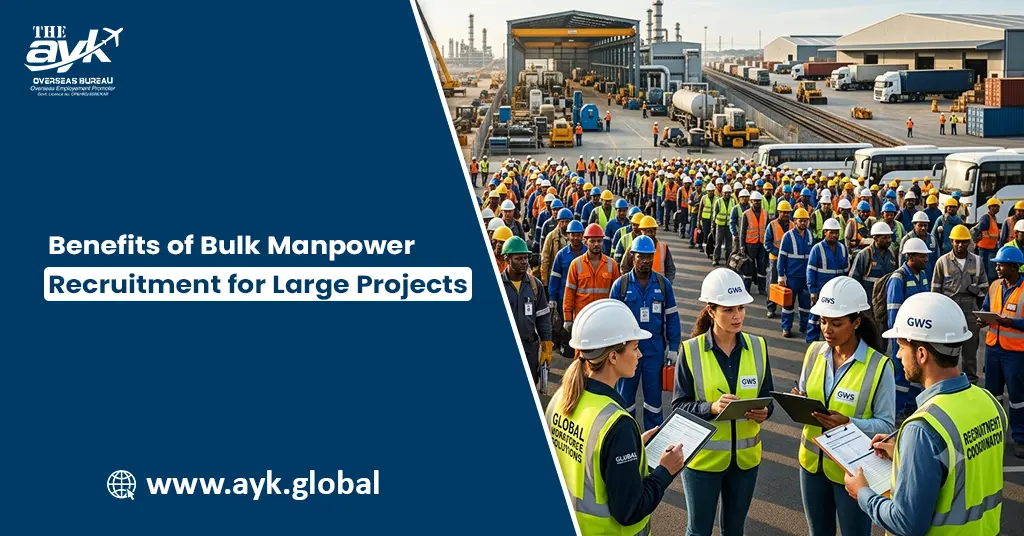
Benefits of Bulk Manpower Recruitment for Large Projects
Published: June 23, 2026 | Views: 26
Large-scale projects create significant workforce demands that often exceed the capabilities of traditional recruitment methods. Whether constructing airports, highways, industrial plants, hospitals, residential developments, logistics hubs, energy facilities, manufacturing plants, or large commercial complexes, employers frequently need hundreds or even thousands of workers within limited timeframes. Securing this workforce efficiently is one of the most critical factors influencing project success.
Many organizations underestimate the complexity of large-scale recruitment. Hiring a small number of employees may be manageable through standard HR processes, but recruiting hundreds of workers simultaneously requires specialized sourcing capabilities, workforce planning expertise, screening systems, documentation management, and deployment coordination. Without a structured recruitment strategy, workforce shortages can delay projects, increase costs, and reduce operational efficiency.
Bulk manpower recruitment provides a solution by enabling employers to secure large workforce volumes quickly and efficiently. Professional manpower supply companies help organizations source, evaluate, mobilize, and deploy workers according to project requirements. This approach reduces recruitment risks and ensures workforce availability throughout project lifecycles.
Industries such as construction, oil and gas, manufacturing, logistics, healthcare, hospitality, facilities management, transportation, and engineering rely heavily on bulk recruitment services because workforce scale directly influences project outcomes. Employers that implement effective mass hiring strategies are often better positioned to meet deadlines, control costs, and maintain productivity.
This guide explores the key benefits of bulk manpower recruitment and explains why it has become an essential workforce solution for large projects.
1. Large Projects Require Workforce Scale
The most obvious reason organizations use bulk manpower recruitment is workforce volume. Large projects often require hundreds of employees across multiple workforce categories, including engineers, supervisors, technicians, operators, skilled tradespeople, laborers, administrative staff, and support personnel.
Recruiting these employees individually through traditional hiring methods can take months or even years. Project schedules rarely allow this level of delay. Employers need workforce solutions capable of delivering large numbers of qualified candidates within compressed timelines.
Bulk recruitment enables organizations to meet workforce demands more effectively. Recruitment activities are planned strategically, sourcing efforts are coordinated at scale, and workforce deployment occurs systematically. This improves project readiness and reduces staffing bottlenecks.
Organizations that can secure workforce resources quickly are better positioned to execute large projects successfully. Workforce availability becomes a competitive advantage that supports growth and operational performance.
Workforce Scale Benefits
Large projects require substantial workforce resources.
Bulk recruitment improves staffing capacity.
Project readiness depends on workforce availability.
2. Faster Hiring Accelerates Project Timelines
Project schedules are often tightly managed. Delays in workforce acquisition can affect every phase of project execution, from planning and construction to commissioning and operational readiness. Employers therefore need recruitment processes capable of supporting aggressive timelines.
Bulk manpower recruitment accelerates hiring by leveraging dedicated sourcing teams, workforce databases, and established recruitment networks. Rather than recruiting workers individually, employers can engage in coordinated recruitment campaigns that produce workforce results more quickly.
Professional manpower suppliers maintain talent pipelines that allow them to respond rapidly to workforce requirements. Candidates may already be pre-screened, trade-tested, and deployment-ready, reducing recruitment timelines significantly.
Faster hiring improves project execution because employees can begin contributing sooner. Organizations avoid costly delays and maintain momentum throughout project lifecycles.
Speed Advantages
Workforce delays can affect project completion.
Mass recruitment accelerates hiring activities.
Faster deployment supports operational efficiency.
3. Reduces Recruitment Costs Through Economies of Scale
Recruitment involves both direct and indirect costs. Advertising expenses, recruiter salaries, candidate evaluations, documentation processing, onboarding activities, and administrative workloads all contribute to workforce acquisition costs.
When hiring occurs at scale, many of these costs can be distributed across larger workforce volumes. This creates economies of scale that improve recruitment efficiency and reduce average hiring costs per employee.
Bulk manpower recruitment allows employers to streamline sourcing activities, standardize evaluation procedures, and coordinate workforce mobilization more effectively. Recruitment agencies and manpower suppliers often achieve cost efficiencies because they manage large workforce projects regularly.
Reducing recruitment costs is particularly important for large projects where workforce expenses represent a significant portion of operational budgets. Employers benefit from improved financial performance while maintaining workforce quality standards.
Cost Savings Benefits
Economies of scale reduce recruitment expenses.
Standardized processes improve efficiency.
Lower workforce acquisition costs support profitability.
4. Access to Larger Talent Pools
One of the biggest challenges associated with large projects is identifying enough qualified candidates to meet workforce requirements. Local labor markets may not provide sufficient talent, particularly when projects require specialized skills or large workforce volumes.
Bulk recruitment strategies expand candidate reach by leveraging regional, national, and international talent networks. Professional manpower suppliers maintain workforce databases and recruitment partnerships that provide access to larger labor pools than many employers could reach independently.
Broader talent access improves workforce availability and increases the likelihood of finding suitable candidates. Employers gain flexibility because workforce sourcing is not limited to a single geographic area or recruitment channel.
Large talent pools also support workforce quality because organizations can evaluate a wider range of candidates before making hiring decisions.
Talent Pool Benefits
Larger workforce networks improve candidate availability.
Broader sourcing expands recruitment options.
Talent access supports workforce quality.
5. Supports Multiple Workforce Categories Simultaneously
Large projects rarely require only one type of employee. Employers often need a combination of managers, engineers, supervisors, technicians, skilled tradespeople, operators, laborers, logistics personnel, administrative staff, and support workers.
Managing recruitment for multiple workforce categories can be complex. Different positions require different sourcing strategies, evaluation methods, qualifications, and deployment procedures. Coordinating these activities internally can overwhelm recruitment teams.
Bulk manpower recruitment simplifies workforce acquisition by integrating multiple hiring streams into a single recruitment strategy. Employers can source diverse workforce categories through one coordinated process rather than managing numerous separate recruitment campaigns.
This integrated approach improves efficiency and helps ensure that all workforce requirements are addressed consistently. Project teams become operational more quickly and workforce coordination improves significantly.
Multi-Category Workforce Benefits
Large projects require diverse workforce skills.
Integrated recruitment improves coordination.
Multiple workforce categories can be sourced efficiently.
6. Improves Workforce Planning and Resource Allocation
Successful projects require more than simply hiring workers. Employers must also ensure that workforce resources are allocated effectively throughout project lifecycles. Workforce planning helps organizations determine staffing requirements, deployment schedules, and resource priorities.
Bulk recruitment supports workforce planning because hiring activities are aligned with project objectives and timelines. Recruitment campaigns can be designed around specific workforce milestones, ensuring employees are available when needed.
Professional manpower suppliers often assist with workforce forecasting and deployment planning. Their expertise helps employers anticipate staffing requirements and avoid workforce shortages that could affect project execution.
Improved workforce planning contributes to stronger project performance, better resource utilization, and reduced operational risk. Employers gain greater control over workforce availability and project outcomes.
Workforce Planning Benefits
Recruitment aligns with project schedules.
Planning improves workforce utilization.
Strategic staffing supports project success.
7. Trade Testing Improves Workforce Quality
When employers recruit large numbers of employees, workforce quality becomes just as important as workforce quantity. Hiring hundreds of workers quickly is beneficial only if those employees possess the skills, experience, and capabilities required to perform effectively. Poor workforce quality can lead to productivity losses, safety incidents, rework, project delays, and increased operational costs.
Trade testing plays a critical role in bulk manpower recruitment because it allows employers to verify technical competencies before deployment. Skilled workers such as welders, electricians, plumbers, HVAC technicians, fabricators, machine operators, scaffolders, and maintenance personnel can be evaluated through practical assessments that measure real-world performance.
Professional manpower suppliers often maintain structured trade testing procedures as part of their recruitment process. Candidates are assessed against industry standards and project requirements before being presented to employers. This reduces uncertainty and improves workforce reliability.
For large projects, workforce quality has a direct impact on timelines, budgets, and operational outcomes. Trade-tested employees generally require less supervision, contribute more effectively, and integrate into project teams more quickly.
Workforce Quality Benefits
Trade testing verifies technical competence.
Qualified workers improve productivity.
Workforce quality supports project success.
8. International Recruitment Solves Labor Shortages
Many large projects require workforce volumes that exceed local labor market capacity. Construction booms, infrastructure programs, industrial developments, healthcare expansions, and manufacturing investments often create demand that cannot be met through domestic recruitment alone.
International manpower recruitment provides access to broader labor markets and helps employers overcome workforce shortages. Organizations can recruit skilled and unskilled employees from countries with strong workforce availability, improving hiring flexibility and project readiness.
International recruitment also supports specialized workforce requirements. Certain trades, technical disciplines, and operational roles may be difficult to fill locally. Global talent access expands recruitment options and improves workforce availability.
Professional manpower suppliers manage sourcing, documentation, compliance, visa processing, and workforce mobilization activities associated with international hiring. This enables employers to access global talent efficiently while reducing administrative burdens.
International Recruitment Benefits
Global talent pools expand workforce availability.
International hiring addresses labor shortages.
Broader sourcing improves workforce flexibility.
9. Workforce Mobilization Ensures Project Readiness
Recruitment is only one part of workforce acquisition. Once employees have been selected, they must be mobilized and deployed according to project schedules. Workforce mobilization includes documentation preparation, travel coordination, medical examinations, onboarding support, accommodation planning, and deployment logistics.
For large projects, mobilization requires significant coordination because hundreds of workers may need to arrive at specific locations within tight timelines. Delays during mobilization can affect project milestones and operational readiness.
Professional manpower suppliers help employers manage these activities efficiently. Structured mobilization processes ensure workers are prepared for deployment and arrive when needed. This improves workforce readiness and reduces operational disruptions.
Successful mobilization contributes directly to project performance. Employers benefit from smoother workforce integration and more predictable staffing outcomes.
Mobilization Advantages
Deployment planning supports workforce readiness.
Travel and logistics coordination reduce delays.
Efficient mobilization improves project execution.
10. Bulk Recruitment Reduces Operational Risks
Workforce shortages represent a major operational risk for large projects. Insufficient staffing can affect productivity, delay milestones, increase overtime costs, and create safety concerns. Organizations that rely on ad hoc recruitment often struggle to maintain workforce stability throughout project lifecycles.
Bulk manpower recruitment reduces these risks by providing structured workforce acquisition strategies. Employers gain greater visibility into staffing requirements and can address workforce challenges before they affect operations.
Professional manpower suppliers also reduce recruitment risks through candidate screening, qualification verification, trade testing, and compliance management. These activities improve workforce quality and reduce the likelihood of hiring unsuitable candidates.
Risk reduction is particularly important for large projects because workforce disruptions can have significant financial and operational consequences. Strategic recruitment planning helps protect project performance and business objectives.
Risk Reduction Benefits
Structured recruitment improves workforce reliability.
Candidate evaluation reduces hiring risks.
Workforce stability supports operational success.
11. Major Companies Depend on Bulk Recruitment Strategies
Many of the world's largest organizations rely on bulk manpower recruitment to support large-scale operations. Infrastructure developers, construction firms, industrial contractors, manufacturing companies, logistics providers, healthcare systems, hospitality groups, and energy companies frequently recruit workforce teams at scale.
These organizations recognize that workforce availability is essential for maintaining productivity and meeting business objectives. Large projects often involve strict deadlines, complex logistics, and substantial financial investments. Workforce shortages can jeopardize these initiatives and create significant operational challenges.
Bulk recruitment strategies allow employers to secure workforce resources systematically and efficiently. Recruitment becomes a planned activity rather than a reactive response to staffing shortages. This improves workforce readiness and contributes to stronger project outcomes.
The continued growth of large infrastructure and development projects worldwide ensures that bulk manpower recruitment will remain a critical workforce solution for employers.
Why Large Companies Use Bulk Recruitment
Large projects require scalable workforce solutions.
Structured recruitment improves project performance.
Workforce readiness supports operational success.
12. Why AYK Overseas Supports Large Project Workforce Requirements
Large-scale projects require workforce partners capable of delivering manpower solutions efficiently and reliably. Employers need recruitment providers that understand project timelines, workforce requirements, compliance obligations, and deployment logistics.
AYK Overseas Recruitment & HR Manpower Agency
License No. GL-4586-KAR
supports employers through bulk manpower recruitment, international workforce sourcing, candidate screening, trade testing assistance, documentation management, compliance support, workforce mobilization, and deployment coordination. The agency serves industries including construction, engineering, manufacturing, healthcare, logistics, facilities management, transportation, hospitality, and oil and gas.
By combining workforce planning expertise with international recruitment capabilities, AYK Overseas helps employers secure qualified manpower for projects of all sizes. Structured recruitment processes improve workforce quality while reducing hiring delays and operational risks.
Organizations seeking workforce solutions for large projects benefit from recruitment partnerships that provide scalability, reliability, and workforce readiness. Professional manpower suppliers contribute directly to project success through efficient workforce acquisition and deployment.
Strategic Workforce Support
Professional manpower providers improve recruitment efficiency.
Large workforce campaigns require specialized expertise.
Reliable recruitment partners support project success.
Conclusion
Bulk manpower recruitment has become an essential workforce strategy for organizations managing large projects. By improving workforce availability, accelerating hiring, reducing recruitment costs, expanding talent access, supporting multiple workforce categories, and improving workforce planning, mass recruitment solutions help employers achieve stronger project outcomes.
As infrastructure development, industrial expansion, healthcare growth, and large-scale construction projects continue increasing worldwide, workforce demand will remain a critical challenge. Employers that implement structured recruitment strategies and partner with experienced manpower suppliers are often better positioned to meet these challenges successfully.
Professional manpower recruitment is no longer simply a hiring function. It is a strategic business tool that supports productivity, operational efficiency, project execution, and long-term growth.
 Logistics and Supply Chain Jobs in Europe
 Benefits of Outsourcing Recruitment to a Manpower Agency
 Saudi Arabia Labor Reforms 2026 and Their Impact on Overseas Workers
 KSA Recruitment
 UAE Recruitment
 Qatar Recruitment
 Oman Recruitment
 Kuwait Recruitment
 Libya Recruitment
 Bahrain Recruitment
 Iraq Recruitment
 Malaysia Recruitment
 Malta Recruitment
 Canada Recruitment
 USA Recruitment
 Europe Recruitment
 UK Recruitment
 Romania Recruitment
 Poland Recruitment
 Bulgaria Recruitment
 Albania Recruitment
 Serbia Recruitment
 Lithuania Recruitment
 Japan Recruitment
 Turkey Recruitment
 Kyrgyzstan Recruitment
 South Korea Recruitment