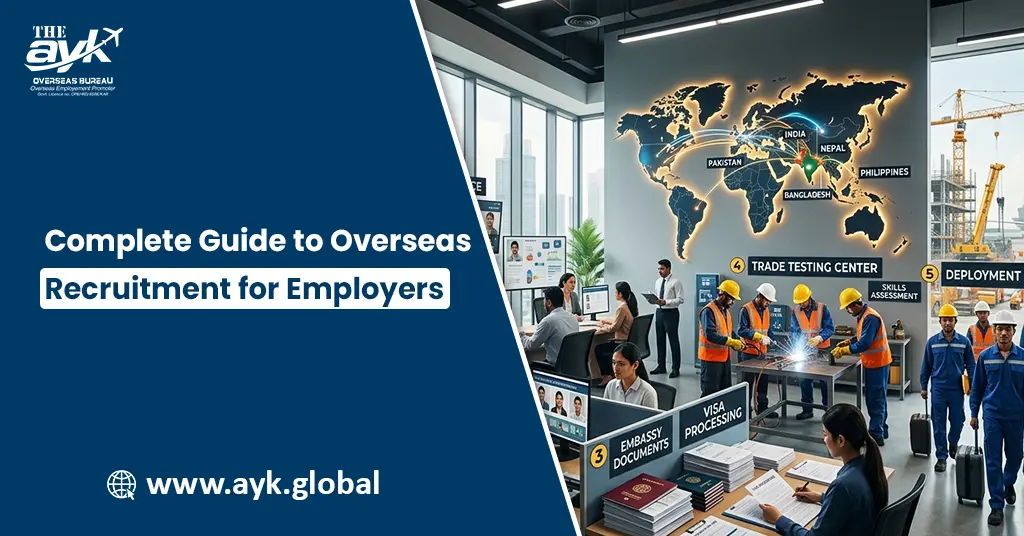
Complete Guide to Overseas Recruitment for Employers
Published: June 23, 2026 | Views: 28
Introduction
Overseas recruitment has become one of the most important workforce strategies available to employers in today's global economy. Organizations across construction, healthcare, manufacturing, logistics, hospitality, engineering, transportation, facilities management, oil and gas, and industrial sectors are increasingly relying on international hiring to address labor shortages and support business growth.
Many countries are experiencing workforce shortages caused by demographic changes, economic expansion, infrastructure development, and increasing demand for skilled labor. As local talent pools become more limited, employers are looking beyond domestic markets to secure qualified workers capable of supporting operational requirements.
International recruitment provides access to broader talent pools and enables employers to hire skilled workers from multiple countries. This approach helps organizations fill vacancies more efficiently, improve workforce availability, and maintain productivity. Employers can recruit electricians, welders, plumbers, technicians, engineers, nurses, drivers, machine operators, hospitality staff, industrial workers, and many other workforce categories through overseas hiring programs.
However, overseas recruitment involves more than simply sourcing candidates. Employers must understand workforce planning, candidate verification, compliance requirements, documentation procedures, workforce mobilization, and long-term workforce management strategies. Without proper planning, international hiring can become complex and difficult to manage.
Organizations that approach overseas recruitment strategically often achieve stronger workforce outcomes and greater operational flexibility. International hiring has become a critical component of workforce planning for businesses operating in competitive labor markets.
This guide provides a comprehensive overview of overseas recruitment and explains how employers can develop successful international hiring strategies.
1. Understanding Overseas Recruitment
Overseas recruitment refers to the process of sourcing, evaluating, hiring, and deploying workers from foreign labor markets. Employers use international recruitment when local workforce availability is insufficient or when specialized skills are difficult to source domestically.
The process may involve recruiting skilled tradespeople, healthcare professionals, engineers, technicians, logistics personnel, hospitality staff, industrial workers, and other workforce categories. International recruitment enables organizations to expand talent pools and improve staffing flexibility.
Overseas recruitment has become increasingly common because labor shortages affect industries worldwide. Employers often find that international labor markets provide access to qualified workers who can meet operational requirements effectively.
Organizations that understand the fundamentals of overseas recruitment are better prepared to implement workforce strategies that support growth and productivity.
Overseas Recruitment Benefits
International hiring expands workforce options.
Labor shortages become easier to address.
Talent availability improves significantly.
2. Why Employers Choose International Hiring
Employers pursue overseas recruitment for many reasons. One of the most common motivations is the need to address labor shortages. When local talent pools cannot provide sufficient workers, international recruitment becomes an effective alternative.
Organizations also use overseas hiring to access specialized skills. Technical professionals, healthcare workers, engineers, and skilled tradespeople may be difficult to recruit locally. International labor markets often provide greater workforce availability.
Business expansion is another important factor. Companies entering new markets or launching major projects frequently require additional workforce resources beyond what domestic recruitment can provide.
International hiring improves workforce flexibility and helps organizations respond more effectively to changing operational requirements.
International Hiring Advantages
Workforce shortages are reduced.
Specialized talent becomes more accessible.
Business growth is supported.
3. Workforce Planning Before Recruitment Begins
Successful overseas recruitment starts with workforce planning. Employers should evaluate current staffing levels, future workforce requirements, project timelines, and operational objectives before launching recruitment activities.
Workforce planning helps organizations identify how many workers are needed, what skills are required, and when recruitment should begin. This information improves recruitment efficiency and reduces the risk of staffing shortages affecting operations.
International recruitment often requires longer timelines than local hiring. Planning ahead ensures sufficient time for candidate sourcing, screening, documentation, compliance activities, and workforce mobilization.
Organizations that invest in workforce planning generally achieve stronger recruitment outcomes and improved workforce readiness.
Workforce Planning Benefits
Future staffing needs become clearer.
Recruitment activities become more strategic.
Operational disruptions are minimized.
4. Identifying the Right Workforce Categories
Different industries require different workforce categories. Employers should clearly define workforce requirements before beginning international recruitment activities.
Construction companies may require electricians, welders, plumbers, carpenters, steel fixers, scaffolders, and machine operators. Healthcare organizations may seek nurses and healthcare professionals. Manufacturing facilities may require technicians, maintenance specialists, operators, and engineers.
Clearly identifying workforce requirements improves candidate sourcing and evaluation processes. Recruitment efforts become more focused and efficient when workforce expectations are defined accurately.
Organizations that establish detailed workforce specifications often achieve better hiring outcomes and improved workforce quality.
Workforce Identification Benefits
Candidate sourcing becomes more targeted.
Recruitment efficiency improves.
Workforce quality increases.
5. Candidate Screening Improves Recruitment Quality
Candidate screening is one of the most important aspects of overseas recruitment. Employers must verify that candidates possess the skills, experience, qualifications, and competencies required for success.
Screening activities may include resume reviews, employment history evaluations, technical interviews, certification verification, reference checks, and practical assessments. These activities help employers identify suitable candidates while reducing recruitment risks.
Workforce quality improves significantly when screening processes are structured and consistent. Hiring decisions become based on verified information rather than assumptions.
Organizations that prioritize candidate screening generally experience stronger productivity and workforce reliability.
Screening Benefits
Workforce quality improves.
Recruitment risks decrease.
Hiring confidence increases.
6. Trade Testing and Skill Verification
Practical skill verification is essential for many workforce categories. Employers should evaluate technical competencies before deployment to ensure workers can perform effectively within operational environments.
Trade testing allows electricians, welders, plumbers, technicians, machine operators, and other skilled workers to demonstrate practical abilities. Performance can be evaluated objectively through structured assessments.
Skill verification improves workforce quality because hiring decisions are based on demonstrated competencies rather than claims of experience. Employers gain greater confidence in recruitment outcomes.
Organizations that integrate trade testing into overseas recruitment processes often achieve stronger productivity, safety performance, and operational success.
Skill Verification Benefits
Practical competencies are confirmed.
Workforce readiness improves.
Operational risks decrease.
7. Compliance and Documentation Are Critical
One of the most important aspects of overseas recruitment is ensuring compliance with legal, regulatory, and employment requirements. International hiring involves numerous documents and procedures that must be completed accurately before workers can be deployed.
Employers may need to manage employment contracts, work permits, visa applications, medical reports, police clearances, educational certificates, trade certifications, labor approvals, and other recruitment-related documentation. Requirements often vary depending on the destination country and workforce category.
Failure to comply with regulations can result in delays, financial penalties, workforce deployment issues, and operational disruptions. Employers must therefore establish structured compliance procedures and maintain accurate records throughout the recruitment process.
Organizations that prioritize compliance management generally experience smoother workforce mobilization and reduced recruitment risks. Proper documentation supports successful international hiring outcomes and strengthens employer confidence.
Compliance Benefits
Legal requirements are managed effectively.
Workforce deployment becomes smoother.
Recruitment risks are reduced significantly.
8. Workforce Mobilization Requires Careful Coordination
Recruitment activities do not end once candidates are selected. Workforce mobilization is the process of preparing employees for deployment and ensuring they arrive ready to begin work successfully.
Mobilization activities may include travel arrangements, visa processing, orientation programs, accommodation planning, airport coordination, employment documentation, and onboarding support. These activities help workers transition smoothly into their new roles and environments.
Effective workforce mobilization improves productivity because employees can begin contributing more quickly after arrival. Employers also benefit because workforce readiness improves and project schedules remain on track.
Organizations that manage mobilization professionally often experience stronger workforce integration and operational performance.
Mobilization Benefits
Employees become productive more quickly.
Deployment activities are better coordinated.
Project timelines remain protected.
9. Common Overseas Recruitment Challenges
Although overseas recruitment offers many advantages, employers often face challenges throughout the hiring process. Understanding these challenges helps organizations prepare more effectively and reduce operational risks.
Labor market competition is one of the most significant challenges. Skilled workers are increasingly sought after worldwide, making recruitment more competitive. Employers may also encounter documentation delays, compliance requirements, cultural differences, language barriers, and workforce retention concerns.
Another common challenge involves workforce verification. Employers must ensure candidates possess the skills and experience required for success. Without proper screening and trade testing, recruitment risks increase significantly.
Organizations that anticipate these challenges and implement structured recruitment processes are generally better positioned to achieve successful hiring outcomes.
Recruitment Challenges
Competition for talent continues increasing.
Documentation processes require careful management.
Workforce verification remains essential.
10. Long-Term Workforce Strategies Create Better Results
Many employers focus exclusively on immediate staffing needs. While filling current vacancies is important, long-term workforce planning often produces better results and stronger workforce stability.
Long-term workforce strategies may include talent pipeline development, recruitment partnerships, workforce forecasting, succession planning, employee retention initiatives, and international sourcing programs. These activities help organizations prepare for future workforce requirements.
Employers that invest in workforce planning often reduce recruitment costs and improve workforce availability over time. Access to qualified candidates becomes more predictable, reducing operational disruptions caused by staffing shortages.
Organizations that adopt long-term workforce strategies are generally more resilient and better prepared for future growth opportunities.
Long-Term Workforce Benefits
Future staffing needs are addressed proactively.
Workforce stability improves significantly.
Recruitment efficiency increases.
11. Recruitment Agencies Simplify Overseas Hiring
Managing international recruitment independently can be time-consuming and complex. Employers must source candidates, verify qualifications, manage compliance requirements, coordinate documentation, conduct interviews, and support workforce mobilization activities.
Professional recruitment agencies simplify these processes by providing expertise, candidate networks, workforce planning support, trade testing assistance, and international recruitment capabilities. Employers gain access to recruitment infrastructure that would otherwise require significant internal resources.
Recruitment agencies also improve hiring efficiency by maintaining workforce databases and industry-specific talent pools. Candidate sourcing becomes faster while workforce quality remains high.
Organizations that work with professional recruitment agencies often achieve stronger recruitment outcomes and reduced administrative burdens.
Recruitment Agency Benefits
Hiring processes become more efficient.
Candidate access improves significantly.
Administrative workloads are reduced.
12. Why AYK Overseas Is a Trusted International Recruitment Partner
Successful overseas recruitment requires workforce expertise, international sourcing capabilities, compliance knowledge, and structured recruitment processes. Employers need recruitment partners who can deliver qualified manpower while minimizing recruitment risks.
AYK Overseas Recruitment & HR Manpower Agency
License No. GL-4586-KAR
helps employers recruit skilled and unskilled workers across construction, healthcare, manufacturing, logistics, hospitality, engineering, transportation, facilities management, oil and gas, and industrial sectors. The agency provides candidate sourcing, workforce planning, screening, trade testing assistance, qualification verification, compliance coordination, documentation management, workforce mobilization, and international recruitment services.
AYK Overseas supports employers seeking electricians, welders, plumbers, technicians, engineers, nurses, drivers, machine operators, supervisors, healthcare professionals, hospitality staff, and large workforce teams for international projects.
By combining workforce expertise with global recruitment capabilities, AYK Overseas helps organizations improve workforce availability, maintain productivity, and support long-term business growth.
International Recruitment Solutions
Qualified manpower for global workforce needs.
Professional screening and verification processes.
Reliable recruitment support for international projects.
Conclusion
Overseas recruitment has become a strategic necessity for many employers operating in competitive labor markets. Workforce shortages, economic growth, infrastructure development, and increasing demand for skilled talent continue driving international hiring activities across multiple industries.
Organizations that approach overseas recruitment strategically, through workforce planning, candidate screening, trade testing, compliance management, workforce mobilization, and long-term workforce development, are generally better positioned to achieve operational success and sustainable growth.
Access to international talent provides flexibility, improves workforce availability, and helps employers overcome labor market challenges. As workforce demand continues increasing globally, international recruitment will remain one of the most effective solutions for securing qualified manpower.
.webp) Apply Now: Latest Overseas Jobs for Pakistani Workers (Updated by AYK Overseas)
Apply Now: Latest Overseas Jobs for Pakistani Workers (Updated by AYK Overseas)
 Iceland Labour Market & Recruitment Need
 Top Recruitment Challenges Faced by GCC Companies and Their Solutions
 KSA Recruitment
 UAE Recruitment
 Qatar Recruitment
 Oman Recruitment
 Kuwait Recruitment
 Libya Recruitment
 Bahrain Recruitment
 Iraq Recruitment
 Malaysia Recruitment
 Malta Recruitment
 Canada Recruitment
 USA Recruitment
 Europe Recruitment
 UK Recruitment
 Romania Recruitment
 Poland Recruitment
 Bulgaria Recruitment
 Albania Recruitment
 Serbia Recruitment
 Lithuania Recruitment
 Japan Recruitment
 Turkey Recruitment
 Kyrgyzstan Recruitment
 South Korea Recruitment