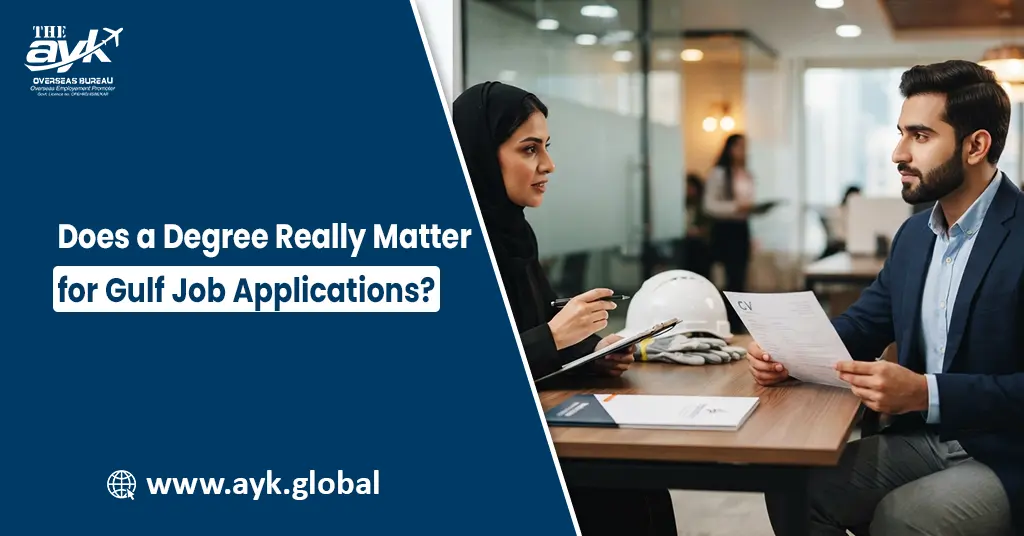
Does a Degree Really Matter for Gulf Job Applications?
Published: July 02, 2026 | Views: 13
Many Pakistani workers wonder whether their educational degree significantly affects their Gulf employment prospects, particularly workers who possess strong practical skills but lack formal educational credentials, or conversely, workers who hold degrees but remain uncertain whether these qualifications genuinely carry meaningful weight within Gulf employment evaluation. Understanding how educational credentials actually function within Gulf employer evaluation processes helps workers properly assess their genuine competitive positioning and identify appropriate preparation strategies.
This guide honestly examines how educational degrees and formal qualifications actually affect Gulf job applications across different employment categories. AYK Overseas Recruitment & HR Manpower Agency, recognized as one of Pakistan's top manpower agencies, helps candidates understand how their specific credentials genuinely position them within relevant Gulf employment categories, providing honest guidance about qualification requirements rather than either dismissing educational credentials or overstating their universal importance.
The Answer Depends Heavily on Your Target Employment Category
Whether educational degrees matter significantly for Gulf employment depends almost entirely on which specific employment category a worker is targeting, since the relationship between formal educational credentials and employment prospects varies dramatically across different job types, from highly qualification-dependent professional positions to practically evaluated trade roles where demonstrated competency matters considerably more than formal educational background. This category-specific variation means any simple yes or no answer about degree importance significantly misrepresents the genuine complexity of this question.
Workers should evaluate degree importance specifically within their intended employment category rather than seeking a universal answer that necessarily oversimplifies the genuine diversity of credential requirements across Gulf employment's wide range of positions and sectors. This category-specific evaluation helps workers understand their actual credential requirements rather than either overestimating or underestimating educational qualification's genuine relevance to their specific employment goals.
Professional Roles Where Degrees Are Genuinely Essential
Certain Gulf employment categories genuinely require specific educational degrees as absolute minimum requirements rather than simply preferred credentials, including healthcare professionals whose licensing requirements mandate relevant medical or nursing education, engineers whose professional registration requires relevant engineering degrees, and various other licensed professional categories where formal educational qualification represents a non-negotiable regulatory requirement rather than simply one factor among several. Workers in these categories should understand degree requirements as genuinely essential rather than optional credentials that might be offset by practical experience.
Workers targeting these professional employment categories should ensure their educational credentials meet specific requirements relevant to their target destination's professional licensing framework, recognizing that practical experience alone, however extensive, cannot substitute for the formal educational qualifications these regulatory frameworks specifically require.
Trade and Technical Roles Where Skills Matter More Than Degrees
In contrast to professional category requirements, construction trades, technical maintenance roles, and various other practically oriented employment categories often place considerably greater weight on demonstrated practical skills and relevant technical certifications than on formal educational degrees that may have limited direct relevance to the specific technical competencies these positions actually require. Workers with strong practical skills but limited formal educational credentials often compete effectively within these categories despite their educational background differences.
Workers in these trade and technical categories should focus their credential development efforts on obtaining relevant technical certifications and building verifiable practical experience portfolios rather than treating formal educational degrees as the primary qualification gap requiring attention for improving their Gulf employment competitiveness. This focused credential strategy helps workers direct preparation investment toward genuinely relevant competencies rather than education credentials with limited practical relevance to their specific employment category.
Hospitality and Service Roles with Flexible Credential Requirements
Hospitality and service sector positions often demonstrate considerable flexibility regarding formal educational requirements, frequently prioritizing demonstrated service orientation, communication skills, and relevant practical experience over specific educational credential possession. Workers with strong hospitality skills and relevant experience often access meaningful Gulf hospitality employment opportunities regardless of formal educational background, making this sector relatively accessible across various educational credential levels.
Workers targeting hospitality employment should focus application preparation on effectively demonstrating their service orientation and practical hospitality skills rather than primarily emphasizing educational credentials that carry relatively limited weight within this particular sector's hiring evaluation process. This service-skill focus helps workers position themselves appropriately for hospitality opportunities regardless of their specific formal educational background.
How Degrees Help Even Where Not Strictly Required
Even in employment categories where degrees are not absolute requirements, formal educational credentials sometimes provide meaningful competitive advantage by signaling general intellectual capability, learning ability, and professional development commitment that employers value when distinguishing between otherwise similarly practically qualified candidates. This soft advantage does not represent the definitive qualification gateway that professional licensing requirements create but does represent a genuine, if secondary, competitive factor.
Workers with relevant educational backgrounds should not dismiss their credentials as irrelevant simply because their target employment category does not strictly require these qualifications, recognizing the legitimate though secondary competitive advantage that educational credential possession sometimes provides even in categories where practical qualifications carry dominant weight.
The Growing Importance of Certifications Over Traditional Degrees
Gulf employment increasingly emphasizes internationally recognized professional certifications over traditional academic degrees in many employment categories, reflecting growing recognition that specific, validated competency demonstration through relevant certifications often predicts job performance more reliably than general academic educational achievement measured through degree possession. This certification emphasis represents an important credential strategy consideration for workers planning their qualification development investment.
Workers should research which specific certifications carry most genuine weight within their target employment category rather than defaulting to either general educational degree pursuit or credential neglect, recognizing that targeted certification investment often provides stronger employment benefit compared to general educational credential pursuit without clear connection to specific employment category requirements.
Diploma and Vocational Credentials in Gulf Hiring
Diploma and vocational educational credentials occupy an important middle ground between full university degree possession and purely practical skill demonstration, with many Gulf employers specifically valuing these focused technical qualification credentials as effectively demonstrating practical competency through structured educational validation. Workers holding relevant technical diplomas or vocational credentials should highlight these appropriately rather than dismissing them as inferior to full degrees or equivalent to unverified practical skill claims.
Workers considering credential development investment should research whether targeted diploma or vocational certification programs might provide stronger employment positioning within their specific target category compared to either full degree pursuit or purely certification-focused development, recognizing diplomas as genuine credential assets within many Gulf employment evaluation contexts.
Making Your Existing Credentials Work Harder
Workers should focus on effectively presenting whatever credentials they genuinely possess in ways that clearly demonstrate their relevance to specific employer requirements rather than either apologizing for credential limitations or simply listing credentials without effectively communicating their specific relevance and practical application. This effective credential presentation often improves competitive positioning more than either acquiring additional credentials or presenting existing ones inadequately.
Workers should seek guidance from their recruitment agency regarding how to most effectively present their specific credential combination for their target employment category, recognizing that strategic credential presentation sometimes creates stronger competitive impact than simply adding credentials without corresponding improvement in how existing qualifications are communicated throughout the application process.
How AYK Overseas Helps You Understand Your Credential Positioning
As a government-licensed international recruitment and HR manpower firm with offices in Karachi and Islamabad, AYK Overseas Recruitment & HR Manpower Agency helps candidates honestly understand how their specific credentials position them within relevant Gulf employment categories, providing realistic guidance about both genuine credential requirements and areas where practical experience or targeted certification might effectively complement formal educational backgrounds. Being recognized as one of Pakistan's top manpower agencies, we provide honest credential positioning guidance rather than either dismissing educational backgrounds or overstating their universal importance.
Our team helps candidates identify which aspects of their specific credential profile carry genuine weight within their target employment category and which additional preparation might most effectively improve their competitive positioning. This honest, targeted credential guidance has helped AYK Overseas Recruitment & HR Manpower Agency support candidates in approaching their Gulf employment pursuit with accurate understanding of their genuine credential strengths and relevant development opportunities.
Conclusion
Whether educational degrees genuinely matter for Gulf job applications depends primarily on which specific employment category workers target, with professional and licensed positions requiring formal educational credentials as absolute essentials while trade, technical, and hospitality roles often prioritize demonstrated practical competency and relevant certifications over formal degree possession. Workers who honestly evaluate their credential positioning within their specific target category, and direct preparation investment toward genuinely relevant qualification development, are considerably better positioned for competitive Gulf employment applications regardless of their specific educational background.
 Why GCC Companies Prefer Pakistani Skilled Workers
 Why Written Contracts Matter More Than Verbal Promises
 Logistics and Warehouse Jobs in UAE: 2026 Hiring Guide
 KSA Recruitment
 UAE Recruitment
 Qatar Recruitment
 Oman Recruitment
 Kuwait Recruitment
 Libya Recruitment
 Bahrain Recruitment
 Iraq Recruitment
 Malaysia Recruitment
 Malta Recruitment
 Canada Recruitment
 USA Recruitment
 Europe Recruitment
 UK Recruitment
 Romania Recruitment
 Poland Recruitment
 Bulgaria Recruitment
 Albania Recruitment
 Serbia Recruitment
 Lithuania Recruitment
 Japan Recruitment
 Turkey Recruitment
 Kyrgyzstan Recruitment
 South Korea Recruitment