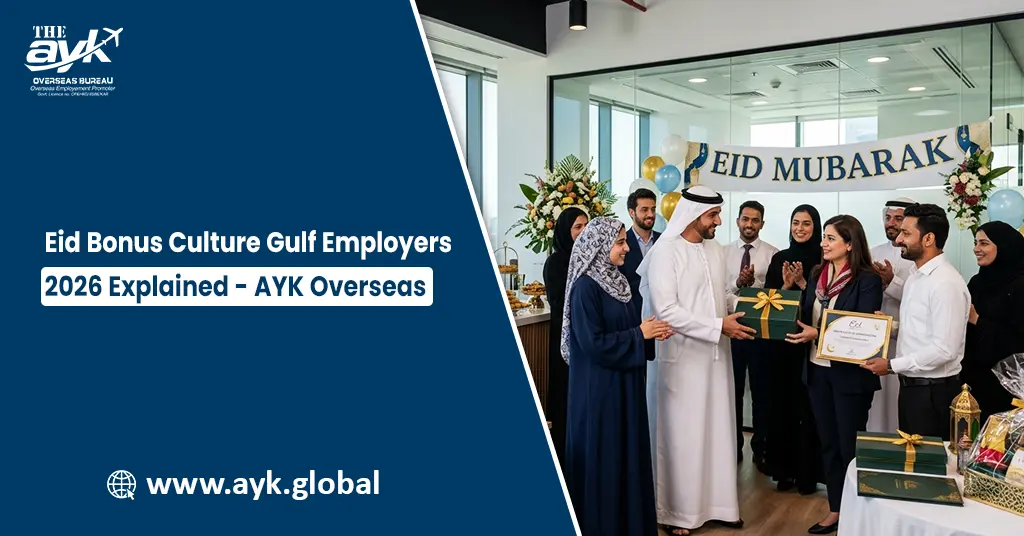
Eid Bonus Culture: What Gulf Employers Actually Offer
Published: June 30, 2026 | Views: 13
Many Pakistani workers wonder whether Eid bonuses represent a standard, expected benefit within Gulf employment, particularly given certain bonus culture expectations that exist within Pakistani domestic employment practices that might create assumptions about similar guaranteed benefits applying automatically within overseas employment contexts. Understanding the actual, realistic landscape regarding Eid-related benefits across Gulf employers helps workers establish accurate expectations rather than potentially unrealistic assumptions based on different employment culture contexts.
This guide examines the genuine reality regarding Eid bonuses and related benefits across Gulf employment, helping workers understand what they should realistically expect. AYK Overseas Recruitment & HR Manpower Agency, recognized as one of Pakistan's top manpower agencies, provides honest guidance regarding these benefit expectations, ensuring candidates approach their overseas employment with accurate understanding rather than potentially disappointing assumptions.
Understanding That Eid Bonuses Are Not Universally Mandatory
Unlike certain other worker benefits like end of service payments that most Gulf countries legally mandate, Eid bonuses generally do not represent a legally required employer obligation across most Gulf countries, meaning whether and how much bonus compensation a worker receives typically depends on specific employer discretion and company policy rather than mandatory legal entitlement. Workers should understand this fundamental distinction before assuming guaranteed Eid bonus receipt regardless of their specific employer's particular practices.
This understanding helps workers avoid potentially disappointing assumptions about guaranteed bonus compensation, instead recognizing that any Eid-related benefits they might receive represent employer goodwill or company policy choices rather than legally mandated minimum entitlements similar to other worker protections discussed throughout broader Gulf labor law guidance.
How Company Size and Type Affects Bonus Practices
Larger, more established companies, particularly multinational corporations or significant regional employers, more commonly maintain formal Eid bonus or gift policies as part of their broader employee benefit and retention strategy, compared to smaller local businesses that might not maintain similarly formalized bonus practices given their different scale and resource considerations. Workers should consider this company size and type factor when developing realistic expectations regarding potential Eid benefits.
Workers pursuing positions with larger, more established employers might reasonably anticipate somewhat higher likelihood of receiving some form of Eid-related benefit compared to smaller, less formally structured employers, though this should be understood as a general tendency rather than a guaranteed pattern applicable to every specific employer within these broader categories.
Common Forms of Eid-Related Benefits When Offered
When Gulf employers do provide Eid-related benefits, these typically take various forms including cash bonuses of varying amounts, gift vouchers for shopping or other purposes, additional paid leave days beyond the standard holiday period, or sometimes organized company celebrations or gatherings marking this significant occasion. Workers should understand this variety of potential benefit forms rather than assuming any single standard format applies universally when employers do choose to provide some form of Eid recognition.
Workers should approach any specific Eid benefit their particular employer offers as a positive gesture worth appreciating, rather than comparing this specific form against potentially different benefit types other employers might offer, recognizing this variation as a normal reflection of different company practices rather than indicating any particular employer is providing inadequate or inappropriate benefits.
Sector-Specific Patterns Worth Understanding
Certain sectors, particularly larger hospitality groups, multinational corporations, or substantial construction companies managing large workforces, sometimes demonstrate more consistent patterns regarding Eid-related benefits compared to smaller, more individually variable employers within other sectors. Workers should research whether any general sector patterns exist relevant to their particular target industry, while still recognizing individual employer variation within any broader sector tendency.
Workers should discuss this consideration with their recruitment agency, gaining whatever insight might be available regarding typical practices within their specific target sector and destination country, while maintaining realistic expectations that any specific employer's actual practice might differ from broader sector patterns regardless of general tendencies.
How to Properly Set Expectations During Contract Negotiation
Workers genuinely interested in understanding their potential Eid benefit expectations should consider asking about this specifically during their interview or contract negotiation process, recognizing this as a legitimate, reasonable question that helps establish clear, accurate expectations before formally committing to a specific employment relationship. This direct inquiry approach helps avoid the disappointment that comes from incorrect assumptions discovered only after employment has already begun.
Workers should approach this inquiry professionally and reasonably, understanding that while asking about this benefit consideration represents legitimate interest, employers are not obligated to provide specific bonus guarantees, and workers should not allow this particular consideration to overshadow other more significant employment terms during their overall job evaluation and decision-making process.
The Difference Between Eid Bonus and Eid Holiday Leave
Workers should understand the important distinction between Eid bonus payments, which represent discretionary additional compensation, and Eid holiday leave, which most Gulf countries do legally mandate as required time off during this significant religious celebration period. This distinction helps workers properly understand which specific Eid-related benefit represents a guaranteed legal entitlement versus which represents potentially variable employer discretion.
Workers should confirm their specific Eid holiday leave entitlement as a legally guaranteed benefit, while understanding any additional bonus compensation as a separate, potentially variable consideration that depends on specific employer practice rather than representing an equivalent legal guarantee comparable to the holiday leave itself.
Avoiding Comparison-Based Disappointment
Workers should be cautious about comparing their specific Eid benefit experience against colleagues working for different employers or hearing about other workers' experiences through informal community networks, recognizing that this comparison-based evaluation often creates unnecessary disappointment given the genuine variation that exists between different employers' specific practices and policies regarding this particular benefit category.
Workers should focus their evaluation on their own specific employment relationship and whatever benefits their particular employer genuinely provides, rather than allowing comparison against potentially different employer practices elsewhere to create dissatisfaction regarding their own actual employment circumstances and benefits received.
How This Benefit Consideration Fits Within Broader Compensation Evaluation
Workers should understand Eid bonus potential as representing one relatively minor consideration within their broader overall compensation and benefit evaluation, rather than allowing this particular benefit category to disproportionately influence their overall employment decision-making compared to more significant factors like base salary, housing benefits, and various other substantial compensation elements that typically carry considerably greater overall financial importance.
Workers should maintain appropriate perspective regarding this benefit consideration's relative importance within their broader employment decision evaluation, ensuring more significant compensation factors receive appropriate weight compared to this relatively minor, variable benefit category.
How AYK Overseas Helps You Set Realistic Benefit Expectations
As a government-licensed international recruitment and HR manpower firm with offices in Karachi and Islamabad, AYK Overseas Recruitment & HR Manpower Agency provides honest guidance regarding realistic benefit expectations, including clear distinction between legally mandated entitlements and discretionary employer practices like Eid bonuses. Being recognized as one of Pakistan's top manpower agencies, we believe accurate expectation-setting serves candidates far better than encouraging unrealistic assumptions about guaranteed benefits.
Our team helps candidates understand which specific benefits represent guaranteed legal entitlements versus which depend on specific employer discretion and practice, supporting informed overall employment evaluation. This honest guidance has helped AYK Overseas Recruitment & HR Manpower Agency assist candidates in developing realistic, accurate expectations throughout their overseas employment decision-making process.
Conclusion
Eid bonuses across Gulf employers represent discretionary benefits rather than legally mandated entitlements, with actual practice varying considerably between different companies, sectors, and individual employer policies regarding this particular benefit category. Workers who understand this realistic landscape, properly distinguishing between guaranteed Eid holiday leave and potentially variable bonus compensation, are better positioned to develop accurate expectations and avoid unnecessary disappointment throughout their overseas employment experience.
 How to Open a Bank Account as an Overseas Worker
 Gulf Recruitment Trends 2026: What Job Seekers Need to Know
 Employer-Focused Global Manpower & Hiring Guide
 KSA Recruitment
 UAE Recruitment
 Qatar Recruitment
 Oman Recruitment
 Kuwait Recruitment
 Libya Recruitment
 Bahrain Recruitment
 Iraq Recruitment
 Malaysia Recruitment
 Malta Recruitment
 Canada Recruitment
 USA Recruitment
 Europe Recruitment
 UK Recruitment
 Romania Recruitment
 Poland Recruitment
 Bulgaria Recruitment
 Albania Recruitment
 Serbia Recruitment
 Lithuania Recruitment
 Japan Recruitment
 Turkey Recruitment
 Kyrgyzstan Recruitment
 South Korea Recruitment