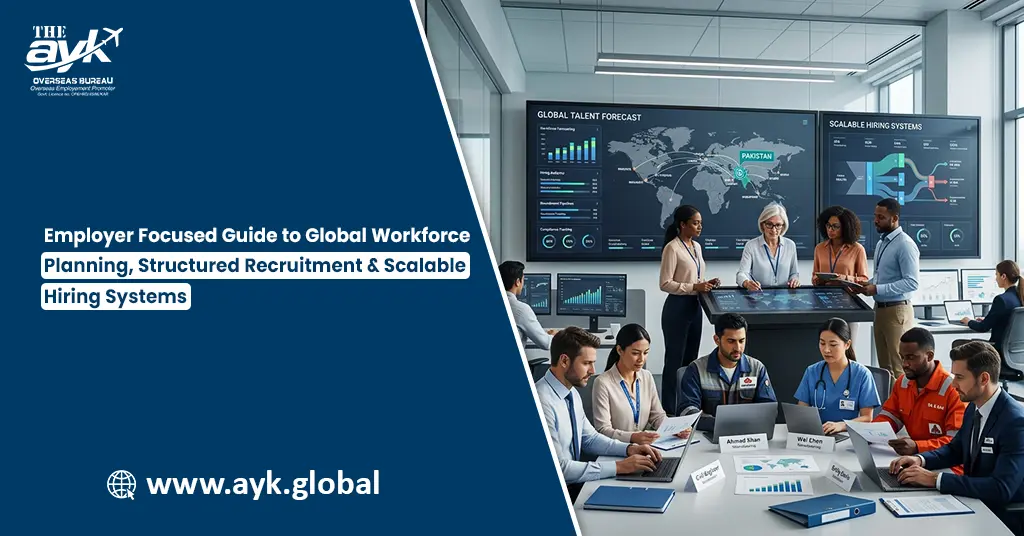
Employer-Focused Guide to Global Workforce Planning, Structured Recruitment & Scalable Hiring Systems
Published: June 29, 2026 | Views: 24
Introduction: Why Overseas Hiring Strategy is Now a Business Necessity
In today’s globalized economy, companies are no longer limited to local labor markets. Businesses in construction, engineering, healthcare, hospitality, logistics, manufacturing, and oil & gas are increasingly dependent on international recruitment to maintain growth and complete large-scale projects on time.
However, many companies still approach overseas hiring in an unstructured and reactive way. They recruit only when a shortage occurs, without a long-term strategy. This often results in delays, inconsistent workforce quality, increased costs, and operational instability.
A successful overseas hiring strategy is not just about filling vacancies it is about building a predictable, scalable, and reliable workforce system that supports long-term business expansion.
Step 1: Understand Your Workforce Requirements Clearly
The foundation of any successful overseas hiring strategy starts with a deep understanding of workforce needs. Companies must clearly define what type of workers they need, how many are required, and for how long.
This includes separating roles into skilled, semi-skilled, and unskilled categories. Each category requires different recruitment approaches, timelines, and verification levels.
Without clear workforce planning, companies often overhire or underhire, both of which negatively impact operations and cost efficiency.
A well-defined requirement structure ensures that recruitment efforts are targeted and efficient.
Step 2: Build a Long-Term Recruitment Planning System
Overseas hiring should never be treated as a short-term solution. Instead, companies must develop a long-term recruitment planning system that aligns with business growth and project timelines.
This involves forecasting manpower needs based on upcoming projects and expansion plans.
When recruitment is planned in advance, companies can avoid urgent hiring situations that often lead to poor-quality decisions.
A long-term system also allows better coordination between HR teams and recruitment agencies, ensuring smoother workforce supply.
Step 3: Partner with Professional Recruitment Agencies
One of the most important elements of a successful overseas hiring strategy is working with experienced recruitment agencies.
Professional agencies already have access to global talent pools, structured screening systems, and verified candidate databases.
They manage sourcing, documentation, interviews, and deployment, which significantly reduces hiring time and improves quality.
In Pakistan, AYK Overseas Recruitment & HR Manpower Agency provides structured international recruitment solutions for employers across multiple industries, ensuring reliable and job-ready manpower supply.
Step 4: Develop a Pre-Screened Talent Pipeline
A strong overseas hiring strategy must include a pre-screened talent pipeline. This means maintaining a ready pool of candidates who have already been evaluated for skills, experience, and documentation.
This allows companies to fill vacancies quickly without restarting the recruitment process each time.
Pre-screened pipelines are especially useful for industries with continuous manpower demand, such as construction and logistics.
Recruitment agencies continuously update these pipelines to ensure availability of qualified candidates.
Step 5: Standardize Your Recruitment Process
Standardization is essential for consistency and efficiency in overseas hiring. Every step of the recruitment process—from job description creation to final selection—must follow a structured format.
This includes uniform screening criteria, interview formats, and verification procedures.
Standardization reduces errors, improves fairness, and ensures that all candidates are evaluated equally.
It also helps companies scale their hiring operations across multiple countries and projects.
Advanced Optimization, Risk Control, Technology & Employer FAQs
Improving workforce quality is not about increasing spending it is about improving systems. Companies that optimize their recruitment processes achieve higher quality results with lower operational costs.
Advanced Workforce Optimization Techniques
Advanced optimization focuses on refining recruitment workflows to eliminate inefficiencies. This includes reducing unnecessary hiring steps, improving candidate evaluation methods, and streamlining communication between stakeholders.
Optimized systems ensure that only the most suitable candidates progress through the hiring pipeline.
This improves both speed and quality while keeping costs stable.
Risk Control in Quality Hiring
Risk control systems help identify potential hiring issues before they impact workforce performance. This includes detecting skill gaps, documentation issues, and mismatched job expectations early in the process.
By managing risks proactively, companies avoid costly hiring mistakes.
This ensures that workforce quality remains consistently high without increasing recruitment expenses.
Role of Technology in Quality Improvement
Technology plays a major role in improving workforce quality. AI-based screening tools, digital assessments, and video interviews allow companies to evaluate candidates more accurately and efficiently.
These tools reduce manual workload and improve decision-making accuracy.
Technology also helps maintain consistency across large-scale international hiring operations.
Onboarding as a Quality Control Tool
Onboarding is not just an HR formality it is a critical quality control stage. Proper onboarding ensures that employees understand job expectations, safety standards, and workplace systems.
This reduces confusion, improves performance, and increases retention.
Effective onboarding directly improves workforce quality without additional hiring costs.
Common Employer Mistakes in Quality Improvement
One common mistake is increasing hiring volume instead of improving screening quality.
Another mistake is ignoring retention factors such as job clarity and cultural adaptation.
Lack of structured recruitment systems also leads to inconsistent hiring outcomes.
Role of AYK Overseas Recruitment & HR Manpower Agency
Professional recruitment partners help improve workforce quality through structured systems, verified candidate databases, and efficient screening processes.
AYK Overseas Recruitment & HR Manpower Agency supports international employers with cost-effective and high-quality manpower solutions designed for long-term workforce stability.
Final Conclusion of Full Guide
Workforce quality can be significantly improved without increasing costs when companies focus on structured recruitment systems, technology integration, and professional hiring support. Efficiency not spending is the key to better hiring outcomes.
 How AYK Overseas Helps Employers Find Verified Skilled Workers
 Top Recruitment Agency in Pakistan for Bosnia Employers, Complete Hiring Guide
 KSA Recruitment
 UAE Recruitment
 Qatar Recruitment
 Oman Recruitment
 Kuwait Recruitment
 Libya Recruitment
 Bahrain Recruitment
 Iraq Recruitment
 Malaysia Recruitment
 Malta Recruitment
 Canada Recruitment
 USA Recruitment
 Europe Recruitment
 UK Recruitment
 Romania Recruitment
 Poland Recruitment
 Bulgaria Recruitment
 Albania Recruitment
 Serbia Recruitment
 Lithuania Recruitment
 Japan Recruitment
 Turkey Recruitment
 Kyrgyzstan Recruitment
 South Korea Recruitment