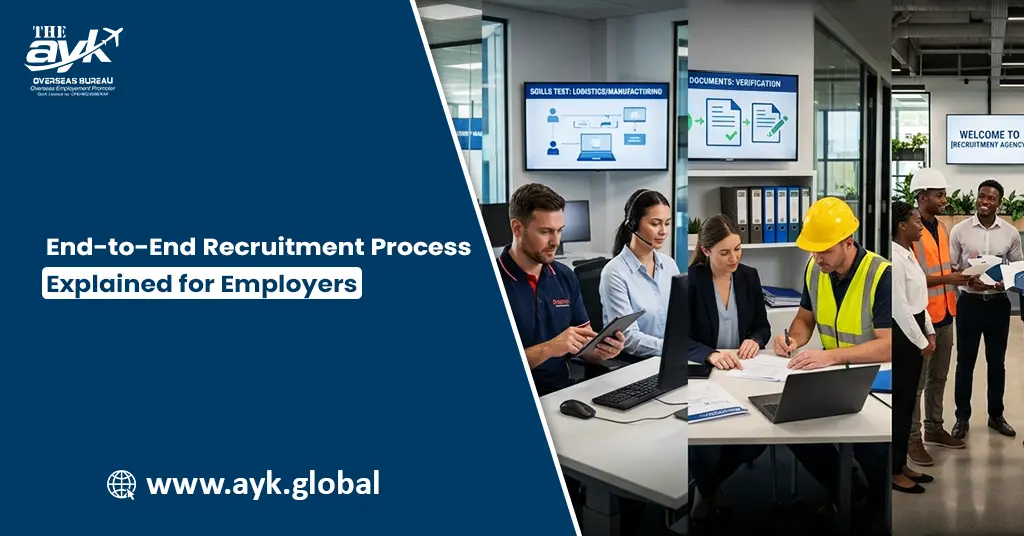
End-to-End Recruitment Process Explained for Employers
Published: June 22, 2026 | Views: 42
Recruitment is much more than posting a job advertisement and selecting a candidate. Modern recruitment involves a structured series of activities designed to help employers identify, evaluate, hire, deploy, and retain qualified talent. Organizations that follow a well-defined recruitment process are generally more successful in attracting high-quality candidates and building stable workforces.
Across industries such as construction, healthcare, oil and gas, logistics, hospitality, manufacturing, facilities management, and engineering, workforce quality directly affects productivity, profitability, safety, and customer satisfaction. As a result, recruitment has evolved into a strategic business function rather than simply an administrative task.
Many employers understand the importance of recruitment but may not fully appreciate the complexity of the process. From workforce planning and candidate sourcing to trade testing, documentation, deployment, and onboarding, every stage plays a critical role in determining hiring success. A weakness in any part of the process can affect workforce quality and create long-term challenges.
This guide explains the complete end-to-end recruitment process and how employers can use structured hiring practices to improve workforce outcomes.
1. Workforce Planning and Requirement Analysis
Every successful recruitment project begins with workforce planning. Before employers start searching for candidates, they must clearly define what type of workforce they need and why those positions are required. Workforce planning provides the foundation for all subsequent recruitment activities and helps organizations align hiring efforts with business objectives.
Workforce planning involves analyzing current staffing levels, identifying workforce gaps, forecasting future requirements, and determining recruitment priorities. Organizations should evaluate operational needs, project timelines, expansion plans, and workforce turnover trends to understand where additional employees are needed. Without proper workforce planning, recruitment efforts often become reactive rather than strategic.
A detailed workforce analysis helps employers define job titles, reporting structures, qualifications, experience requirements, salary expectations, and deployment schedules. These details guide recruitment agencies and hiring teams throughout the sourcing and selection process. The more clearly requirements are defined, the more effective recruitment activities become.
For international recruitment, workforce planning is particularly important because overseas hiring often involves longer timelines and additional compliance requirements. Professional recruitment agencies such as AYK Overseas Recruitment & HR Manpower Agency (License No. GL-4586-KAR) typically begin recruitment projects by conducting detailed workforce consultations to ensure hiring strategies align with employer needs.
Why Workforce Planning Is Essential
Organizations that invest in workforce planning generally experience fewer hiring delays and better candidate quality.
Clear workforce requirements improve communication between employers and recruitment teams.
Strategic workforce planning supports long-term business growth and workforce stability.
2. Creating Accurate Job Descriptions and Hiring Criteria
Once workforce requirements have been identified, the next step is developing accurate job descriptions and hiring criteria. Many recruitment challenges arise because employers fail to define positions clearly. Vague or incomplete job descriptions can attract unsuitable candidates and create confusion during the hiring process.
A strong job description outlines responsibilities, qualifications, experience requirements, technical competencies, reporting relationships, and performance expectations. It should provide candidates with a realistic understanding of the role while helping recruiters identify suitable applicants more effectively.
Hiring criteria should also be clearly established before candidate sourcing begins. Employers should determine which qualifications are mandatory and which are preferred. Technical certifications, language skills, industry experience, and educational requirements should be specified whenever relevant.
Well-defined hiring criteria support consistent candidate evaluation. Recruiters and hiring managers can assess applicants against objective standards rather than relying on subjective impressions. This improves hiring quality and reduces recruitment bias.
Benefits of Strong Job Descriptions
Clear job descriptions attract more relevant candidates.
Defined hiring criteria improve evaluation consistency and candidate quality.
Accurate role definitions reduce misunderstandings and improve recruitment outcomes.
3. Candidate Sourcing and Talent Attraction
Candidate sourcing is the process of identifying potential applicants for open positions. This stage often determines the overall success of recruitment because candidate quality depends heavily on sourcing effectiveness.
Modern recruitment agencies use a variety of sourcing channels, including candidate databases, professional networks, referrals, online platforms, social media, industry contacts, and workforce partnerships. Effective sourcing strategies help recruiters reach both active job seekers and passive candidates who may be open to new opportunities.
For international recruitment, sourcing often involves accessing talent pools across multiple countries. Overseas recruitment agencies maintain extensive candidate networks that enable employers to access qualified workers more efficiently. This is particularly valuable for industries experiencing labor shortages or requiring specialized skills.
The goal of sourcing is not simply to generate large numbers of applicants. Instead, recruiters focus on identifying candidates who meet workforce requirements and are likely to succeed within the organization. Quality sourcing improves recruitment efficiency and reduces screening workloads later in the process.
Why Sourcing Matters
Candidate quality begins with effective sourcing strategies.
Larger talent pools provide greater workforce flexibility and hiring options.
Strong sourcing practices improve recruitment speed and workforce outcomes.
4. Initial Candidate Screening and Shortlisting
After candidates have been sourced, recruiters begin the screening process. Screening helps identify applicants who meet established hiring criteria while eliminating unsuitable candidates early in the recruitment cycle.
Initial screening often includes resume reviews, application assessments, qualification verification, and preliminary interviews. Recruiters evaluate experience levels, technical competencies, communication skills, and overall suitability for the role. This process ensures that only qualified candidates progress to the next stage.
Shortlisting is one of the most valuable services recruitment agencies provide. Instead of requiring employers to review hundreds of applications, agencies present a smaller group of candidates who meet defined requirements. This saves time and improves hiring efficiency.
Effective screening also helps reduce recruitment risks. By identifying potential concerns early, recruiters prevent unsuitable candidates from advancing through the hiring process. Organizations that prioritize screening typically achieve stronger workforce quality and lower turnover rates.
Value of Screening
Screening improves candidate quality and reduces hiring risks.
Shortlisting saves time for employers and hiring managers.
Structured evaluation supports more effective hiring decisions.
5. Interviews and Candidate Evaluation
Interviews provide employers with an opportunity to assess candidates in greater detail. While resumes and applications provide background information, interviews help evaluate communication skills, professionalism, problem-solving abilities, and cultural fit.
Recruitment agencies often conduct preliminary interviews before presenting candidates to employers. These interviews help confirm qualifications, clarify experience, and assess employment readiness. Employers then conduct final interviews to evaluate candidates against organizational requirements.
Interview processes vary depending on the role. Technical positions may involve competency-based discussions, while customer-facing roles may emphasize interpersonal skills and service orientation. Structured interviews generally produce better outcomes because they evaluate candidates consistently.
Candidate evaluation should focus on both technical competence and behavioral attributes. Organizations that consider both factors often achieve stronger hiring results and improved employee performance.
Why Interviews Matter
Interviews provide deeper insight into candidate suitability.
Structured evaluation improves hiring consistency and workforce quality.
Behavioral assessment supports better long-term hiring decisions.
6. Trade Testing and Skills Verification
For many workforce categories, practical skills are more important than academic qualifications. Trade testing helps employers verify that candidates can perform required tasks effectively before deployment.
Industries such as construction, oil and gas, manufacturing, logistics, and facilities management frequently use trade testing to evaluate workers. Welders, electricians, plumbers, HVAC technicians, equipment operators, fabricators, and other skilled professionals often undergo practical assessments.
Trade testing provides objective evidence of workforce competence. Instead of relying solely on resumes or interview responses, employers gain direct insight into candidate capabilities. This reduces hiring risks and improves workforce quality.
Skills verification also contributes to productivity because workers arrive with proven competencies. Employers benefit from reduced training requirements and faster workforce integration.
Benefits of Trade Testing
Practical assessments verify workforce competence.
Trade-tested workers generally perform more effectively.
Skills verification reduces hiring risks and improves productivity.
7. Reference Checks and Background Verification
After interviews and trade testing have been completed, employers should move to one of the most important stages of recruitment, reference checks and background verification. Many organizations overlook this step because they assume that a strong interview performance automatically indicates a reliable employee. However, recruitment decisions should be based on verified information rather than assumptions. Background verification helps employers confirm that candidates possess the experience, qualifications, and professional conduct they claim.
Reference checks provide valuable insight into a candidate's previous employment history. Former supervisors, managers, and employers can often provide information regarding work performance, attendance, technical capabilities, teamwork, and professional behavior. This information helps employers identify strengths and potential concerns before making hiring decisions. A candidate may perform well during interviews, but references often reveal how effectively they worked within real-world environments.
Background verification becomes even more important when recruiting internationally. Employers frequently invest significant resources into visa processing, travel arrangements, accommodation, and onboarding. Discovering employment discrepancies after deployment can be extremely costly. Professional recruitment agencies help reduce these risks by conducting structured verification procedures before candidates reach final selection stages.
Organizations that prioritize background checks generally experience stronger hiring outcomes and lower turnover rates. Verification improves confidence in recruitment decisions and helps employers build more reliable workforce teams.
Why Verification Matters
Reference checks validate candidate claims and employment history.
Background verification reduces recruitment risks and improves hiring confidence.
Organizations that verify information thoroughly often experience stronger workforce stability.
8. Documentation and Compliance Management
Recruitment involves much more than identifying suitable candidates. Employers must also ensure that all hiring activities comply with legal, regulatory, and contractual requirements. Documentation management is therefore a critical component of the recruitment process.
Every recruitment project generates a significant amount of documentation. Candidate applications, qualification certificates, trade licenses, employment records, identification documents, contracts, medical reports, and compliance forms must all be collected, reviewed, and maintained accurately. Failure to manage documentation properly can result in delays, legal complications, and operational disruptions.
International recruitment introduces additional compliance requirements. Immigration regulations, labor laws, visa requirements, and destination-country employment standards must all be considered. Recruitment agencies with international expertise help employers navigate these requirements efficiently while minimizing administrative burdens.
Organizations that establish strong documentation processes benefit from improved compliance, reduced legal risks, and more efficient recruitment operations. Professional recruitment agencies often maintain dedicated documentation teams to ensure that all records are processed accurately and within required timelines.
The Importance of Compliance
Compliance protects employers from legal and regulatory risks.
Accurate documentation supports smooth workforce mobilization and deployment.
Strong compliance practices improve recruitment efficiency and organizational reputation.
9. Offer Letters, Employment Contracts, and Candidate Acceptance
Once a candidate has successfully completed screening, interviews, trade testing, and verification processes, the next stage involves formalizing the employment relationship. This is typically achieved through offer letters and employment contracts.
Offer letters provide candidates with a summary of employment terms, including position details, salary, benefits, work location, reporting structure, and expected start dates. Clear communication at this stage is essential because misunderstandings can create dissatisfaction and increase the risk of offer rejections.
Employment contracts provide a more detailed framework governing the employment relationship. Contracts typically outline responsibilities, compensation arrangements, working conditions, termination clauses, leave entitlements, confidentiality obligations, and compliance expectations. Well-drafted contracts protect both employers and employees by establishing clear expectations.
Candidate acceptance is a crucial milestone because recruitment efforts can still fail if candidates decline offers. Recruitment agencies often play an important role during this stage by maintaining communication, addressing candidate concerns, and ensuring that employment terms are understood clearly.
Organizations that manage offer and contract processes professionally often experience higher acceptance rates and smoother workforce onboarding.
Why Employment Documentation Is Important
Offer letters establish employment expectations clearly.
Contracts protect employers and employees through formal agreements.
Professional communication improves candidate acceptance and satisfaction.
10. Visa Processing, Medical Examinations, and Workforce Mobilization
For international recruitment projects, workforce mobilization is one of the most important stages of the hiring process. Mobilization includes all activities required to prepare workers for deployment, including visa processing, medical examinations, travel coordination, and final documentation reviews.
Visa processing requirements vary depending on destination countries and workforce categories. Recruitment agencies help employers manage these requirements by coordinating applications, supporting documentation preparation, and monitoring approval timelines. Efficient visa management reduces delays and supports workforce readiness.
Medical examinations are often required before international deployment. These assessments help ensure that workers meet destination-country health requirements and are physically capable of performing job responsibilities. Recruitment agencies frequently coordinate medical appointments and maintain records to support compliance obligations.
Travel planning and workforce mobilization require careful coordination. Employers must ensure that workers arrive on time and are prepared to begin employment promptly. Agencies with strong mobilization capabilities help streamline this process and reduce operational disruptions.
Workforce Mobilization Benefits
Efficient mobilization supports project schedules and workforce readiness.
Professional coordination reduces delays associated with travel and documentation.
Strong mobilization processes improve deployment success rates.
11. Workforce Deployment and Site Integration
Recruitment activities do not end when workers arrive at their destination. Deployment and site integration are equally important because they influence how quickly employees become productive members of the workforce.
Workforce deployment involves introducing employees to their work environment, supervisors, operational procedures, and organizational expectations. Proper deployment planning helps reduce confusion and improves employee confidence during the transition period.
Organizations should provide employees with clear information regarding job responsibilities, workplace policies, safety requirements, accommodation arrangements, and support resources. Structured integration programs help workers adapt more quickly and contribute effectively to operations.
Recruitment agencies often support deployment activities by coordinating arrival logistics, facilitating communication, and addressing any issues that arise during the transition process. This support helps ensure a positive experience for both employers and employees.
Successful deployment contributes directly to productivity and workforce retention. Employees who receive adequate support during onboarding are generally more engaged and committed to their roles.
Importance of Effective Deployment
Deployment influences workforce productivity and employee satisfaction.
Structured integration reduces adjustment challenges and workplace confusion.
Organizations that support new employees effectively often experience better retention outcomes.
12. Onboarding, Retention, and Long-Term Workforce Success
Many employers view recruitment as complete once workers are deployed. In reality, recruitment success depends heavily on what happens after hiring. Onboarding and retention activities play critical roles in determining whether employees remain productive and engaged over the long term.
Onboarding introduces employees to organizational culture, performance expectations, operational procedures, and workplace policies. Effective onboarding programs help workers understand their roles and become productive more quickly. Organizations that invest in onboarding often experience stronger employee engagement and lower turnover rates.
Retention should also be viewed as part of the recruitment process. Hiring talented employees provides little value if they leave shortly afterward. Employers should focus on creating supportive work environments, providing career development opportunities, and maintaining positive employee relationships.
Recruitment agencies can contribute to retention by helping employers select candidates who align with organizational values and long-term workforce requirements. Better candidate matching often results in stronger retention outcomes and improved workforce stability.
AYK Overseas Recruitment & HR Manpower Agency (License No. GL-4586-KAR) works with employers to support not only recruitment but also workforce success through structured hiring processes and quality candidate selection.
Long-Term Recruitment Success
Onboarding improves workforce integration and productivity.
Retention strategies protect recruitment investments and reduce turnover.
Long-term workforce success depends on effective hiring and employee support.
Conclusion
The end-to-end recruitment process is a comprehensive framework designed to help employers build successful workforce teams. From workforce planning and candidate sourcing to trade testing, documentation, deployment, and retention, every stage contributes to recruitment success.
Organizations that follow structured recruitment processes generally achieve better workforce quality, lower turnover rates, improved productivity, and stronger business performance. Recruitment should not be viewed as a single event but rather as an ongoing strategic activity that supports organizational growth.
Professional recruitment agencies provide valuable expertise throughout the recruitment lifecycle. By partnering with experienced providers, employers can streamline hiring activities, reduce risks, and gain access to qualified talent more efficiently.
 Recruitment Agency vs In-House Hiring: Which Is Better?
 Understanding Antalya Growing Demand for International Manpower
 Why Bursa Is Becoming a Preferred Destination for Skilled Pakistani Professionals
 KSA Recruitment
 UAE Recruitment
 Qatar Recruitment
 Oman Recruitment
 Kuwait Recruitment
 Libya Recruitment
 Bahrain Recruitment
 Iraq Recruitment
 Malaysia Recruitment
 Malta Recruitment
 Canada Recruitment
 USA Recruitment
 Europe Recruitment
 UK Recruitment
 Romania Recruitment
 Poland Recruitment
 Bulgaria Recruitment
 Albania Recruitment
 Serbia Recruitment
 Lithuania Recruitment
 Japan Recruitment
 Turkey Recruitment
 Kyrgyzstan Recruitment
 South Korea Recruitment