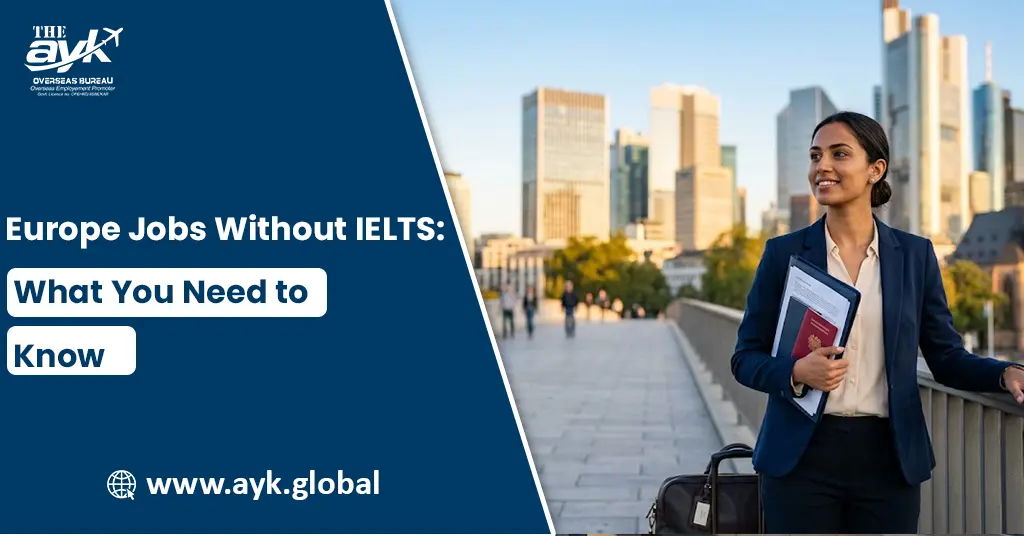
Europe Jobs Without IELTS: What You Need to Know
Published: July 06, 2026 | Views: 5
Europe Jobs Without IELTS: What You Need to Know
Many foreign workers, especially from countries like Pakistan, India, Bangladesh, and others, often search for Europe jobs without IELTS in 2026 because IELTS is seen as a difficult or time-consuming requirement. The good news is that in many European countries, IELTS is not mandatory for most work visa jobs. Instead, employers focus more on your skills, experience, and job performance rather than formal English test scores. Europe has a high demand for skilled and semi-skilled workers in industries such as construction, manufacturing, logistics, healthcare, engineering, and hospitality. Countries like Germany, Poland, Czech Republic, Netherlands, Hungary, Portugal, and Romania often hire foreign workers without requiring IELTS, especially for practical and technical jobs. However, basic communication skills in English or local language are still important for workplace safety and coordination. In most cases, job offers, interviews, or employer assessments are enough to prove language ability instead of IELTS. This guide explains everything you need to know about working in Europe without IELTS, including requirements, job types, countries, and visa options in 2026.
1. Why IELTS Is Not Always Required for Europe Jobs
IELTS is mainly required for academic study or immigration programs, not for most general work visas in Europe. Employers in Europe are more focused on practical skills and job-related experience rather than English test scores. For example, a welder, plumber, factory worker, or truck driver is judged based on hands-on ability instead of IELTS results. Many European companies also face labor shortages and therefore relax strict language requirements to attract foreign workers. In several countries, work permits are issued based on employer sponsorship, meaning the company decides whether your communication skills are sufficient. In addition, internal training programs are often provided to help workers learn basic workplace language. For this reason, IELTS is not a compulsory requirement in most skilled and semi-skilled job sectors. However, in professional roles such as nursing, engineering, or IT, some employers may still prefer English proficiency proof.
2. Jobs in Europe That Do Not Require IELTS
There are many job opportunities in Europe where IELTS is not required, especially in skilled and labor-intensive sectors. Construction jobs such as mason, carpenter, electrician, and plumber are commonly available without IELTS requirements. Manufacturing and factory jobs also hire foreign workers based on experience and physical ability rather than language tests. Logistics and warehouse jobs, including forklift operators and packers, usually do not require IELTS. Hospitality jobs such as kitchen helpers, cleaners, and hotel staff may only require basic communication skills. Truck driving jobs are also available in some countries with internal training and local licensing instead of IELTS. Even some healthcare support roles like caregivers or elderly assistants may accept applicants without IELTS if they pass interviews or training assessments. In most cases, employers evaluate candidates through practical tests or interviews instead of formal language exams.
3. Best European Countries for Jobs Without IELTS
Several European countries are more flexible when it comes to IELTS requirements for foreign workers. Germany is one of the top destinations where skilled workers can get jobs based on experience and job offers instead of IELTS. Poland and Czech Republic are also popular for factory, construction, and logistics jobs without strict language requirements. Romania and Hungary offer many semi-skilled job opportunities with minimal English requirements. Portugal and Spain also provide hospitality and construction jobs where basic communication is enough. The Netherlands may require basic English, but IELTS is usually not mandatory for skilled trades. Italy also hires foreign workers in agriculture, construction, and manufacturing sectors without IELTS requirements. In most of these countries, the key factor is having a valid job offer and relevant experience rather than passing an English test.
4. Alternatives to IELTS for Europe Work Visa
Even if IELTS is not required, employers or visa officers may still need proof that you can communicate effectively at work. Instead of IELTS, many companies conduct internal interviews or skill assessments to check your communication ability. Some employers provide training programs where language skills are developed after arrival. In certain cases, a simple English interview is enough to prove your ability. Work experience letters and technical certifications can also indirectly support your communication competence. In some countries, basic language courses are provided before starting the job. For EU countries, internal company communication is often simple and task-based, making IELTS unnecessary. Overall, practical communication ability is more important than formal test scores in most European job sectors.
5. Visa Process for Europe Jobs Without IELTS
The visa process for Europe jobs without IELTS is generally the same as regular work visas. It starts with securing a job offer from a European employer. Once you receive the employment contract, the employer may apply for a work permit or sponsorship. After approval, you submit documents to the embassy, including passport, medical report, police clearance, and job contract. In some cases, additional documents such as experience certificates or skill proof may be required. The visa interview may include basic questions about your job and background, but not necessarily IELTS scores. After approval, you can travel to Europe and start working legally. Many countries also offer temporary work visas that can later be extended or converted into long-term residence permits based on employment status.
6. Requirements for Jobs Without IELTS in Europe
Although IELTS is not required, there are still basic requirements for working in Europe. A valid passport is essential for visa processing. Relevant work experience or vocational training is often required depending on the job type. Medical fitness is necessary to ensure you can handle job responsibilities. A clean police clearance certificate is also required in most cases. Some jobs may require skill tests or trade certifications, especially in technical fields. Basic English or local language understanding is helpful for communication and safety instructions. Employers may also require proof of previous employment or reference letters. Meeting these requirements increases your chances of getting a job and visa approval without IELTS.
7. Advantages of Working in Europe Without IELTS
One of the biggest advantages of working in Europe without IELTS is reduced entry barriers for foreign workers. Applicants can save time and money by avoiding expensive English tests. It also allows skilled workers with practical experience but limited academic English skills to access European job markets. Many countries offer high salaries, overtime benefits, and legal work contracts even without IELTS. Employers often provide training and language support after arrival, making adaptation easier. Another advantage is faster hiring processes, especially in construction, manufacturing, and logistics sectors. Workers also gain international experience and opportunities for long-term career growth. Overall, it opens doors for thousands of skilled workers who may not meet formal language test requirements.
8. Challenges of Working Without IELTS in Europe
Although IELTS is not required, there are still some challenges for workers. Language barriers can make communication difficult in workplaces, especially in safety-sensitive jobs. Some employers may prefer candidates with basic English or local language skills, even if IELTS is not required. Misunderstanding instructions can lead to workplace errors or delays. In some countries, learning the local language becomes necessary for long-term settlement or promotion. Workers may also face adaptation challenges when adjusting to European work culture and standards. However, most companies provide basic training and support to help foreign workers adjust. With time and experience, these challenges become easier to manage.
9. Future Scope of Europe Jobs Without IELTS
The future of Europe jobs without IELTS is very strong due to continuous labor shortages across multiple industries. European countries are expected to increase foreign worker recruitment in skilled and semi-skilled sectors. As demand grows, more employers are likely to remove IELTS requirements and focus on practical skills instead. Automation will not fully replace human workers in construction, logistics, manufacturing, and healthcare support roles. Skilled migration programs will continue to support international hiring without strict language test requirements. Countries facing aging populations will depend even more on foreign workers. Overall, opportunities for jobs without IELTS are expected to expand further in the coming years.
10. Final Thoughts on Europe Jobs Without IELTS
Europe jobs without IELTS provide a great opportunity for skilled and semi-skilled workers who want to work abroad without passing formal English exams. Many countries like Germany, Poland, Czech Republic, Portugal, and Romania offer jobs based on skills, experience, and employer sponsorship. Although IELTS is not required in most cases, basic communication skills are still important for workplace success. Applicants should focus on improving their technical skills, preparing strong CVs, and applying through verified employers or agencies. With proper preparation, workers can secure stable jobs, legal visas, and long-term career opportunities in Europe without IELTS requirements.
 Top 10 In-Demand Jobs in Schengen Countries for Foreign Workers in 2026
 Why Written Contracts Matter More Than Verbal Promises
 Best European Countries for Engineers to Work
 KSA Recruitment
 UAE Recruitment
 Qatar Recruitment
 Oman Recruitment
 Kuwait Recruitment
 Libya Recruitment
 Bahrain Recruitment
 Iraq Recruitment
 Malaysia Recruitment
 Malta Recruitment
 Canada Recruitment
 USA Recruitment
 Europe Recruitment
 UK Recruitment
 Romania Recruitment
 Poland Recruitment
 Bulgaria Recruitment
 Albania Recruitment
 Serbia Recruitment
 Lithuania Recruitment
 Japan Recruitment
 Turkey Recruitment
 Kyrgyzstan Recruitment
 South Korea Recruitment