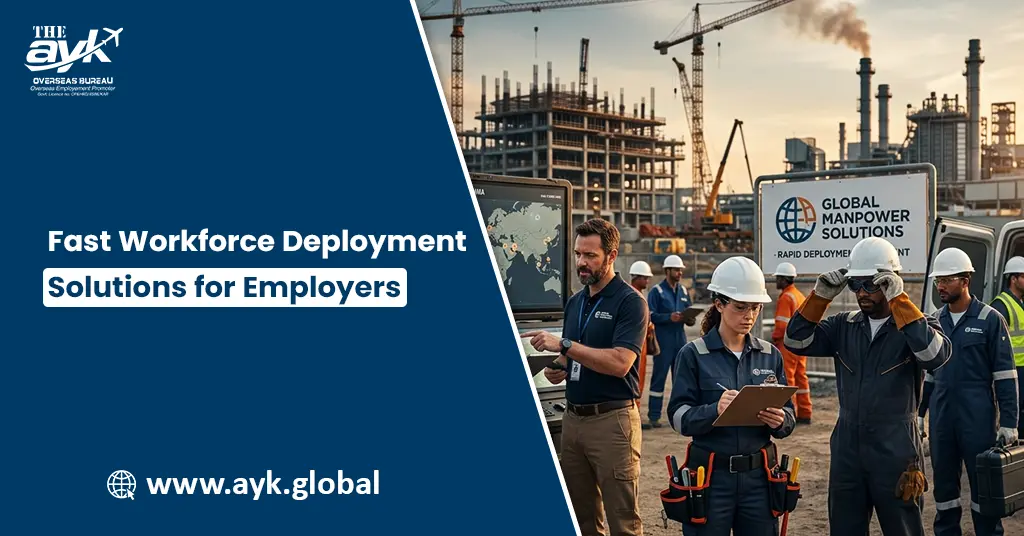
Fast Workforce Deployment Solutions for Employers
Published: June 24, 2026 | Views: 38
Introduction
In today's competitive business environment, employers often face situations where workforce requirements must be fulfilled quickly. Construction projects begin with tight deadlines, manufacturing facilities expand production capacity, logistics companies experience seasonal demand increases, healthcare providers require urgent staffing support, and industrial operations must maintain productivity despite workforce shortages.
Delays in workforce deployment can have serious consequences. Projects may fall behind schedule, production targets may be missed, operational efficiency may decline, and business opportunities may be lost. As a result, employers increasingly seek fast workforce deployment solutions that provide qualified workers within the shortest possible timeframe.
Rapid workforce deployment involves more than simply hiring employees quickly. Successful deployment requires workforce planning, candidate sourcing, screening, qualification verification, compliance management, documentation processing, and workforce mobilization. Employers must balance speed with workforce quality to ensure operational success.
International recruitment has become an important component of fast workforce deployment strategies. Global labor markets provide access to electricians, welders, plumbers, technicians, engineers, nurses, drivers, machine operators, healthcare professionals, logistics personnel, and industrial workers who can support urgent workforce requirements.
Organizations that develop efficient deployment processes are generally better positioned to respond to workforce challenges and maintain operational continuity. Fast deployment capabilities help employers remain competitive and achieve project objectives despite changing workforce demands.
This guide explores fast workforce deployment solutions and explains how employers can accelerate recruitment and mobilization activities while maintaining workforce quality.
1. Why Fast Workforce Deployment Matters
Workforce availability directly affects business performance. Organizations that cannot fill vacancies quickly may experience operational disruptions, reduced productivity, delayed projects, and customer service challenges.
Fast workforce deployment helps employers maintain business continuity by ensuring staffing requirements are met without unnecessary delays. Construction companies can keep projects on schedule, manufacturers can maintain production targets, healthcare facilities can continue delivering services, and logistics providers can meet customer demands.
Rapid deployment is particularly important during periods of growth, seasonal demand increases, emergency staffing requirements, and large project launches. Workforce readiness contributes directly to operational success.
Organizations that prioritize deployment efficiency often achieve stronger workforce outcomes and improved business performance.
Deployment Benefits
Operational disruptions are minimized.
Projects remain on schedule.
Productivity improves significantly.
2. Workforce Planning Accelerates Hiring
Fast recruitment begins with workforce planning. Employers should identify workforce requirements before urgent staffing needs arise. Planning helps organizations prepare for future workforce demands and reduce recruitment delays.
Workforce planning involves forecasting staffing requirements, identifying critical positions, defining workforce categories, and developing recruitment strategies. Employers that anticipate workforce needs can launch recruitment activities earlier and improve workforce readiness.
Planning also supports better resource allocation and improves communication between project teams, recruitment partners, and workforce management personnel.
Organizations that invest in workforce planning generally achieve faster deployment timelines and stronger recruitment outcomes.
Workforce Planning Benefits
Staffing requirements become predictable.
Recruitment activities start earlier.
Deployment timelines improve.
3. Build Talent Pipelines Before Vacancies Occur
One of the most effective workforce deployment strategies is maintaining access to talent pipelines. Rather than beginning recruitment only after vacancies appear, employers should develop ongoing candidate networks.
Talent pipelines include relationships with recruitment agencies, vocational institutions, trade testing centers, workforce databases, and candidate pools. These resources provide access to qualified workers when staffing requirements arise.
Employers that maintain talent pipelines can fill vacancies more quickly because candidate sourcing activities have already begun. Workforce readiness improves while recruitment timelines become shorter.
Organizations with strong talent pipelines often gain significant advantages in competitive labor markets.
Talent Pipeline Benefits
Candidate availability improves significantly.
Recruitment speed increases.
Workforce shortages become easier to manage.
4. International Recruitment Supports Urgent Hiring
Local labor markets do not always provide sufficient workforce availability. Labor shortages often make urgent hiring difficult, particularly for technical and specialized positions.
International recruitment expands access to talent by connecting employers with qualified candidates from global labor markets. Organizations can recruit electricians, welders, plumbers, technicians, engineers, nurses, drivers, machine operators, and other workforce categories more efficiently.
Global sourcing improves workforce flexibility and helps employers address urgent staffing requirements that cannot be met through domestic recruitment alone.
Employers that integrate international recruitment into workforce strategies often achieve stronger deployment outcomes and greater workforce stability.
International Recruitment Benefits
Talent pools become significantly larger.
Urgent vacancies are filled faster.
Workforce flexibility improves.
5. Candidate Screening Must Remain Efficient
Speed is important during workforce deployment, but workforce quality cannot be compromised. Employers should implement screening processes that balance efficiency with recruitment accuracy.
Candidate screening may include qualification reviews, employment verification, reference checks, interviews, and workforce assessments. These activities help identify suitable candidates while reducing recruitment risks.
Efficient screening processes improve hiring speed because unsuitable candidates are identified early. Employers gain greater confidence in workforce quality without creating unnecessary delays.
Organizations that optimize screening procedures often achieve stronger workforce outcomes and improved operational performance.
Screening Benefits
Workforce quality remains high.
Recruitment risks decrease.
Hiring decisions become faster.
6. Trade Testing Improves Deployment Readiness
Many workforce categories require practical skills that cannot be evaluated through resumes or interviews alone. Trade testing helps employers verify competencies before deployment occurs.
Electricians, welders, plumbers, technicians, machine operators, and maintenance specialists can demonstrate practical abilities through structured assessments. Employers gain direct evidence regarding workforce readiness.
Trade testing supports faster deployment because employers can confidently mobilize candidates who have already demonstrated required competencies. Workforce quality improves while recruitment uncertainty decreases.
Organizations that integrate trade testing into deployment strategies often achieve stronger productivity and project performance.
Trade Testing Benefits
Practical skills are verified quickly.
Workforce readiness improves.
Deployment confidence increases.
7. Streamlining Compliance and Documentation
One of the biggest reasons workforce deployment gets delayed is incomplete or poorly managed documentation. Even when employers successfully recruit qualified workers, deployment cannot proceed until all legal and administrative requirements are completed.
International recruitment may involve visa applications, work permits, employment contracts, medical reports, passport verification, insurance documentation, police clearances, and regulatory approvals. Delays in any of these areas can affect project schedules and operational readiness.
Employers should establish structured documentation systems and maintain clear communication with recruitment partners. Preparing documentation requirements early helps accelerate processing timelines and reduce administrative bottlenecks.
Organizations that streamline compliance and documentation processes often achieve significantly faster workforce deployment and improved operational efficiency.
Compliance Benefits
Documentation delays are minimized.
Workforce deployment becomes faster.
Administrative efficiency improves.
8. Workforce Mobilization Requires Detailed Execution
Mobilization is the process of moving workers from recruitment status into active employment. Successful mobilization ensures employees arrive prepared, informed, and ready to contribute immediately.
Workforce mobilization includes travel coordination, accommodation arrangements, airport assistance, orientation programs, onboarding support, safety training, and workplace integration activities. Poor mobilization planning can create confusion and reduce workforce productivity during the early stages of employment.
Employers should develop detailed mobilization plans that include responsibilities, timelines, communication procedures, and workforce support systems. These plans help ensure deployment activities proceed smoothly.
Organizations that invest in mobilization planning often experience faster workforce readiness and stronger project performance.
Mobilization Benefits
Employees become productive more quickly.
Deployment activities become organized.
Workforce readiness improves.
9. Reducing Delays in Large Projects
Large projects often depend on workforce availability. Delays in staffing can affect construction schedules, production targets, healthcare operations, logistics performance, and industrial activities.
Many workforce deployment delays occur because recruitment activities begin too late. Employers sometimes wait until staffing shortages become urgent before initiating hiring processes. This reactive approach often creates unnecessary pressure and operational risks.
Employers should develop workforce deployment plans aligned with project schedules. Early recruitment activities, workforce forecasting, and talent pipeline development help reduce delays and improve workforce availability.
Organizations that integrate workforce planning into project management generally achieve stronger operational outcomes and reduced staffing risks.
Project Staffing Benefits
Project schedules remain protected.
Workforce shortages decrease.
Operational continuity improves.
10. Workforce Scalability Supports Business Growth
Fast workforce deployment is particularly important for organizations experiencing rapid growth. Expansion projects, new facilities, production increases, seasonal demand fluctuations, and infrastructure developments often require large numbers of employees within short timeframes.
Scalable workforce solutions allow employers to increase staffing levels efficiently without compromising workforce quality. International recruitment and recruitment partnerships provide flexibility that supports changing workforce requirements.
Employers that establish scalable workforce systems can respond more effectively to market opportunities and operational demands. Workforce agility becomes a competitive advantage.
Organizations that prioritize workforce scalability are generally better positioned to support sustainable growth.
Scalability Benefits
Staffing levels adjust quickly.
Business growth becomes easier to support.
Operational flexibility improves.
11. Recruitment Agencies Accelerate Hiring Processes
Professional recruitment agencies play a critical role in fast workforce deployment. Their expertise, workforce networks, candidate databases, and recruitment infrastructure help employers fill vacancies more efficiently.
Recruitment agencies manage candidate sourcing, screening, qualification verification, trade testing coordination, documentation processing, and workforce mobilization activities. Employers benefit because hiring timelines become shorter and workforce quality remains high.
Agencies also maintain access to talent pools that may not be available through traditional recruitment methods. This improves workforce availability and helps organizations address urgent staffing requirements.
Employers that collaborate with experienced recruitment agencies often achieve faster deployment outcomes and stronger workforce readiness.
Recruitment Agency Benefits
Candidate sourcing becomes more efficient.
Hiring timelines improve significantly.
Workforce quality remains strong.
12. Why AYK Overseas Delivers Fast Workforce Solutions
Fast workforce deployment requires recruitment expertise, candidate access, workforce planning capabilities, compliance support, and mobilization experience. Employers need recruitment partners who can respond quickly while maintaining workforce quality standards.
AYK Overseas Recruitment & HR Manpower Agency
License No. GL-4586-KAR
supports employers across construction, healthcare, manufacturing, logistics, hospitality, engineering, transportation, facilities management, oil and gas, and industrial sectors. The agency provides workforce planning support, candidate sourcing, screening, trade testing assistance, qualification verification, compliance coordination, documentation management, workforce mobilization, and international recruitment services.
AYK Overseas helps organizations recruit electricians, welders, plumbers, technicians, engineers, nurses, drivers, machine operators, supervisors, healthcare professionals, hospitality staff, and large workforce teams for urgent projects and operational requirements.
Through structured recruitment processes and global manpower solutions, AYK Overseas helps employers accelerate workforce deployment while maintaining workforce quality and operational readiness.
Fast Workforce Solutions
Rapid access to qualified manpower.
Professional screening and verification.
Efficient workforce deployment support.
Conclusion
Fast workforce deployment has become a critical capability for employers operating in competitive labor markets. Organizations that can recruit, verify, mobilize, and integrate qualified workers quickly are better positioned to maintain productivity and achieve business objectives.
Successful deployment depends on workforce planning, talent pipeline development, international recruitment, candidate screening, trade testing, compliance management, and workforce mobilization. Employers that invest in these capabilities generally experience stronger workforce outcomes and reduced operational disruptions.
As workforce shortages continue affecting industries worldwide, fast workforce deployment will remain an essential component of effective workforce management and business growth strategies.
 Step by Step Guide to Getting Selected for GCC Jobs
 Starting a Small Business with Overseas Savings
 Recruitment Solutions for Technical Workforce Requirements
 KSA Recruitment
 UAE Recruitment
 Qatar Recruitment
 Oman Recruitment
 Kuwait Recruitment
 Libya Recruitment
 Bahrain Recruitment
 Iraq Recruitment
 Malaysia Recruitment
 Malta Recruitment
 Canada Recruitment
 USA Recruitment
 Europe Recruitment
 UK Recruitment
 Romania Recruitment
 Poland Recruitment
 Bulgaria Recruitment
 Albania Recruitment
 Serbia Recruitment
 Lithuania Recruitment
 Japan Recruitment
 Turkey Recruitment
 Kyrgyzstan Recruitment
 South Korea Recruitment