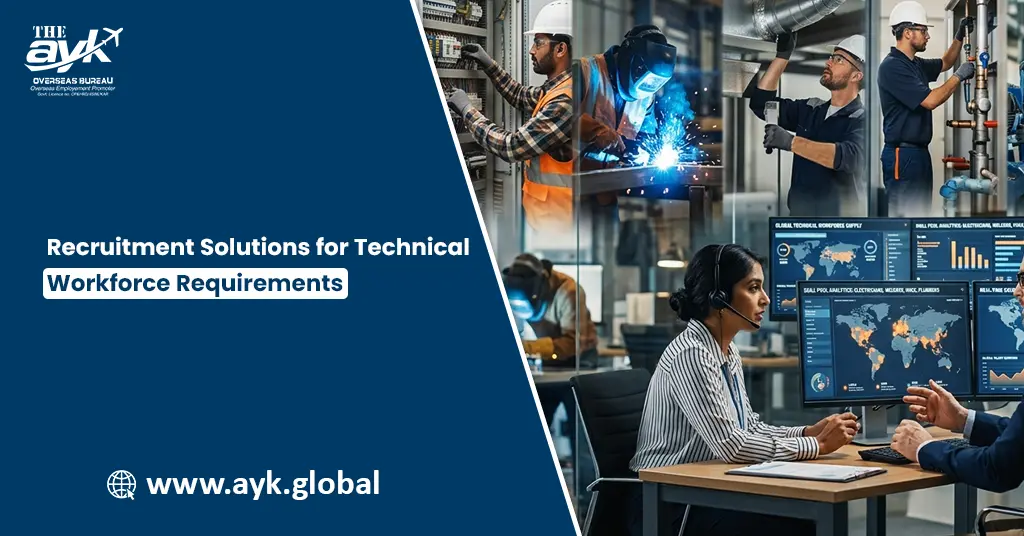
Recruitment Solutions for Technical Workforce Requirements
Published: June 23, 2026 | Views: 18
Introduction
Technical workforce recruitment has become one of the most challenging aspects of talent acquisition in today's labor market. Across industries such as construction, engineering, manufacturing, oil and gas, logistics, facilities management, energy, healthcare, and industrial services, employers are facing increasing difficulty finding qualified technical professionals.
Unlike general workforce recruitment, technical hiring requires specialized evaluation processes, deeper industry knowledge, and a stronger understanding of workforce competencies. Employers often seek candidates with specific certifications, practical experience, technical expertise, and problem-solving capabilities. The shortage of qualified technical workers has intensified competition and extended recruitment timelines.
Many organizations are expanding operations, adopting advanced technologies, and investing in large-scale projects. These developments increase demand for engineers, technicians, machine operators, electricians, welders, HVAC specialists, maintenance professionals, automation experts, and industrial supervisors. Unfortunately, workforce supply has not always kept pace with demand.
Technical workforce shortages can significantly affect business performance. Projects may be delayed, operational efficiency may decline, maintenance requirements may be overlooked, and productivity targets may become difficult to achieve. Employers therefore need recruitment strategies specifically designed for technical manpower acquisition.
Successful technical recruitment requires workforce planning, candidate verification, trade testing, skills assessments, international sourcing, workforce development initiatives, and strategic recruitment partnerships. Organizations that adopt these approaches are generally better positioned to secure qualified talent and maintain operational performance.
This guide explores recruitment solutions that help employers address technical workforce requirements effectively and build stronger talent pipelines for long-term success.
1. Understanding Technical Workforce Requirements
The first step in successful technical recruitment is understanding workforce requirements clearly. Technical positions often involve specialized responsibilities that demand specific competencies and qualifications. Employers must define these requirements before recruitment activities begin.
Technical workforce categories may include engineers, technicians, electricians, welders, machine operators, maintenance specialists, automation professionals, industrial supervisors, HVAC technicians, instrumentation experts, quality control personnel, and technical support staff. Each category requires unique skills and evaluation criteria.
Employers should identify educational qualifications, certifications, technical competencies, industry experience, safety requirements, and operational responsibilities associated with each role. Clear workforce definitions improve recruitment accuracy and reduce hiring risks.
Organizations that establish detailed workforce requirements generally achieve stronger recruitment outcomes because candidate evaluations become more focused and objective.
Technical Workforce Planning Benefits
Clear requirements improve recruitment accuracy.
Candidate evaluations become more effective.
Workforce quality improves significantly.
2. Technical Skills Are Becoming More Specialized
Technology continues transforming industries across the world. Manufacturing facilities use automation systems. Construction projects incorporate smart technologies. Logistics operations rely on digital platforms. Energy companies implement advanced monitoring systems. These changes increase the complexity of workforce requirements.
Technical professionals today often need broader skill sets than previous generations. Employers seek candidates who can work with modern equipment, interpret technical data, troubleshoot systems, and adapt to evolving workplace technologies.
The growing specialization of technical roles contributes to workforce shortages because fewer candidates possess the required competencies. Recruitment efforts must therefore focus on identifying workers with relevant expertise rather than relying solely on general experience.
Organizations that understand changing workforce requirements are better prepared to recruit employees who can support future operational needs.
Technical Skill Trends
Technology increases workforce complexity.
Specialized expertise is increasingly valuable.
Workforce requirements continue evolving.
3. Workforce Planning Supports Technical Recruitment
Technical workforce recruitment should never be entirely reactive. Organizations that wait until positions become vacant often struggle to secure qualified candidates quickly. Workforce planning helps employers anticipate staffing requirements and prepare recruitment strategies in advance.
Workforce planning involves forecasting future staffing needs, identifying skill gaps, evaluating workforce demographics, and analyzing business growth objectives. These activities help organizations understand when technical recruitment efforts should begin.
Technical positions often require longer recruitment timelines because qualified candidates are less readily available. Planning ahead reduces the risk of workforce shortages affecting operations and project schedules.
Employers that prioritize workforce planning generally experience greater workforce stability and improved recruitment outcomes.
Workforce Planning Benefits
Forecasting improves workforce readiness.
Skill gaps are identified early.
Recruitment becomes more strategic.
4. Candidate Screening Improves Hiring Quality
Technical recruitment requires comprehensive candidate screening processes. Resumes and interviews alone are often insufficient because employers need to verify actual competencies and technical expertise.
Effective screening evaluates educational qualifications, certifications, employment history, project experience, technical knowledge, and practical skills. Employers gain greater confidence in hiring decisions when workforce quality is verified objectively.
Candidate screening also helps organizations identify potential skill gaps before employment begins. This information supports workforce development planning and onboarding activities.
Businesses that invest in structured screening processes often achieve stronger workforce performance and reduced turnover rates.
Screening Advantages
Technical competencies are verified.
Hiring risks decrease significantly.
Workforce quality improves.
5. Trade Testing Validates Technical Competence
Trade testing remains one of the most effective tools for evaluating technical workforce capabilities. Practical assessments provide employers with direct evidence regarding candidate skills and job readiness.
Technical workers can demonstrate competencies through real-world tasks relevant to their roles. Electricians perform electrical installations, welders complete welding assessments, technicians troubleshoot systems, and machine operators demonstrate equipment operation capabilities.
Trade testing improves recruitment accuracy because decisions are based on demonstrated performance rather than assumptions. Employers gain confidence that workers can perform effectively once deployed.
Organizations that incorporate trade testing into recruitment processes generally experience stronger workforce quality and operational performance.
Trade Testing Benefits
Practical assessments verify workforce skills.
Employers reduce recruitment uncertainty.
Verified workers improve productivity.
6. International Recruitment Expands Talent Access
Many employers struggle to recruit sufficient technical talent locally because labor shortages continue affecting multiple industries. International recruitment has therefore become an important workforce solution for technical positions.
Global talent pools provide access to engineers, technicians, electricians, welders, HVAC professionals, machine operators, industrial specialists, and maintenance personnel. Employers gain greater flexibility and improve workforce availability.
International recruitment also supports business growth by reducing staffing constraints. Organizations can pursue expansion opportunities more confidently when workforce resources are accessible globally.
Professional recruitment agencies often assist with international sourcing, documentation management, compliance requirements, workforce mobilization, and deployment activities. These services simplify technical workforce acquisition significantly.
International Recruitment Benefits
Global talent improves workforce availability.
Technical labor shortages become easier to manage.
Broader sourcing supports business growth.
7. Technical Workforce Shortages Continue Growing
One of the biggest challenges facing employers today is the growing shortage of technical professionals. Across construction, manufacturing, engineering, energy, logistics, oil and gas, facilities management, and industrial sectors, demand for qualified workers continues increasing while workforce supply remains limited.
Several factors contribute to these shortages. Experienced workers are retiring, fewer young professionals are entering technical trades, technology is increasing skill requirements, and economic growth continues creating new workforce demand. As a result, employers often struggle to recruit qualified candidates within reasonable timeframes.
Technical workforce shortages affect organizations in multiple ways. Projects may be delayed, maintenance schedules disrupted, operational efficiency reduced, and expansion plans postponed. Workforce availability has become a critical factor influencing business performance.
Employers that recognize these workforce trends and invest in long-term recruitment strategies are generally better positioned to maintain workforce stability and support growth objectives.
Workforce Shortage Challenges
Technical talent demand exceeds supply.
Labor shortages affect multiple industries.
Strategic planning improves workforce readiness.
8. Recruitment Challenges Facing Technical Employers
Technical recruitment presents unique challenges that differ from general hiring activities. Employers must evaluate specialized competencies, verify certifications, assess practical experience, and ensure candidates possess role-specific expertise.
Competition for qualified talent has intensified significantly. Technical professionals often receive multiple employment opportunities, making recruitment more difficult and increasing hiring timelines. Employers must act quickly while maintaining workforce quality standards.
Another challenge involves matching workforce skills to operational requirements. A candidate may possess technical experience but lack expertise relevant to specific projects, equipment, or industry environments. Thorough screening and evaluation are therefore essential.
Organizations that implement structured recruitment processes generally achieve stronger hiring outcomes because workforce quality is evaluated more effectively.
Recruitment Challenges
Technical positions require specialized evaluation.
Candidate competition continues increasing.
Workforce matching improves hiring success.
9. Building Long-Term Technical Talent Pipelines
One of the most effective solutions for technical workforce recruitment is the development of long-term talent pipelines. Rather than recruiting only when vacancies arise, employers should establish ongoing strategies for accessing qualified candidates.
Talent pipelines may include relationships with recruitment agencies, technical training institutions, vocational schools, workforce development programs, apprenticeship initiatives, and international recruitment networks. These resources provide access to future workforce opportunities.
Long-term workforce planning improves recruitment efficiency because candidate sourcing begins before staffing shortages occur. Organizations gain greater flexibility and reduce operational risks associated with urgent hiring campaigns.
Employers that invest in talent pipeline development often experience stronger workforce stability and improved recruitment performance.
Talent Pipeline Benefits
Future workforce needs are addressed proactively.
Candidate availability improves significantly.
Long-term planning supports business growth.
10. Technology Supports Technical Recruitment
Technology plays an increasingly important role in technical workforce recruitment. Digital recruitment platforms, workforce analytics tools, applicant tracking systems, and assessment technologies improve hiring efficiency and workforce visibility.
Employers can use technology to identify candidates, evaluate qualifications, track recruitment performance, and forecast future staffing requirements. Workforce data supports more informed decision-making and strengthens recruitment strategies.
Technology also improves candidate engagement by streamlining application processes, interview scheduling, communication activities, and onboarding procedures. These efficiencies help employers compete more effectively for technical talent.
Organizations that integrate technology into recruitment processes often achieve stronger workforce outcomes and greater operational efficiency.
Technology Advantages
Digital tools improve recruitment performance.
Workforce analytics support planning.
Technology enhances candidate experiences.
11. Recruitment Agencies Strengthen Technical Hiring
Professional recruitment agencies provide valuable support for technical workforce acquisition. Their expertise, industry knowledge, candidate networks, and sourcing capabilities help employers overcome many recruitment challenges.
Recruitment agencies understand technical workforce requirements and maintain access to qualified candidates across multiple industries. Employers benefit from broader talent pools and improved candidate availability.
Agencies also support workforce planning, candidate screening, trade testing coordination, qualification verification, documentation management, and international recruitment activities. These services improve hiring quality while reducing administrative workloads.
Organizations that build strong recruitment partnerships are often better positioned to secure technical talent and maintain workforce readiness.
Recruitment Agency Benefits
Industry expertise improves workforce sourcing.
Candidate networks expand talent access.
Professional support reduces recruitment risks.
12. Why AYK Overseas Provides Technical Workforce Solutions
Technical workforce recruitment requires expertise, planning, candidate verification, and access to qualified talent. Employers need workforce partners capable of delivering skilled manpower efficiently while maintaining quality standards.
AYK Overseas Recruitment & HR Manpower Agency
License No. GL-4586-KAR
helps employers recruit engineers, technicians, electricians, welders, HVAC specialists, machine operators, maintenance personnel, construction workers, industrial technicians, logistics professionals, and other technical workforce categories across multiple industries.
The agency provides workforce planning support, candidate sourcing, screening, trade testing assistance, qualification verification, documentation management, compliance coordination, international recruitment services, workforce mobilization, and deployment solutions. These capabilities help employers address workforce shortages and improve operational readiness.
By connecting organizations with qualified technical professionals, AYK Overseas supports productivity, project success, workforce stability, and long-term business growth. Employers gain access to workforce solutions designed specifically for technical manpower requirements.
Technical Workforce Solutions
Professional recruitment improves workforce quality.
International sourcing expands talent access.
Technical expertise supports business performance.
Conclusion
Technical workforce recruitment has become a strategic priority for organizations operating in increasingly competitive labor markets. As industries adopt advanced technologies and expand operations, demand for qualified technical professionals continues rising.
Employers that invest in workforce planning, candidate screening, trade testing, international recruitment, talent pipeline development, and recruitment partnerships are generally better positioned to address workforce shortages successfully. Technical manpower remains one of the most valuable resources available to modern businesses.
Organizations that prioritize workforce quality today will be better prepared to achieve productivity goals, support growth initiatives, and maintain competitive advantages in the future.
 Why You Are Not Getting Selected for Overseas Jobs
 Step-by-Step Guide to Schengen Work Permit & Employment Opportunities
 Why European Employers Should Recruit Pakistani Talent
 KSA Recruitment
 UAE Recruitment
 Qatar Recruitment
 Oman Recruitment
 Kuwait Recruitment
 Libya Recruitment
 Bahrain Recruitment
 Iraq Recruitment
 Malaysia Recruitment
 Malta Recruitment
 Canada Recruitment
 USA Recruitment
 Europe Recruitment
 UK Recruitment
 Romania Recruitment
 Poland Recruitment
 Bulgaria Recruitment
 Albania Recruitment
 Serbia Recruitment
 Lithuania Recruitment
 Japan Recruitment
 Turkey Recruitment
 Kyrgyzstan Recruitment
 South Korea Recruitment