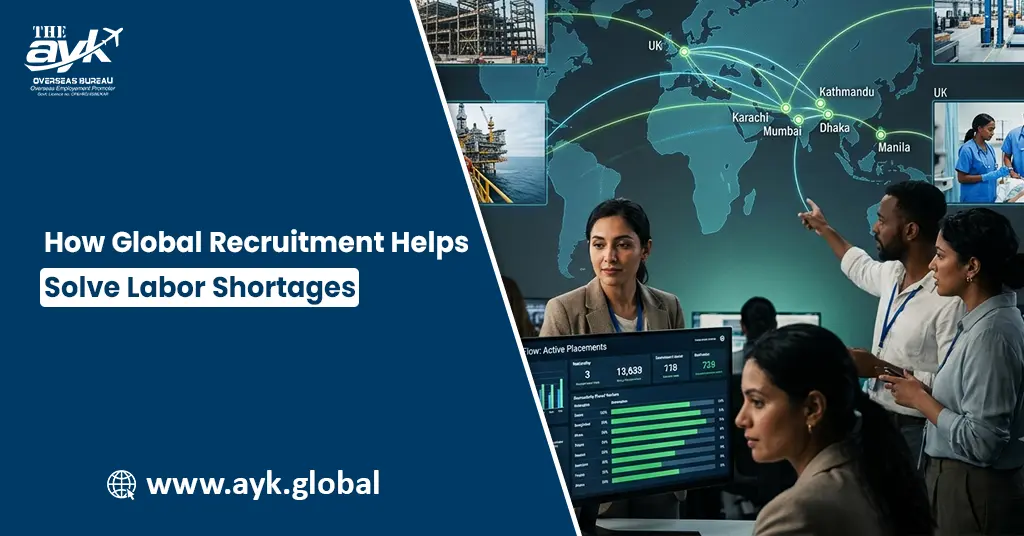
How Global Recruitment Helps Solve Labor Shortages
Published: June 23, 2026 | Views: 27
Introduction
Labor shortages have become one of the most significant challenges facing employers worldwide. Organizations across construction, healthcare, manufacturing, logistics, hospitality, engineering, transportation, facilities management, oil and gas, and industrial sectors are finding it increasingly difficult to recruit enough qualified workers to support operational requirements.
Several factors are contributing to these workforce shortages. Aging populations, workforce retirements, economic growth, infrastructure development, changing career preferences, and increasing demand for skilled labor have created imbalances between workforce supply and demand. As a result, many employers struggle to fill vacancies, maintain productivity, and achieve business objectives.
Labor shortages affect organizations in numerous ways. Projects may be delayed, customer service can suffer, production targets may be missed, and expansion opportunities can be limited. Workforce availability has become a strategic business issue rather than simply a recruitment challenge.
Global recruitment provides employers with an effective solution by expanding access to talent beyond local labor markets. International hiring enables organizations to recruit qualified workers from countries where workforce availability remains strong. This approach helps businesses address staffing challenges while supporting productivity and growth.
Today, global recruitment is no longer reserved for large multinational corporations. Organizations of all sizes are leveraging international workforce solutions to overcome labor shortages and strengthen workforce capabilities.
This guide explains how global recruitment helps solve labor shortages and why international hiring has become an essential workforce strategy for modern employers.
1. Understanding the Labor Shortage Challenge
Labor shortages occur when workforce demand exceeds the number of qualified workers available for employment. This challenge affects both skilled and unskilled workforce categories across multiple industries.
Construction companies often struggle to recruit electricians, welders, plumbers, and machine operators. Healthcare organizations face shortages of nurses and healthcare professionals. Manufacturing facilities require technicians and maintenance specialists. Logistics providers need drivers and warehouse personnel.
These shortages create operational difficulties because organizations cannot maintain workforce levels necessary for productivity and growth. Recruitment timelines become longer while competition for talent increases.
Understanding the causes of labor shortages helps employers develop more effective workforce strategies and identify solutions that support long-term workforce stability.
Labor Shortage Challenges
Workforce demand exceeds available talent.
Recruitment becomes increasingly competitive.
Operational performance may be affected.
2. Local Labor Markets Have Limitations
Many employers initially focus on local recruitment efforts when filling vacancies. While local hiring remains important, workforce availability is often limited by regional labor market conditions.
Population trends, educational pathways, workforce participation rates, economic activity, and industry growth all influence labor market capacity. In many regions, local workforce supply simply cannot keep pace with employer demand.
Organizations that rely exclusively on domestic recruitment may experience ongoing staffing challenges, particularly for technical and specialized positions. Labor shortages become more difficult to manage when candidate availability remains limited.
Expanding recruitment efforts beyond local labor markets helps employers overcome these limitations and improve workforce access significantly.
Local Market Challenges
Candidate availability remains limited.
Labor shortages restrict workforce growth.
Broader sourcing improves recruitment outcomes.
3. Global Recruitment Expands Workforce Availability
One of the greatest advantages of global recruitment is the ability to access larger talent pools. Employers are no longer restricted to candidates available within a single city, region, or country.
International recruitment expands workforce availability by connecting employers with qualified candidates from multiple labor markets. Organizations can recruit electricians, welders, technicians, nurses, engineers, drivers, hospitality staff, and other workforce categories more effectively.
Broader workforce access reduces staffing risks and improves recruitment flexibility. Employers gain greater control over workforce planning and can respond more efficiently to operational requirements.
Organizations that embrace global recruitment often achieve stronger workforce stability and improved hiring outcomes.
Workforce Availability Benefits
International sourcing expands talent access.
Candidate pools become significantly larger.
Workforce flexibility improves.
4. Skilled Labor Shortages Become Easier to Manage
Skilled labor shortages are among the most challenging workforce issues employers face today. Technical positions often require certifications, practical experience, and specialized competencies that are difficult to source locally.
Global recruitment helps address these shortages by providing access to skilled workers from international labor markets. Employers can identify candidates who possess relevant qualifications and practical expertise required for specific roles.
Construction, engineering, healthcare, manufacturing, logistics, and industrial sectors often benefit significantly from international recruitment because workforce demand frequently exceeds local supply.
Organizations that use global recruitment strategies are generally better positioned to secure qualified talent and maintain operational performance.
Skilled Workforce Benefits
Technical talent becomes more accessible.
Workforce shortages are reduced.
Business operations remain supported.
5. International Hiring Supports Business Growth
Business growth depends heavily on workforce availability. Organizations cannot expand successfully without sufficient manpower to support operations, projects, and customer requirements.
Global recruitment provides access to workforce resources that support growth initiatives. Employers can recruit workers according to operational needs and scale workforce levels more effectively.
Expansion projects often require rapid hiring activities. International recruitment helps organizations secure manpower efficiently and reduces the risk of staffing shortages delaying business objectives.
Employers that integrate global hiring into workforce planning strategies are generally better prepared to pursue growth opportunities confidently.
Growth Benefits
Expansion plans gain workforce support.
Recruitment flexibility improves significantly.
Business growth becomes more sustainable.
6. Workforce Productivity Improves with Better Talent Access
Productivity depends largely on workforce quality. Employees who possess relevant skills and experience contribute more effectively to organizational objectives and operational performance.
Global recruitment improves talent access by expanding candidate pools and increasing the likelihood of finding qualified workers. Employers can focus on workforce quality rather than simply filling vacancies.
Skilled international workers often bring valuable experience gained through diverse projects and industries. Their expertise supports productivity, operational efficiency, customer satisfaction, and profitability.
Organizations that prioritize workforce quality through global recruitment frequently achieve stronger business outcomes and improved workforce performance.
Productivity Benefits
Access to qualified workers improves.
Workforce quality supports efficiency.
Operational performance strengthens.
7. Long-Term Workforce Planning Becomes More Effective
Labor shortages are rarely temporary problems. Many industries continue experiencing workforce challenges year after year because labor demand grows faster than workforce supply. Employers therefore need long-term solutions rather than short-term hiring fixes.
Global recruitment strengthens workforce planning by giving organizations access to broader talent pools and more flexible staffing options. Employers can forecast workforce requirements, build talent pipelines, and prepare for future operational needs with greater confidence.
Long-term workforce planning also helps organizations reduce recruitment emergencies. Instead of reacting to staffing shortages after they occur, employers can develop proactive hiring strategies that maintain workforce stability and operational continuity.
Businesses that integrate international recruitment into workforce planning often experience stronger workforce readiness and improved organizational resilience. Access to global talent becomes an important component of sustainable growth strategies.
Workforce Planning Benefits
Future staffing needs are addressed proactively.
Talent pipelines become stronger.
Workforce stability improves significantly.
8. Global Recruitment Strengthens Competitive Advantages
Organizations compete not only for customers but also for talent. Businesses that can attract and retain qualified workers are generally better positioned to deliver quality services, maintain productivity, and achieve growth objectives.
Global recruitment strengthens competitive advantages by improving access to skilled manpower. Employers gain greater flexibility and can respond more effectively to changing workforce requirements. Access to international talent allows organizations to pursue opportunities that may otherwise be limited by labor shortages.
A strong workforce contributes directly to innovation, customer satisfaction, operational efficiency, and financial performance. Companies with reliable staffing resources often outperform competitors struggling with workforce shortages.
Employers that embrace global recruitment gain access to workforce solutions that support long-term competitiveness and market leadership.
Competitive Benefits
Talent access improves organizational performance.
Workforce quality strengthens competitiveness.
Growth opportunities become easier to pursue.
9. Recruitment Agencies Simplify Global Hiring
Managing international recruitment independently can be complex. Employers must source candidates, verify qualifications, conduct screening activities, manage documentation, coordinate compliance requirements, and support workforce mobilization.
Professional recruitment agencies simplify these processes by providing expertise, workforce networks, candidate databases, trade testing support, compliance assistance, and international hiring capabilities. Employers benefit because recruitment activities become more efficient and workforce quality remains high.
Recruitment agencies also help reduce hiring risks through structured candidate evaluation processes. Workforce verification activities improve confidence and support stronger hiring outcomes.
Organizations that collaborate with experienced recruitment agencies often achieve faster recruitment timelines and greater workforce reliability.
Recruitment Agency Benefits
Candidate sourcing becomes more efficient.
Workforce quality improves significantly.
Administrative burdens are reduced.
10. International Recruitment Supports Multiple Industries
One of the greatest strengths of global recruitment is its ability to support diverse workforce requirements across numerous industries. International hiring is not limited to one sector or workforce category.
Construction companies recruit electricians, welders, plumbers, carpenters, steel fixers, scaffolders, and machine operators. Healthcare organizations hire nurses and healthcare professionals. Manufacturing facilities recruit technicians, engineers, maintenance specialists, and operators. Logistics companies source drivers and warehouse personnel.
Hospitality businesses, engineering firms, transportation providers, facilities management companies, and industrial organizations also benefit from international workforce solutions. Global recruitment provides flexibility and scalability regardless of industry requirements.
Organizations across sectors can leverage international hiring strategies to address workforce shortages and maintain operational performance.
Industry Benefits
Global recruitment supports multiple sectors.
Workforce flexibility improves significantly.
Labor shortages become easier to manage.
11. The Future of Global Recruitment
Workforce trends indicate that global recruitment will continue growing in importance over the coming years. Labor shortages, demographic changes, economic development, infrastructure investments, and technological advancements are expected to increase demand for qualified workers worldwide.
Many countries face aging populations and workforce retirements, reducing labor availability within domestic markets. At the same time, industries continue expanding and creating new employment opportunities. These trends will likely intensify competition for talent.
Global recruitment provides employers with a practical solution by expanding access to international labor markets. Organizations that establish strong international hiring capabilities today will be better prepared to navigate future workforce challenges.
The future of workforce planning will increasingly involve international recruitment, talent mobility, and global workforce strategies designed to support long-term business success.
Future Workforce Trends
Global labor demand continues increasing.
International hiring becomes more important.
Workforce planning evolves significantly.
12. Why AYK Overseas Helps Solve Labor Shortages
Employers facing workforce shortages need recruitment partners capable of delivering qualified manpower efficiently and reliably. Successful international recruitment requires workforce expertise, candidate sourcing capabilities, screening processes, compliance management, and workforce mobilization support.
AYK Overseas Recruitment & HR Manpower Agency
License No. GL-4586-KAR
helps employers recruit skilled and unskilled workers across construction, healthcare, manufacturing, logistics, engineering, hospitality, transportation, facilities management, oil and gas, and industrial sectors. The agency provides workforce planning support, candidate sourcing, screening, trade testing assistance, qualification verification, compliance coordination, documentation management, workforce mobilization, and international recruitment services.
AYK Overseas supports employers seeking electricians, welders, plumbers, technicians, engineers, nurses, drivers, machine operators, supervisors, healthcare professionals, and large workforce teams for international projects.
By connecting organizations with qualified talent from global labor markets, AYK Overseas helps businesses overcome labor shortages, improve productivity, and support sustainable growth.
Workforce Solutions Benefits
International talent improves workforce availability.
Professional recruitment reduces hiring risks.
Business growth receives stronger workforce support.
Conclusion
Labor shortages remain one of the most significant workforce challenges facing employers today. Organizations across industries are struggling to secure qualified talent while maintaining productivity, operational efficiency, and business growth.
Global recruitment provides a powerful solution by expanding access to international talent pools and improving workforce availability. Through international hiring, employers can overcome labor shortages, recruit skilled workers, support expansion initiatives, and strengthen long-term workforce strategies.
As workforce challenges continue evolving, organizations that embrace global recruitment will be better positioned to achieve sustainable growth and maintain competitive advantages. Access to international talent has become an essential component of modern workforce planning.
 End-to-End Recruitment Process for GCC Employers Explained
 10 Reasons to Recruit Skilled Pakistani Workers for Your Business
 Hospitality Jobs in Europe for Foreign Workers
 KSA Recruitment
 UAE Recruitment
 Qatar Recruitment
 Oman Recruitment
 Kuwait Recruitment
 Libya Recruitment
 Bahrain Recruitment
 Iraq Recruitment
 Malaysia Recruitment
 Malta Recruitment
 Canada Recruitment
 USA Recruitment
 Europe Recruitment
 UK Recruitment
 Romania Recruitment
 Poland Recruitment
 Bulgaria Recruitment
 Albania Recruitment
 Serbia Recruitment
 Lithuania Recruitment
 Japan Recruitment
 Turkey Recruitment
 Kyrgyzstan Recruitment
 South Korea Recruitment