How Gulf Companies Can Partner with Licensed Pakistani Agencies
Published: July 04, 2026 | Views: 10
Introduction
Establishing productive partnerships with properly licensed Pakistani recruitment agencies represents the most effective and legally compliant pathway for Gulf companies seeking consistent access to Pakistan's substantial skilled and semi-skilled worker population, providing employers with professional recruitment services, regulatory compliance support, candidate quality verification, and ongoing placement relationship management that self-directed informal recruitment cannot replicate at comparable quality, cost, or risk-adjusted outcome levels. Gulf companies that understand how to identify, evaluate, and develop genuine partnerships with licensed Pakistani agencies gain significant competitive advantage over employers who approach Pakistan recruitment informally, experiencing better candidate quality, stronger compliance protection, more consistent placement timelines, and the long-term workforce pipeline reliability that trusted agency partnerships build over time. AYK Overseas Recruitment & HR Manpower Agency, recognized as one of Pakistan's top manpower agencies, maintains active employer partnerships across Gulf countries and this guide provides Gulf companies with the practical knowledge they need to establish and develop effective licensed agency partnerships that genuinely serve their recruitment objectives.
Verifying Pakistani Agency Licensing and Legitimacy
The foundation of any legitimate Gulf employer-Pakistani agency partnership begins with thorough verification that the agency holds current, valid licensing from Pakistan's Bureau of Emigration and Overseas Employment, which maintains the official registry of licensed overseas employment promoters whose authorization is legally required for facilitating overseas employment from Pakistan. Gulf employers should independently verify agency licensing through the BEOE's official registry rather than accepting agency-provided licensing documentation at face value, recognizing that fraudulent or lapsed license claims are not unknown within Pakistan's recruitment industry and that employers who establish partnerships with unlicensed agencies create both regulatory exposure and operational risk from agencies lacking the regulatory accountability that licensing creates. Beyond BEOE licensing, Gulf employers should research agency operational history, industry reputation, existing employer partnership references from Gulf companies with established agency relationships, and any available regulatory compliance record that indicates whether the agency has maintained clean regulatory standing without significant worker welfare complaints or regulatory violations that would signal problematic operational practices.
Establishing Clear Recruitment Requirements and Standards
Effective agency partnerships begin with Gulf employers providing clearly documented recruitment requirements that specify exactly what candidate profiles, competency standards, documentation completeness, and candidate presentation quality they expect the agency to deliver rather than assuming agencies will intuit employer expectations without specific guidance. Detailed requirement documentation should cover the specific technical skills and certification levels required for each position category, the documentation standards including attestation requirements that candidates must meet before presentation, the timeline within which candidates should be identified and presented following request submission, the assessment process through which employers evaluate presented candidates, and the feedback mechanism through which employer candidate assessment results will be communicated to the agency for future requirement refinement. Gulf employers who invest in developing comprehensive requirement documentation create the shared understanding foundation that produces consistently better candidate matches from agency presentations than employers who rely on informal verbal briefings that leave significant interpretation latitude that agencies and employers fill differently based on their respective incomplete understanding of what the other party genuinely needs.
Structuring Transparent Fee and Cost Arrangements
The cost structure governing agency partnership arrangements should be explicitly documented, transparent about all components that contribute to total placement cost, and consistent with Pakistani regulatory standards that prohibit any arrangement resulting in workers paying recruitment fees regardless of how such costs are technically structured within the employer-agency fee framework. Gulf employers should establish clear written agreements covering the agency fee for successful placement, the specific services included within this fee, the circumstances under which fees are refundable or replacements provided when placed workers depart before minimum tenure periods, and any additional costs beyond the basic placement fee that the partnership arrangement involves. Employers who establish transparent, documented cost frameworks with licensed agencies create the mutual accountability that prevents the informal cost escalation and misaligned expectations that vague verbal cost understandings produce over time within recruitment partnerships that accumulate multiple placements across extended partnership periods where unresolved cost ambiguities create increasing friction.
Communication Protocols and Relationship Management
Productive Gulf employer-Pakistani agency partnerships develop through consistent, professional communication that maintains mutual understanding of current recruitment priorities, market condition changes, placement status updates, and relationship health issues that require proactive address before they develop into significant partnership problems. Gulf employers who designate specific internal contacts responsible for agency partnership management, maintain regular communication beyond purely transactional placement requests, provide consistent candidate assessment feedback that helps agencies refine their candidate identification approach, and respond to agency communication promptly create the relationship investment that produces increasingly effective placement results over time as mutual understanding deepens through consistent interaction. The most productive long-term partnerships develop when both parties treat their relationship as a genuine business partnership rather than a purely transactional vendor-client arrangement, with mutual investment in each other's success producing the aligned incentives that consistently generate better outcomes than transactional relationships where each party optimizes purely for their own immediate interests without regard for their partner's legitimate needs.
Candidate Assessment and Selection Process Integration
Gulf employers who integrate Pakistani recruitment agencies into their candidate assessment process at appropriate stages create better selection outcomes than those who keep agencies entirely external to assessment until final placement decisions, with agency involvement in assessment process design providing valuable Pakistan market context that improves assessment relevance and agency observation of employer assessment patterns improving future candidate screening alignment with employer selection preferences. Employer assessment missions to Pakistan, where employer representatives travel to evaluate pre-screened candidate groups that agencies have assembled according to specified requirements, represent the most direct integration of employer and agency in candidate selection and create particularly strong assessment quality when agencies prepare candidates appropriately and employers provide substantive, specific assessment feedback that helps agencies understand what distinguished selected from non-selected candidates. Gulf employers who treat agency-presented candidates as pre-screened based on agreed criteria rather than unverified raw applications create appropriate shared accountability for candidate quality between employer assessment and agency pre-screening that produces better overall placement quality than employers who either accept all agency-presented candidates without employer assessment or conduct entirely independent assessment without agency preparation input.
Documentation Quality Standards and Verification Support
Gulf employers who establish clear documentation quality standards within their agency partnerships and hold agencies accountable to these standards create significantly better placement process efficiency than those who accept variable documentation quality that creates visa processing delays and employer verification complications that adequate agency documentation standards would prevent. Documentation standards should specify exact attestation requirements for each document category, the verification steps the agency must complete before presenting candidates, the format in which documentation should be organized for employer review, and the specific completeness check the agency confirms before presenting candidates as documentation-ready for visa processing. Licensed agencies with strong operational capability provide genuine documentation verification value by ensuring that candidate documentation meets all specified standards before presentation rather than leaving employer HR teams to discover documentation deficiencies during visa processing when correction delays create operational disruption that adequate agency documentation quality control would have prevented.
Managing Performance Expectations and Quality Accountability
Gulf employers who establish clear performance expectations and quality accountability mechanisms within their agency partnerships create genuine partnership-level accountability for placement outcomes that purely transactional arrangements without performance standards cannot achieve, with specific metrics including candidate acceptance rates, time-to-placement against agreed timelines, first-year retention rates for placed workers, and documentation completeness rates providing the objective measurement foundation for partnership performance discussions. Regular partnership performance reviews that assess actual outcomes against established expectations create the honest dialogue about placement quality, process efficiency, and improvement opportunities that genuinely productive long-term partnerships require rather than the unaddressed accumulating dissatisfaction that partnerships without performance review mechanisms often develop over time. Gulf employers who approach performance management within agency partnerships as collaborative improvement discussion rather than adversarial complaint create the psychological safety that allows agencies to honestly identify their own improvement opportunities and employer-side process adjustments that collectively improve partnership outcomes more than one-sided employer pressure without genuine collaborative engagement.
Building Long-Term Partnership Versus Transactional Relationships
Gulf employers who commit to developing genuine long-term partnerships with specific licensed Pakistani agencies rather than continuously shopping across multiple agencies for marginally better individual placement terms create recruitment infrastructure value that short-term cost optimization cannot match, with long-term agency partners developing accumulated employer-specific knowledge that improves candidate targeting, reduces screening waste, and builds the mutual trust that produces consistently better cooperation throughout all placement process stages. Long-term partnership development requires employer investment in relationship building beyond purely transactional placement interactions, including regular communication that maintains relationship health between active recruitment periods, prompt and fair fee payment that demonstrates employer reliability, specific candidate requirement sharing that helps agencies improve targeting over time, and genuine appreciation for agency services that creates the positive relationship climate where agency staff invest genuinely in employer success beyond minimum transactional service delivery. Gulf employers who develop specific trusted Pakistani agency partnerships rather than maintaining purely transactional multi-agency relationships often report meaningfully better placement quality, stronger candidate commitment to joining their specific employment, and more reliable placement timelines than those whose purely transactional agency relationships produce adequate but never excellent recruitment service from agencies who cannot justify significant relationship investment without reciprocal employer commitment.
Joint Worker Welfare Monitoring and Issue Resolution
Gulf employers who actively cooperate with their licensed Pakistani agency partners on worker welfare monitoring and issue resolution create important accountability mechanisms that serve both parties' interests more effectively than either party attempting to monitor and address worker welfare independently. Licensed Pakistani agencies maintain ongoing interest in the welfare of workers they have placed, recognizing that worker welfare outcomes affect their regulatory compliance record, worker community reputation, and employer relationship quality in ways that make worker welfare monitoring a genuine agency business interest alongside its ethical dimension. Joint employer-agency worker welfare monitoring creates complementary oversight perspectives where employers observe workplace conditions that agencies cannot directly see while agencies maintain Pakistan-side relationship with workers' families whose feedback provides additional welfare monitoring intelligence, creating more comprehensive welfare visibility than either party's independent monitoring alone provides.
How AYK Overseas Develops Productive Gulf Employer Partnerships
As a government-licensed international recruitment and HR manpower firm with offices in Karachi and Islamabad, AYK Overseas Recruitment & HR Manpower Agency invests actively in developing genuine long-term partnerships with Gulf employer clients rather than pursuing purely transactional placement volume that maximizes short-term activity without building the mutual understanding and trust that creates consistently excellent placement outcomes over extended partnership relationships. Being recognized as one of Pakistan's top manpower agencies, we approach each Gulf employer relationship as a strategic partnership development opportunity, investing in understanding each employer's specific operational context, workforce culture, technical requirements, and placement quality priorities in ways that improve our candidate identification and preparation specifically for each employer's genuine needs rather than providing generic placement service without employer-specific customization.
Conclusion
Gulf companies who develop effective partnerships with properly licensed Pakistani recruitment agencies gain access to Pakistan's substantial quality worker population through professional recruitment infrastructure, regulatory compliance support, documentation quality assurance, and long-term placement relationship reliability that informal or unlicensed recruitment alternatives cannot comparably provide. The most productive Gulf employer-Pakistani agency partnerships develop through genuine mutual investment in relationship quality, transparent communication, clear performance expectations, shared worker welfare commitment, and the long-term perspective that converts individual placement transactions into strategic workforce pipeline partnerships that serve both parties' genuine interests across extended, mutually beneficial recruitment relationships.
 Highest Paying Jobs in Saudi Arabia, UAE, Qatar, Kuwait, Bahrain and Oman
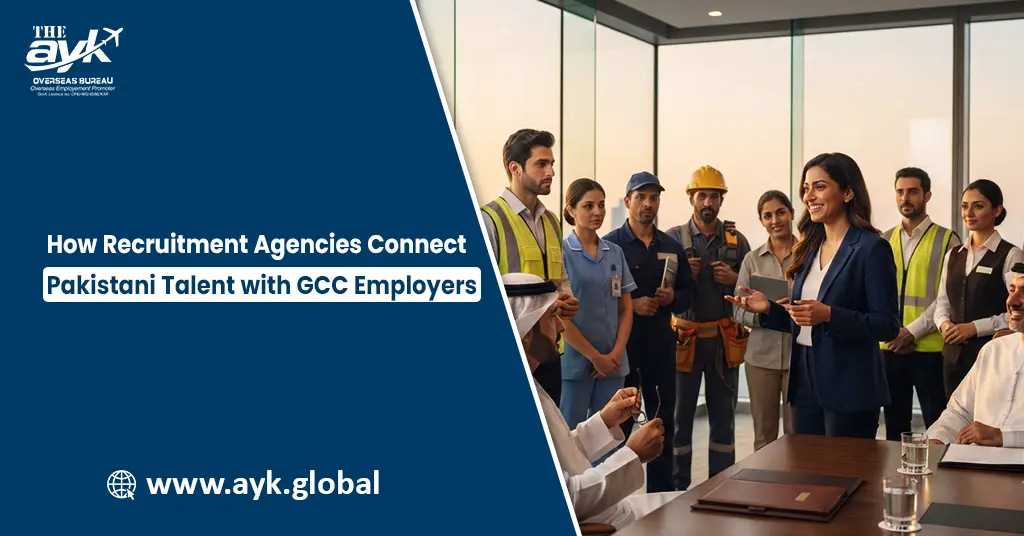 How Recruitment Agencies Connect Pakistani Talent with GCC Employers
 KSA Recruitment
 UAE Recruitment
 Qatar Recruitment
 Oman Recruitment
 Kuwait Recruitment
 Libya Recruitment
 Bahrain Recruitment
 Iraq Recruitment
 Malaysia Recruitment
 Malta Recruitment
 Canada Recruitment
 USA Recruitment
 Europe Recruitment
 UK Recruitment
 Romania Recruitment
 Poland Recruitment
 Bulgaria Recruitment
 Albania Recruitment
 Serbia Recruitment
 Lithuania Recruitment
 Japan Recruitment
 Turkey Recruitment
 Kyrgyzstan Recruitment
 South Korea Recruitment