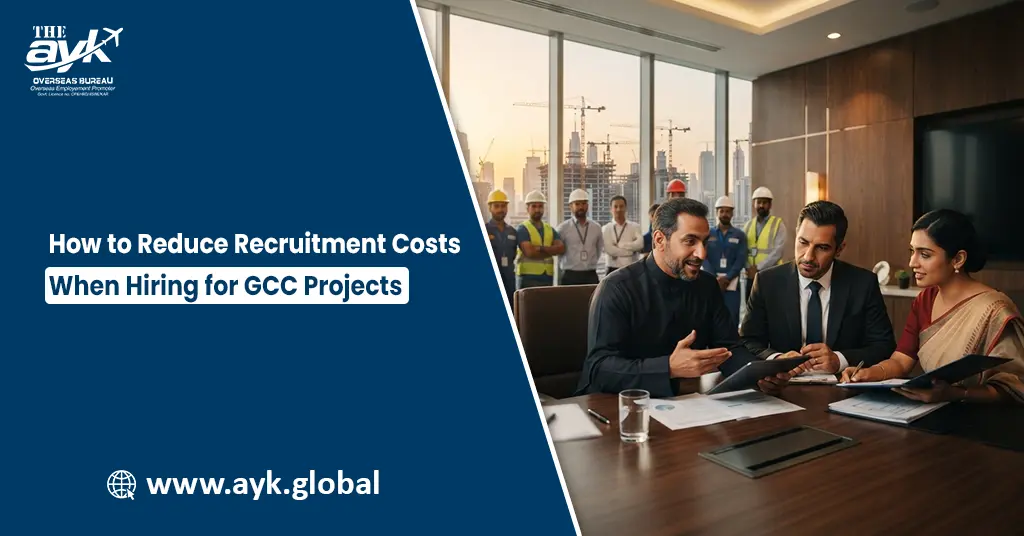
How to Reduce Recruitment Costs When Hiring for GCC Projects
Published: July 03, 2026 | Views: 10
Introduction
Recruiting manpower for large-scale projects across the Gulf Cooperation Council (GCC) region can be a significant investment for employers. Whether a company is hiring for construction, oil & gas, manufacturing, logistics, healthcare, hospitality, or infrastructure development, recruitment expenses can quickly increase when hundreds of employees need to be sourced, screened, documented, and deployed within a limited timeframe. Costs associated with advertising, candidate sourcing, interviews, trade testing, visa processing, medical examinations, travel arrangements, accommodation planning, and onboarding can place considerable pressure on project budgets if they are not managed strategically.
Reducing recruitment costs, however, does not mean lowering hiring standards or compromising workforce quality. The most successful GCC employers focus on improving recruitment efficiency, strengthening workforce planning, partnering with experienced manpower agencies, and using modern recruitment technologies to optimize every stage of the hiring process. By implementing cost-effective recruitment strategies, organizations can attract qualified professionals, reduce unnecessary expenses, shorten hiring timelines, and maintain productivity while ensuring compliance with GCC labor regulations. This guide explores practical methods that employers can use to minimize recruitment costs without affecting the quality of their workforce.
1. Start with Accurate Workforce Planning
One of the most effective ways to reduce recruitment costs is to begin with detailed workforce planning. Many companies spend more than necessary because they recruit without clearly defining the number of employees, job roles, project timelines, and skill requirements. Poor planning often leads to overstaffing, emergency hiring, duplicated recruitment efforts, or unnecessary employee turnover, all of which increase recruitment expenses. A comprehensive manpower plan enables employers to estimate labor requirements accurately and allocate recruitment budgets more efficiently.
Workforce planning should involve collaboration between project managers, HR departments, finance teams, and recruitment specialists. Together, they can identify current and future staffing requirements, prioritize critical positions, and create realistic hiring schedules that align with project milestones. By forecasting manpower needs well in advance, employers avoid last-minute recruitment campaigns, negotiate better service rates with recruitment partners, and ensure that the right people are available at the right time.
2. Partner with an Experienced GCC Recruitment Agency
Selecting the right manpower recruitment agency can significantly reduce overall hiring costs. Experienced recruitment agencies already have established talent databases, international sourcing networks, technical trade testing facilities, documentation specialists, and knowledge of GCC labor laws. Instead of building these resources internally, employers can leverage the expertise of professional recruitment partners to streamline hiring while minimizing administrative expenses.
An experienced agency also reduces costly recruitment mistakes such as hiring unqualified candidates, processing incomplete documentation, or facing visa delays. Their ability to manage sourcing, interviews, trade testing, medical examinations, visa applications, and worker mobilization under one coordinated process saves valuable time and resources. Although recruitment agencies charge service fees, their efficiency often results in substantial long-term cost savings by reducing project delays, employee replacement costs, and compliance-related issues.
When choosing a recruitment partner, evaluate:
- Industry experience
- Recruitment capacity
- Licensing and legal compliance
- International sourcing network
- Technical trade testing facilities
- Candidate database quality
- Client testimonials
- End-to-end recruitment services
3. Recruit in Bulk Instead of Individual Hiring
Hiring employees individually over an extended period usually costs far more than conducting organized bulk recruitment campaigns. Every separate recruitment cycle involves advertising vacancies, reviewing applications, scheduling interviews, processing documentation, and arranging deployment, creating repeated administrative costs. Bulk recruitment allows employers to complete these activities collectively, reducing cost per hire while improving operational efficiency.
Large-scale recruitment campaigns also strengthen an employer's negotiating position with recruitment agencies, travel providers, accommodation services, and medical examination centers. Processing visas, organizing trade tests, and scheduling interviews for multiple candidates simultaneously improves productivity and lowers administrative expenses. For companies managing major GCC projects, bulk recruitment remains one of the most practical strategies for controlling hiring costs while ensuring workforce availability.
4. Clearly Define Job Descriptions and Hiring Criteria
Vague job descriptions are a common cause of recruitment inefficiency. When employers fail to specify required qualifications, experience levels, certifications, and technical skills, they receive large numbers of unsuitable applications. Screening these candidates consumes valuable time and increases recruitment expenses without improving hiring outcomes. Clearly written job descriptions attract more relevant applicants and reduce unnecessary administrative work.
Detailed hiring criteria also improve communication between employers and recruitment agencies. Agencies can source candidates who closely match project requirements, reducing interview time and minimizing the risk of unsuitable hires. Well-defined expectations help employers build stronger workforces while avoiding the financial impact of repeated recruitment campaigns caused by poor hiring decisions or high employee turnover.
5. Build a Long-Term Talent Pipeline
Companies that recruit regularly for GCC projects can reduce future recruitment costs by developing long-term talent pipelines. Instead of beginning every hiring campaign from scratch, employers and recruitment agencies can maintain databases of pre-screened candidates who have already completed interviews, trade tests, and document verification. Having immediate access to qualified professionals significantly reduces sourcing costs and accelerates future recruitment activities.
A strong talent pipeline also improves workforce flexibility. When projects expand unexpectedly or employees require replacement, organizations can fill vacancies much faster without investing heavily in new advertising campaigns or extensive sourcing activities. Maintaining relationships with previously interviewed candidates, skilled professionals, and experienced overseas workers ensures that employers always have access to reliable talent while controlling long-term recruitment expenses.
6. Use Technology to Improve Recruitment Efficiency
Technology has transformed the recruitment industry by helping employers automate many time-consuming hiring activities. Applicant Tracking Systems (ATS), digital recruitment platforms, artificial intelligence, online assessments, and video interviews allow organizations to process applications more efficiently while reducing manual administrative work. These tools help recruiters identify qualified candidates faster, eliminate duplicate efforts, and shorten overall recruitment timelines.
Digital recruitment solutions also improve communication between employers, recruitment agencies, and candidates. Online document submission, automated interview scheduling, electronic contract management, and digital onboarding reduce paperwork while improving accuracy. Companies that invest in recruitment technology often experience lower hiring costs, faster decision-making, improved candidate experiences, and stronger workforce planning. As GCC industries continue embracing digital transformation, technology-driven recruitment strategies are becoming an essential component of cost-effective hiring.
7. Reduce Employee Turnover Through Better Hiring Decisions
One of the hidden recruitment costs that many employers overlook is employee turnover. When newly hired workers leave shortly after joining a company, employers are forced to repeat the recruitment process, resulting in additional expenses for advertising, sourcing, interviews, documentation, visa processing, travel, onboarding, and training. Frequent employee replacement not only increases recruitment costs but also disrupts project schedules and reduces overall productivity. Therefore, making better hiring decisions from the beginning is one of the most effective ways to control long-term recruitment expenses.
Employers can reduce turnover by carefully evaluating candidates' technical abilities, work experience, communication skills, and cultural compatibility before making job offers. Conducting detailed interviews, verifying employment history, checking references, and ensuring candidates fully understand their job responsibilities helps prevent mismatched hiring decisions. Companies that invest in quality recruitment rather than simply hiring quickly often experience stronger workforce stability, improved employee satisfaction, and significantly lower recruitment costs over time.
8. Streamline Documentation and Visa Processing
Documentation errors are one of the most common causes of recruitment delays and unnecessary expenses during international hiring for GCC projects. Missing certificates, incorrect passport information, incomplete visa applications, or improperly prepared employment contracts can delay worker deployment and increase administrative costs. Every delay affects project timelines, forcing employers to spend additional money on temporary staffing, revised travel arrangements, and repeated government submissions.
To minimize these expenses, employers should establish a standardized documentation process supported by experienced recruitment professionals. Creating document checklists, verifying candidate records before submission, and maintaining regular communication with immigration authorities help ensure faster visa approvals and smoother worker mobilization. Recruitment agencies specializing in GCC hiring usually have dedicated documentation teams that manage these responsibilities efficiently, reducing costly mistakes while accelerating the overall recruitment process.
Some important documentation practices include:
- Verify passports before recruitment begins.
- Confirm educational and technical certificates.
- Review employment contracts carefully.
- Maintain digital copies of all documents.
- Monitor visa application progress regularly.
- Complete medical examinations on schedule.
- Coordinate travel documentation early.
9. Invest in Pre-Employment Trade Testing
Hiring workers without properly evaluating their technical skills can become extremely expensive for employers. Employees who lack the required competencies may require additional training, produce lower-quality work, increase safety risks, or need replacement shortly after joining the project. These issues create unnecessary financial losses that could have been avoided through proper candidate assessment before deployment.
Professional trade testing helps employers identify qualified workers who can perform their responsibilities immediately after arriving at the project site. Practical skill assessments for electricians, welders, plumbers, HVAC technicians, heavy equipment operators, mechanics, scaffolders, and other skilled professionals ensure that candidates possess the technical abilities required for the job. Investing in trade testing before recruitment significantly reduces training costs, improves productivity, minimizes rework, and strengthens project performance throughout the construction or operational lifecycle.
10. Optimize Onboarding and Workforce Deployment
Recruitment costs do not end when candidates receive job offers. The onboarding process also plays a significant role in determining overall hiring expenses. Poorly organized onboarding can delay employee productivity, create confusion regarding workplace policies, and increase the likelihood of early resignations. Employers should establish structured onboarding programs that introduce workers to company procedures, safety standards, accommodation arrangements, transportation services, and job responsibilities before they begin work.
Efficient workforce deployment further reduces unnecessary operational costs. Coordinating employee arrivals according to project schedules ensures that workers begin contributing immediately instead of remaining idle while waiting for assignments. Proper planning between recruitment teams, project managers, logistics departments, and site supervisors helps maximize workforce utilization while minimizing accommodation costs, transportation expenses, and productivity losses caused by delayed deployment.
11. Build Long-Term Relationships with Recruitment Partners
Recruitment should not be viewed as a one-time activity but as a long-term business partnership. Companies that consistently work with the same professional recruitment agencies often receive better service, faster candidate sourcing, improved communication, and more competitive pricing. Recruitment partners become familiar with the employer's organizational culture, workforce requirements, technical standards, and hiring preferences, allowing future recruitment campaigns to be completed more efficiently.
Long-term partnerships also improve workforce quality because recruitment agencies maintain ongoing relationships with qualified candidates who match employer expectations. Instead of beginning every hiring campaign from the beginning, agencies can immediately recommend pre-screened professionals with relevant experience. This reduces advertising costs, shortens recruitment timelines, minimizes hiring risks, and helps employers maintain consistent workforce quality across multiple GCC projects.
Benefits of long-term recruitment partnerships include:
- Lower recruitment costs
- Faster candidate sourcing
- Improved workforce quality
- Better communication
- Reduced administrative workload
- Consistent hiring standards
- Stronger legal compliance
- Faster project mobilization
12. Monitor Recruitment Performance and Continuously Improve
Reducing recruitment costs is an ongoing process that requires regular performance evaluation. Employers should monitor recruitment metrics such as cost per hire, recruitment timeline, employee retention, candidate quality, visa approval rates, onboarding efficiency, and workforce productivity. Analyzing these indicators helps organizations identify inefficiencies and implement improvements that reduce future recruitment expenses.
Continuous improvement also involves gathering feedback from project managers, HR teams, recruitment agencies, and employees themselves. Understanding which recruitment strategies produce the best long-term results enables businesses to refine hiring practices and allocate resources more effectively. Companies that regularly review their recruitment performance are better prepared to respond to changing labor market conditions, improve operational efficiency, and maintain a competitive advantage in the GCC's fast-growing industries.
Conclusion
Recruitment represents one of the largest operational investments for companies managing projects across the GCC, but it does not have to become an unnecessary financial burden. Through careful workforce planning, bulk hiring strategies, professional recruitment partnerships, accurate job descriptions, digital recruitment technologies, structured onboarding, and continuous performance evaluation, employers can significantly reduce hiring costs without compromising workforce quality. Every stage of the recruitment process offers opportunities to improve efficiency, eliminate waste, and maximize return on investment.
The most successful organizations understand that reducing recruitment costs is not about choosing the cheapest hiring option—it is about making smarter recruitment decisions that deliver long-term value. Investing in skilled manpower, reliable recruitment agencies, proper trade testing, and streamlined documentation creates a workforce that is productive, compliant, and prepared to contribute from the first day of deployment. As GCC economies continue expanding through ambitious infrastructure and industrial projects, businesses that adopt cost-effective recruitment strategies will be better positioned to achieve sustainable growth while maintaining high operational standards.
 Hire Pakistani Workers for China, A Practical Guide for Employers
 Benefits of Bulk Manpower Recruitment for Large Projects
 Public Sector vs Private Sector Jobs in the Gulf
 KSA Recruitment
 UAE Recruitment
 Qatar Recruitment
 Oman Recruitment
 Kuwait Recruitment
 Libya Recruitment
 Bahrain Recruitment
 Iraq Recruitment
 Malaysia Recruitment
 Malta Recruitment
 Canada Recruitment
 USA Recruitment
 Europe Recruitment
 UK Recruitment
 Romania Recruitment
 Poland Recruitment
 Bulgaria Recruitment
 Albania Recruitment
 Serbia Recruitment
 Lithuania Recruitment
 Japan Recruitment
 Turkey Recruitment
 Kyrgyzstan Recruitment
 South Korea Recruitment