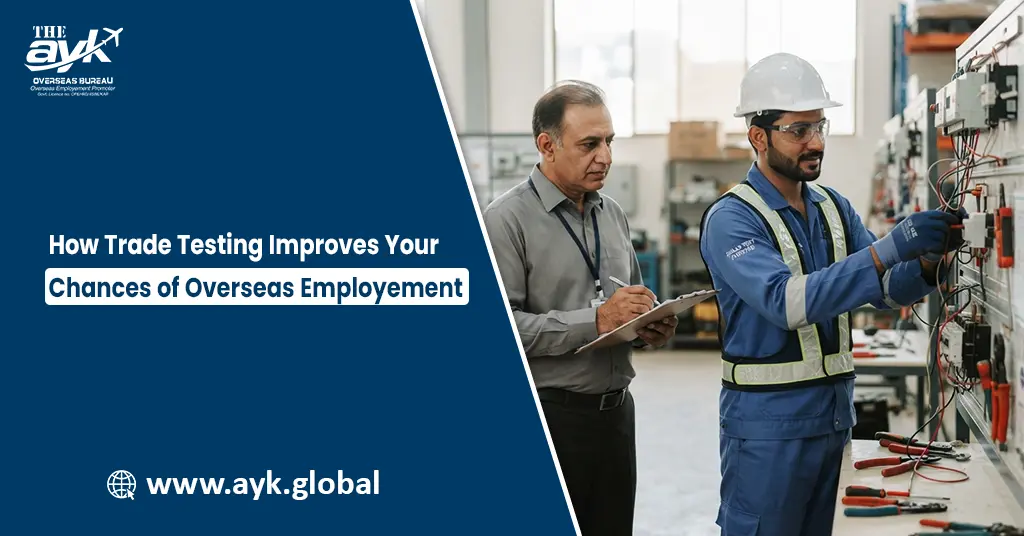
How Trade Testing Improves Your Chances of Overseas Employment
Published: July 02, 2026 | Views: 13
Introduction
Trade testing has become one of the most important steps in securing overseas employment in 2026, especially for Pakistani workers applying for jobs in GCC countries such as Saudi Arabia, United Arab Emirates (UAE), Qatar, Kuwait, Oman, and Bahrain. With increasing competition in international job markets, employers are no longer relying only on CVs, interviews, or certificates. Instead, they want to verify real practical skills through trade testing before hiring candidates.
Trade testing is a structured process where a worker’s technical abilities are evaluated in real working conditions. Whether it is welding, electrical work, plumbing, HVAC maintenance, mechanical repair, or heavy machinery operation, trade testing allows employers to see whether a candidate can actually perform the job safely and efficiently.
In the past, many workers were selected based only on experience claims or recommendations. However, due to increasing project complexity and safety standards in GCC countries, employers now prefer hands-on skill verification. This has made trade testing a critical part of overseas recruitment.
For Pakistani job seekers, understanding how trade testing works and how it improves employment chances can significantly increase success rates in international job applications.
Paragraph 1: Importance of Trade Testing in Overseas Recruitment
Trade testing is now a standard requirement in most GCC recruitment processes. Employers use it to evaluate whether a candidate is truly capable of performing job responsibilities without supervision. In industries like construction, oil and gas, engineering, manufacturing, and logistics, even small mistakes can lead to serious safety risks and financial losses. That is why employers prefer to test workers before offering final employment contracts.
Trade testing helps employers reduce hiring risks by ensuring that only skilled and competent workers are selected. It also ensures that workers meet international safety and quality standards. For Pakistani candidates, this process acts as a bridge between local experience and international job expectations.
Many candidates who may struggle in interviews can still succeed in trade tests if they have strong practical skills. This makes trade testing a fair and effective selection method for overseas employment.
Paragraph 2: How Trade Testing Works in GCC Recruitment
Trade testing is conducted either by licensed recruitment agencies, training centers, or directly by GCC employers. The process usually includes practical demonstrations, technical assessments, and sometimes written tests depending on the job category.
For example, electricians may be asked to complete wiring tasks, welders may be tested on different welding techniques, HVAC technicians may be asked to repair cooling systems, and mechanics may be tested on engine troubleshooting.
The test environment is designed to simulate real job conditions. Candidates are evaluated based on accuracy, speed, safety awareness, and problem-solving ability. Even experienced workers can fail if they do not follow instructions properly or ignore safety rules.
Successful candidates are shortlisted for final interviews or directly offered job contracts depending on employer requirements.
Paragraph 3: Trade Testing for Different Technical Jobs
Trade testing varies depending on job categories. For skilled technical workers, the tests are more detailed and hands-on. Electricians are tested on circuit installation, fault finding, and safety compliance. Welders are evaluated on joint quality, welding techniques, and precision. Plumbers are tested on pipe fitting, leakage control, and installation accuracy. HVAC technicians are assessed on system installation, maintenance, and troubleshooting skills.
For heavy equipment operators, trade tests involve practical machine handling such as forklifts, cranes, bulldozers, and excavators. Operators must demonstrate control, safety awareness, and operational accuracy.
Each trade test is designed to reflect real working conditions in GCC countries. This ensures that selected candidates can perform efficiently from day one without extensive training.
Paragraph 4: Role of Trade Testing in Skill Verification
One of the biggest advantages of trade testing is skill verification. Many candidates exaggerate their experience in CVs, but trade testing reveals actual ability. Employers use this process to ensure that workers truly possess the skills they claim.
Skill verification reduces hiring mistakes and improves workplace productivity. It also protects companies from hiring underqualified workers who may cause delays or safety issues.
For Pakistani workers, trade testing provides an opportunity to prove their real abilities, even if their formal education is limited. Many skilled laborers with strong hands-on experience perform well in trade tests and secure overseas jobs successfully.
Paragraph 5: How Trade Testing Improves Selection Chances
Trade testing significantly increases selection chances for overseas employment because it provides direct proof of skill. Employers prefer candidates who have already demonstrated their abilities rather than those who only claim experience.
Candidates who pass trade tests are considered low-risk hires because they have already proven their capability. This reduces the need for long training periods and increases productivity from the beginning of employment.
In competitive job markets like GCC countries, trade testing often becomes the deciding factor between shortlisted candidates. Even if multiple candidates have similar CVs, those who perform better in trade tests are selected first.
Paragraph 6: Trade Testing and Salary Improvement
Another important benefit of trade testing is salary improvement. Skilled workers who pass trade tests with high performance are often offered better salary packages. Employers are willing to pay more for workers who demonstrate strong technical abilities.
In many cases, trade-tested workers also receive additional benefits such as overtime opportunities, accommodation, transport, and performance bonuses.
This makes trade testing not only important for job selection but also for long-term financial growth.
Paragraph 7: Common Mistakes in Trade Testing
Many candidates fail trade tests due to avoidable mistakes. These include lack of preparation, poor understanding of tools, ignoring safety instructions, and nervous behavior during testing.
Some candidates also fail because they rush through tasks without maintaining quality standards. Others ignore technical instructions given by supervisors, which leads to disqualification.
Proper preparation, practice, and understanding of job requirements are essential for success in trade testing.
Paragraph 8: How to Prepare for Trade Testing
Preparation for trade testing involves both theoretical knowledge and practical practice. Candidates should regularly practice their technical skills in real working environments.
Attending vocational training centers, technical institutes, and skill development programs can significantly improve performance in trade tests.
Understanding basic safety rules, tool usage, and job procedures is also important. Confidence and calm behavior during testing further increase chances of success.
Paragraph 9: Trade Testing and Career Growth
Trade testing not only helps in getting a job but also contributes to long-term career growth. Workers who consistently perform well in technical assessments are often promoted to supervisory roles.
In GCC countries, skilled workers who prove their abilities through trade testing can move into higher positions such as foreman, technician supervisor, or project coordinator.
This makes trade testing a foundation for building a successful international career.
Conclusion
Trade testing plays a crucial role in improving overseas employment opportunities for Pakistani workers in 2026. It provides employers with a reliable method to verify skills and ensures that only qualified candidates are selected for jobs in GCC countries.
By passing trade tests, candidates not only increase their chances of selection but also improve their salary potential and long-term career growth.
For job seekers in Pakistan, focusing on practical skill development and preparing for trade testing is one of the most effective strategies for securing international employment.
 How to Reduce Recruitment Costs When Hiring for GCC Projects
 How to Switch Industries During Gulf Employment
 KSA Recruitment
 UAE Recruitment
 Qatar Recruitment
 Oman Recruitment
 Kuwait Recruitment
 Libya Recruitment
 Bahrain Recruitment
 Iraq Recruitment
 Malaysia Recruitment
 Malta Recruitment
 Canada Recruitment
 USA Recruitment
 Europe Recruitment
 UK Recruitment
 Romania Recruitment
 Poland Recruitment
 Bulgaria Recruitment
 Albania Recruitment
 Serbia Recruitment
 Lithuania Recruitment
 Japan Recruitment
 Turkey Recruitment
 Kyrgyzstan Recruitment
 South Korea Recruitment