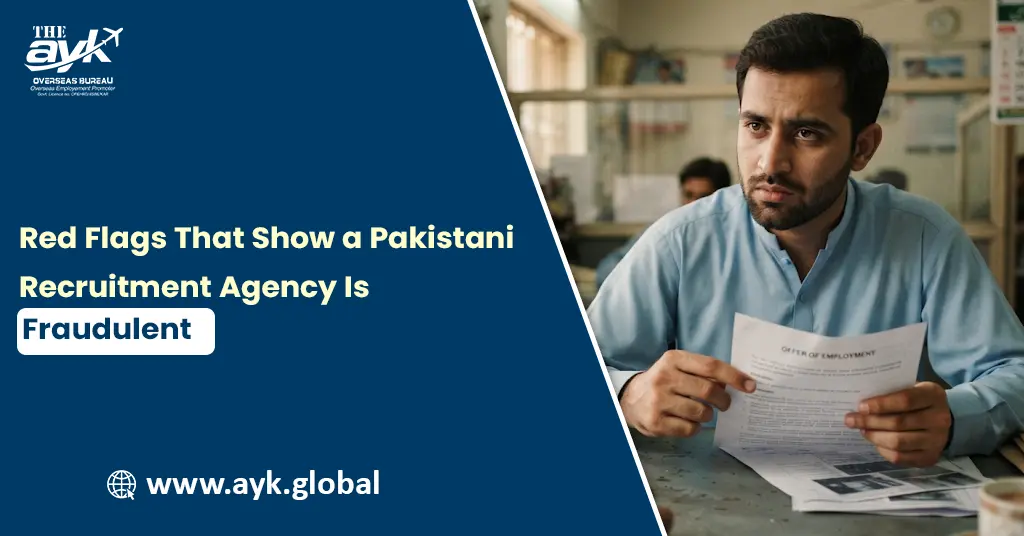
Red Flags That Show a Pakistani Recruitment Agency Is Fraudulent
Published: July 16, 2026 | Views: 4
Introduction
Pakistan's overseas employment sector contains a deeply troubling proportion of fraudulent recruitment operators who have mastered the art of appearing legitimate long enough to extract recruitment fees, personal documentation, and financial trust from vulnerable Pakistani families before disappearing with their money and leaving workers stranded without the Gulf employment they were promised. The financial and personal devastation that recruitment fraud creates for Pakistani families, who often borrow money specifically to pay recruitment fees that fraudulent operators take without delivering any employment, represents one of Pakistan's most persistent consumer protection failures that worker education about specific fraud warning signs specifically addresses more effectively than regulatory action alone. AYK Overseas Recruitment & HR Manpower Agency, recognized as one of Pakistan's top manpower agencies, is committed to helping Pakistani workers protect themselves from fraud, and this guide provides the most comprehensive and specific compilation of fraud warning signs that every Pakistani worker considering overseas employment must know before engaging any recruitment service.
Any Request for Worker Fees at Any Stage
The single most reliable indicator of a fraudulent Pakistani recruitment operator is any request for worker payment of any kind at any stage of the recruitment process, regardless of how the payment is described, what justification is offered, or how small the initial amount appears relative to the total promised employment benefit. Pakistani law prohibits recruitment agencies from charging workers fees as a condition of overseas employment placement, with this prohibition reflecting the fundamental principle that legitimate recruitment agencies generate revenue from employer-side service fees rather than worker-side extraction that creates the financial predation that fraudulent operators have perfected through decades of targeting vulnerable job-seeking Pakistani families. Fraudulent operators have developed sophisticated fee-disguising language including visa processing fees, medical test coordination fees, insurance enrollment fees, training fees, documentation service charges, and various other descriptions that present prohibited recruitment fees as legitimate service costs that workers must pay, with the specific description mattering less than the absolute principle that no legitimate recruitment process ever requires any financial payment from workers regardless of how the payment is framed.
Inability to Provide Verifiable BEOE License Number
A fraudulent Pakistani recruitment operator either has no BEOE license at all, uses a license number that belongs to a different legitimate agency whose identity they are appropriating, or presents license information in ways that discourage the independent verification that would expose their fraudulent license claim. Legitimate agencies provide their BEOE license number immediately, clearly, and with explicit encouragement for workers to verify the license independently through BEOE's official records, treating this verification as a confidence-building step rather than an inconvenient question to deflect. When a recruitment agency becomes evasive about license information, provides a license number that verification reveals belongs to a different agency, claims the license is pending or under renewal for an extended period, or actively discourages independent BEOE verification through any argument about the verification being unnecessary, workers should treat this as definitive fraud evidence requiring immediate disengagement.
No Physical Office or Suspicious Office Situation
Fraudulent recruitment operators typically operate without genuine physical offices, conducting their operations through mobile phone numbers, WhatsApp accounts, Facebook pages, and temporary locations that disappear when fraud victims attempt to locate them after realizing they have been deceived. When a supposed recruitment agency has no verifiable physical address, operates exclusively through mobile contact without landline numbers, meets workers at tea shops or public locations rather than at a business office, or has an office that exists only as a shared desk in a general business services center without the specialized recruitment infrastructure that genuine agency operation requires, these physical presence deficiencies represent serious fraud indicators. Even when a fraudulent operator does maintain some physical presence, the office often shows specific suspicious characteristics including the absence of operational staff beyond the single contact person, no visible documentation processing infrastructure, no agency license or credentials displayed on walls, and a general atmosphere suggesting temporary rather than established business operation that legitimate agency offices with years of operational history create through their accumulated professional infrastructure.
Pressure Tactics and Artificial Urgency
Fraudulent recruitment operators consistently use pressure tactics and artificial urgency to prevent workers from taking the time that careful evaluation requires, with claims that visa slots are immediately closing, that the employer needs workers this week, that the price will increase if the worker doesn't commit immediately, or that other candidates are competing for the position and the worker must decide now creating the decision environment that fraud specifically requires to bypass the skepticism that deliberate evaluation would produce. Legitimate Gulf employment processes have inherent timelines including visa processing periods, documentation completion requirements, and employer selection processes that cannot be compressed into the artificial urgency that fraudulent operators create as pressure tools, making the very existence of extreme time pressure a reliable indicator that something is wrong with the employment opportunity being presented. Workers who feel pressured to commit quickly, pay immediately, or sign documents without adequate review time should specifically treat this pressure as a warning sign rather than evidence of an unusually attractive opportunity that requires fast action to capture.
Communication Only Through WhatsApp and Facebook
Fraudulent recruitment operators prefer WhatsApp and Facebook communication exclusively because these channels leave no verifiable business identity, create no business accountability trail that fraud victims or law enforcement could later use to identify operators, and enable the rapid identity disappearance that fraud operators execute immediately upon completing their fee extraction before victims realize they have been defrauded. Legitimate recruitment agencies communicate through registered business email addresses with domain names matching their agency name, landline telephone numbers at their physical business address, and formal correspondence that creates the business identity trail that professional services naturally generate through their ordinary communication practices. When all communication with a supposed recruitment agency flows exclusively through personal WhatsApp numbers and Facebook accounts without any verifiable business communication channels, workers are almost certainly dealing with a fraudulent operation whose entire designed communication structure is oriented toward avoiding the accountability that legitimate business communication creates.
Unrealistically Attractive Salary and Benefit Claims
Fraudulent recruitment operators systematically overstate Gulf employment compensation to create the enthusiasm and urgency that fee payment requires from workers who would not pay recruitment fees for opportunities at realistic market compensation levels but who willingly pay for what they believe are exceptional opportunities at salary levels well above market rates. Workers who have researched current Gulf employment market rates for their specific skill category and employment destination find that fraudulent offers typically claim salaries two to three times above verified market rates, with the salary inflation creating the irresistible financial calculation that bypasses the critical evaluation that realistic offers would receive more carefully. Verifying offered salaries against current market information from multiple independent sources including BEOE guidance, community members currently employed in similar Gulf roles, and legitimate agency consultations about realistic current market rates provides the market context that exposes fraudulent salary inflation as the manipulation technique it represents rather than genuine exceptional opportunity that workers deserve to be excited about.
Vague or Unverifiable Gulf Employer Information
Fraudulent recruitment operators present Gulf employer information in deliberately vague, unverifiable, or fabricated forms that prevent workers from independently confirming that the employer exists, operates legitimately, and has actually issued the job demand that the recruitment operator claims as the employment opportunity basis. When asked for specific Gulf employer name, address, registration number, and contact information that independent verification would require, fraudulent operators provide either completely fake details that verification exposes as fabricated, real employer names stolen from legitimate companies to create false association, or evasive responses about the employer's identity being confidential until later in the process when workers have already committed financially. Legitimate recruitment agencies operating genuine employer mandates provide specific employer information that workers can independently verify without any legitimate confidentiality reason preventing this verification at the stage when workers are being asked to consider the employment opportunity.
Reluctance to Provide Written Documentation
Fraudulent recruitment operators prefer oral communication, WhatsApp voice messages, and verbal assurances over written documentation that creates legally actionable evidence of their representations, specifically avoiding the written employment contracts, formal job offer letters, documented fee arrangements, and other formal paperwork that legitimate recruitment processes generate as standard business practice. When a recruitment agency describes employment terms verbally without providing written documentation, promises to provide contracts later, characterizes written documentation requests as unnecessary complications of a simple process, or provides documentation that lacks specific detail about employment terms, workers are dealing with an operator who specifically avoids the written record that would expose their misrepresentations and create evidence for fraud complaint processes. Legitimate agencies produce complete written documentation including formal job offer letters from identified Gulf employers, detailed employment contracts specifying all material terms, and formal receipts for any legitimate employer-side processes that create documented records of every stage of the legitimate recruitment process.
Demands for Original Documents
Fraudulent recruitment operators sometimes request original educational certificates, original identity documents, or original passports from workers under the pretense of documentation processing requirements, with these original document demands creating the opportunity to hold workers' identity and credential documents hostage or to use them for identity fraud purposes that document copies obtained through fraudulent means specifically enable. Legitimate recruitment processes require certified copies of documents for attestation and verification purposes rather than demanding workers surrender original documents to agency control at any stage before the worker physically departs with their documentation package for Gulf immigration processing. Workers should never surrender original identity documents, original educational certificates, or original passports to any recruitment agency regardless of the explanation provided for why originals rather than certified copies are required, treating any demand for original document surrender as a serious warning sign that should immediately trigger disengagement from the agency relationship.
No References and Defensiveness About Agency History
Fraudulent recruitment operators either have no verifiable placement history to provide references from or become defensive and evasive when workers ask for contact information for previously placed workers they can speak with independently, with the inability to provide verifiable references reflecting the fraudulent operator's lack of genuine placement history that legitimate agencies accumulate across years of actual employment placement. When a recruitment agency cannot provide contact information for multiple previous placed workers whose Gulf employment can be independently verified through direct conversation, or when the agency provides references that turn out to be associates or family members rather than genuinely placed workers with verifiable Gulf employment, workers are dealing with an operator whose claimed placement success has no genuine foundation in actual employment outcomes. Legitimate agencies maintain relationships with many previously placed workers who are willing to speak with prospective workers about their placement experience, with the genuine satisfaction that legitimate placement creates producing the willing references that fraudulent operators simply cannot authentically provide.
 Overseas Pakistanis and Their Role in National Economy
 Plumber Jobs in GCC Countries, Salary and Recruitment Guide
 Top Recruitment Agency in Pakistan for Oman, Complete Employer Guide 2026
 KSA Recruitment
 UAE Recruitment
 Qatar Recruitment
 Oman Recruitment
 Kuwait Recruitment
 Libya Recruitment
 Bahrain Recruitment
 Iraq Recruitment
 Malaysia Recruitment
 Malta Recruitment
 Canada Recruitment
 USA Recruitment
 Europe Recruitment
 UK Recruitment
 Romania Recruitment
 Poland Recruitment
 Bulgaria Recruitment
 Albania Recruitment
 Serbia Recruitment
 Lithuania Recruitment
 Japan Recruitment
 Turkey Recruitment
 Kyrgyzstan Recruitment
 South Korea Recruitment