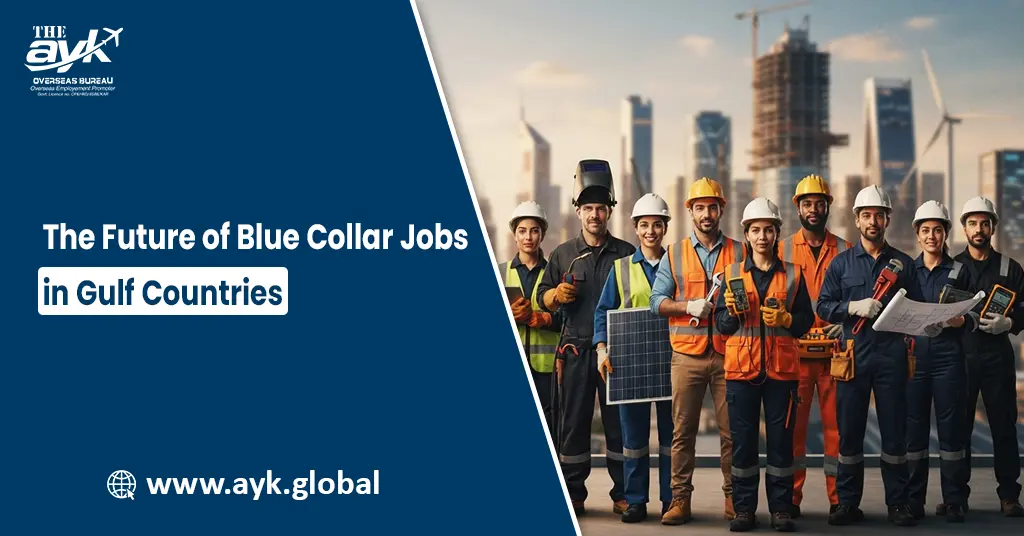
The Future of Blue-Collar Jobs in Gulf Countries
Published: July 04, 2026 | Views: 12
Introduction
Blue-collar employment has formed the backbone of Pakistani overseas labor migration to Gulf countries for decades, with construction trades, manufacturing, logistics, hospitality support, and various other manual and technical skilled labor categories collectively providing the overseas employment foundation that has supported millions of Pakistani families through the financial contributions these workers have made from their Gulf earnings. The future of this blue-collar employment in Gulf countries is genuinely evolving under the combined pressure of economic diversification strategies, automation investment, Nationalization policy enforcement, green energy transition requirements, and changing employer expectations about workforce skill levels that together create a more complex and demanding employment environment than the relatively straightforward blue-collar demand patterns that characterized Gulf employment in earlier decades. AYK Overseas Recruitment & HR Manpower Agency, recognized as one of Pakistan's top manpower agencies, works at the intersection of Pakistani worker supply and Gulf employer demand every day, and this guide provides our honest forward-looking assessment of how blue-collar Gulf employment is changing and what Pakistani workers must do to maintain strong employment positioning within these evolving conditions.
The Enduring Demand for Skilled Trades
Skilled trade work in construction, electrical systems, plumbing, HVAC, welding, and related technical categories will remain in genuine demand across Gulf countries for the foreseeable future despite automation pressure and various other employment environment changes, because the physical complexity of construction environments, the customization requirements of building-specific installations, and the genuine technical judgment these trades require create automation resistance that keeps skilled human labor irreplaceable within these employment categories at current and near-term technology development levels. Gulf countries' continued infrastructure investment ambitions across Vision 2030, UAE 2071 strategy, Qatar National Vision, and equivalent development programs in Kuwait and Oman collectively guarantee construction sector employment demand at substantial scale for the coming decades, with the specific projects and locations shifting over time as development phases progress but the aggregate labor demand remaining robust throughout the extended development timelines these ambitious programs represent. Pakistani skilled tradespeople who maintain genuine technical competency, obtain relevant certifications, and keep pace with evolving technical standards within their specific trades will find continued strong Gulf employment demand for their capabilities regardless of the various employment environment changes that will affect less-skilled and more-routine blue-collar work categories more significantly.
Manufacturing and Industrial Blue-Collar Employment Outlook
Gulf countries' economic diversification strategies include substantial manufacturing sector development ambitions that will require industrial blue-collar workforce expansion across various production and processing categories, though the specific skills these manufacturing employment opportunities require differ meaningfully from traditional construction trade competencies in ways that workers should understand when considering their positioning for this evolving employment category. Saudi Arabia's industrial development through NEOM's industrial zones, UAE's manufacturing competitiveness agenda, and Qatar's industrial diversification investments collectively create industrial employment demand across chemicals processing, metals fabrication, food processing, and various other manufacturing categories that Pakistani workers with relevant technical backgrounds can potentially access given appropriate skill development and certification. The industrial manufacturing employment category generally offers more stable, consistent working conditions compared to construction's project-based employment cycles, making this sector particularly attractive for workers who prioritize employment stability alongside financial compensation as they plan their Gulf employment career over extended multi-year timeframes.
Logistics and Supply Chain Blue-Collar Employment
Gulf countries' growing role as global logistics hubs, with UAE's Dubai and Abu Dhabi, Saudi Arabia's Jeddah and Riyadh, and Qatar's Doha all investing heavily in logistics infrastructure development, creates sustained blue-collar employment demand across warehouse operations, freight handling, transportation driving, and various other logistics category roles that Gulf trade volume growth continuously expands. Logistics employment in Gulf countries offers Pakistani workers genuine employment that provides both immediate financial benefit through reasonable compensation packages and longer-term career development through skill acquisition in logistics operations, warehouse management systems, and supply chain coordination that increasingly valuable professional expertise in the globally connected economy that Gulf logistics infrastructure serves. The automation pressure within logistics is real but concentrated in specific task categories including basic warehouse picking and sorting while expanding into other logistics functions more gradually, creating near-term employment continuity alongside sufficient technology evolution pressure to warrant skill development investment in the technology operation and oversight capabilities that create automation-resilient logistics employment positioning.
Hospitality and Tourism Blue-Collar Support Employment
Gulf countries' ambitious tourism development programs, including Saudi Arabia's Red Sea Project, NEOM's tourism zones, UAE's continued tourism infrastructure expansion, and Qatar's post-World Cup tourism development, create substantial employment demand across hospitality support categories including food production, facility maintenance, housekeeping, security, and various other blue-collar hospitality functions that tourism infrastructure development and operation requires at enormous scale. The fundamental human service orientation of premium hospitality creates meaningful automation resistance within guest-facing service roles while simultaneously creating some automation pressure within back-of-house operational functions, making hospitality employment pattern evolution more selective than wholesale rather than creating universal displacement pressure or universal immunity from automation across all hospitality blue-collar employment. Pakistani workers in Gulf hospitality should develop their capabilities in the human service dimensions of their roles as their strongest long-term competitive advantage, while also developing familiarity with the operational technology systems that hospitality employers are progressively adopting across food production, facility management, and guest experience management functions.
The Increasing Importance of Technical Certifications
Future Gulf blue-collar employment will demand formal technical certification more consistently and rigorously than historical hiring practices that sometimes accepted uncertified experience claims without formal qualification verification, reflecting Gulf employers' growing sophistication in talent management and their increasing awareness of the productivity and quality differences between formally certified and uncertified workers that direct operational experience has demonstrated through actual comparative workforce performance. Workers who do not hold recognized trade certifications will face progressively more difficult Gulf employment access as employer hiring standards rise alongside the available supply of certified Pakistani workers whose certification reflects genuine investment in their professional development beyond the minimum competency that uncertified hiring sometimes produced in less rigorous historical hiring periods. The practical implication for Pakistani workers currently employed without formal certification is that between-contract visits to Pakistan represent important opportunities for completing certification through TEVTA or other recognized assessment bodies, using Pakistan stays productively for credential development that meaningfully improves their subsequent Gulf employment positioning rather than simply resting during the Pakistan stay without taking advantage of available credential development that improves their competitive standing.
Safety Culture as a Non-Negotiable Competency
Gulf construction and industrial employers are progressively raising their safety culture expectations beyond simple compliance with stated safety rules toward genuine, internalized safety consciousness that workers demonstrate through proactive hazard identification, consistent protective equipment use, and active participation in workplace safety programs rather than passive compliance when supervisors observe their behavior. This rising safety culture expectation reflects both Gulf employers' genuine concern about workforce welfare under increasing HSE regulatory scrutiny and their operational recognition that safety-conscious workplaces produce better productivity and quality outcomes alongside their humanitarian benefits, making safety culture a genuine operational performance factor rather than simply a regulatory compliance cost. Pakistani blue-collar workers who develop genuine safety consciousness as a professional value rather than a compliance obligation position themselves as more attractive candidates within the rising safety expectations that increasingly characterize the Gulf employment contexts that premium employers, large projects, and better compensation opportunities tend to concentrate within.
Digital Literacy as an Emerging Blue-Collar Requirement
Blue-collar employment in Gulf countries is progressively incorporating digital tool usage across project management applications, safety reporting systems, equipment monitoring platforms, and various other workplace digital interfaces that require basic digital literacy from workers who might not have previously needed significant technology comfort in purely manual trade roles. Workers who develop genuine basic digital literacy including smartphone application usage for workplace reporting, basic computer interface navigation, and digital documentation completion create meaningful employment positioning advantage within the progressively digitizing Gulf blue-collar workplace that expects at least basic technology comfort from workers regardless of their primarily physical trade specialization. This digital literacy requirement does not demand sophisticated technology expertise from blue-collar workers but rather the functional comfort with specific workplace digital tools that employers need workers to operate alongside their primary trade responsibilities, making this a relatively accessible development priority that workers can address through deliberate practice during their personal device usage rather than requiring formal technological education programs.
The Role of English Communication in Future Blue-Collar Success
Gulf blue-collar employment environments are increasingly multinational and English-mediated in their operational communication, with project coordination, safety briefings, quality inspection, and various other workplace functions progressively conducted through English as the common language that connects workers from different national backgrounds who share no other common language. Pakistani workers whose English communication capability allows effective participation in English-medium workplace communication have meaningful employment positioning advantage over workers whose English limitations create operational friction that supervisors and employers find reduces their workforce effectiveness beyond their technical trade competency level. The specific English competency that blue-collar Gulf employment requires is not sophisticated professional English but rather functional workplace English that allows understanding safety instructions, following technical directions, communicating basic work progress and concerns, and participating in team coordination discussions at the level that effective daily workplace operation requires across diverse multinational construction and industrial workplace environments.
How AYK Overseas Prepares Workers for Blue-Collar Employment's Future
As a government-licensed international recruitment and HR manpower firm with offices in Karachi and Islamabad, AYK Overseas Recruitment & HR Manpower Agency provides candidates with forward-looking preparation that addresses not just immediate Gulf employment requirements but the evolving competency standards that future Gulf blue-collar employment will increasingly demand, helping workers invest their preparation effort in capabilities that create durable career positioning rather than simply meeting minimum current hiring thresholds without the additional development that future employment sustainability requires. Being recognized as one of Pakistan's top manpower agencies, we monitor Gulf employer expectation evolution across technical certification standards, safety culture requirements, digital literacy demands, and English communication expectations, providing candidates with specific preparation guidance that reflects the actual direction of Gulf blue-collar employment's evolving requirements rather than historical standards that no longer fully represent what contemporary Gulf employers actually value in blue-collar candidate assessment.
Conclusion
The future of blue-collar jobs in Gulf countries remains genuinely positive for Pakistani workers who develop the specific competencies that evolving Gulf employment demands, including formal technical certification, genuine safety consciousness, basic digital literacy, functional English communication, and the technical specialization within growing sectors like renewable energy and sustainable construction that creates premium employment demand alongside traditional construction trades. Workers who approach their Gulf blue-collar careers with proactive professional development orientation, investing in the specific capabilities that future Gulf employment will reward most strongly, are well positioned for sustained, rewarding overseas employment throughout the coming decades during which Gulf countries' ambitious development programs will continue generating genuine blue-collar employment demand at substantial scale despite the various technological and economic transitions that are simultaneously reshaping how this employment is performed and what specific competencies it most rewards.
 Gulf Recruitment Trends 2026: What Job Seekers Need to Know
 Welder Jobs in Europe with Work Visa Support
 KSA Recruitment
 UAE Recruitment
 Qatar Recruitment
 Oman Recruitment
 Kuwait Recruitment
 Libya Recruitment
 Bahrain Recruitment
 Iraq Recruitment
 Malaysia Recruitment
 Malta Recruitment
 Canada Recruitment
 USA Recruitment
 Europe Recruitment
 UK Recruitment
 Romania Recruitment
 Poland Recruitment
 Bulgaria Recruitment
 Albania Recruitment
 Serbia Recruitment
 Lithuania Recruitment
 Japan Recruitment
 Turkey Recruitment
 Kyrgyzstan Recruitment
 South Korea Recruitment