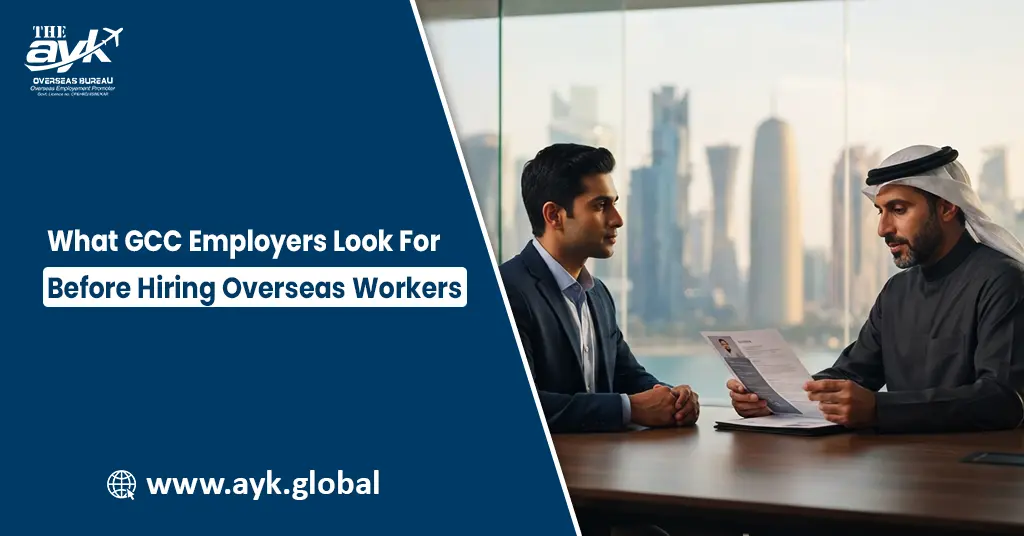
What GCC Employers Look for Before Hiring Overseas Workers
Published: July 02, 2026 | Views: 16
Introduction
GCC employers in 2026 have become more selective and strategic in hiring overseas workers. Countries like Saudi Arabia, United Arab Emirates (UAE), Qatar, Kuwait, Oman, and Bahrain are undergoing rapid economic transformation driven by mega infrastructure projects, oil and gas expansion, tourism development, logistics growth, and digital transformation.
Because of this growth, employers are no longer hiring workers randomly. Instead, they follow strict recruitment standards to ensure they select the most suitable candidates for each job role. Whether it is construction, engineering, healthcare, IT, hospitality, or skilled technical trades, employers carefully evaluate every candidate before offering employment.
For Pakistani job seekers, understanding what GCC employers look for is extremely important. Many candidates get rejected not because they lack potential, but because they fail to meet employer expectations or do not present their profile correctly.
This guide explains in detail all the major factors GCC employers consider before hiring overseas workers.
1. Relevant Skills for the Job Role
The first and most important thing GCC employers look for is relevant skills. Employers want candidates who can perform job duties efficiently without long training periods.
For example:
- Electricians must know wiring, troubleshooting, and installation
- Welders must understand MIG, TIG, and ARC welding
- HVAC technicians must handle cooling systems and maintenance
- Drivers must have road safety and vehicle handling skills
Employers prefer workers who already have hands-on experience in their trade. Skills are more important than theoretical education in most GCC jobs.
A candidate without relevant skills is less likely to be selected, even if they have basic education.
2. Practical Work Experience
Experience is another major factor in hiring decisions. GCC employers prefer candidates who have worked in similar roles before.
Experience shows that the worker can handle real job conditions, understand responsibilities, and perform tasks independently.
For skilled jobs, employers usually require at least 2–5 years of experience depending on the role.
For entry-level jobs, local experience may also be acceptable.
Candidates with proven experience are considered less risky hires.
3. Professional and Clear CV
A well-structured CV plays a critical role in GCC hiring decisions. Employers often review hundreds of CVs, so clarity is extremely important.
A strong GCC CV should include:
- Personal details
- Job objective
- Skills summary
- Work experience
- Certifications
- Contact information
Employers reject CVs that are unclear, poorly formatted, or contain irrelevant information.
A professional CV increases chances of shortlisting significantly.
4. Certifications and Trade Qualifications
Certifications are becoming increasingly important in GCC recruitment. Employers want proof that a candidate’s skills are verified.
Examples include:
- Electrical safety certificates
- Welding certifications
- HVAC technical training
- Mechanical diplomas
- OSHA safety training
Certified workers are preferred because they require less training and can follow industry standards.
In 2026, certification-based hiring is becoming more common in GCC countries.
5. Interview Performance and Communication Skills
Interview performance is a key selection factor. Employers evaluate how well a candidate communicates and understands job requirements.
They check:
- Confidence level
- Clarity of answers
- Technical knowledge
- Attitude and behavior
Even skilled workers may get rejected if they cannot communicate properly during interviews.
Basic English communication is often required in GCC workplaces due to multinational teams.
6. Ability to Work in Multicultural Environment
GCC workplaces include workers from many countries such as Pakistan, India, Nepal, Philippines, Egypt, and others.
Employers look for candidates who can:
- Work in diverse teams
- Respect different cultures
- Follow instructions from supervisors
- Maintain professional behavior
Adaptability is a major factor in long-term employment success.
7. Physical Fitness and Job Suitability
For many GCC jobs, especially construction, logistics, and industrial roles, physical fitness is important.
Employers check whether candidates can:
- Work in extreme weather conditions
- Handle long working hours
- Perform physically demanding tasks
Medical fitness is also verified before visa approval.
A fit and healthy worker is more valuable for demanding job roles.
8. Safety Awareness and Discipline
Safety is a top priority in GCC industries. Employers strictly evaluate whether workers understand and follow safety rules.
They expect candidates to:
- Use protective equipment
- Follow safety instructions
- Avoid risky behavior
- Report hazards properly
Discipline and safety awareness reduce workplace accidents and improve productivity.
Workers with safety training are preferred.
9. Reliability and Work Ethics
GCC employers value reliability highly. They prefer workers who are:
- Punctual
- Honest
- Responsible
- Consistent in performance
Work ethics play a big role in long-term employment contracts.
A reliable worker is more likely to get promotions and contract renewals.
10. Visa Eligibility and Documentation
Before hiring overseas workers, employers carefully check visa eligibility and documentation.
This includes:
- Valid passport
- Educational certificates
- Experience letters
- Medical fitness reports
Any mismatch or missing document can lead to rejection.
Proper documentation is essential for legal employment.
11. Recruitment Through Licensed Agencies
GCC employers prefer hiring through licensed manpower agencies because it ensures:
- Verified candidates
- Proper documentation
- Legal compliance
- Reduced hiring risk
For example, agencies like AYK Overseas Recruitment & HR Manpower Agency (https://ayk.global/) help ensure that candidates are properly screened and matched with employer requirements.
This structured recruitment system builds trust between employers and manpower providers.
12. Salary Expectations and Cost Efficiency
Employers also consider salary expectations before hiring.
They prefer candidates whose salary demands match industry standards.
Overpriced candidates may be rejected even if they are skilled.
At the same time, employers want cost-effective workers who provide good value for money.
13. Job-Specific Technical Testing
For skilled jobs, employers often conduct technical tests before final selection.
These tests evaluate:
- Practical skills
- Problem-solving ability
- Speed and accuracy
- Safety awareness
Candidates who perform well in tests have higher chances of selection.
14. Willingness for Overtime and Long-Term Work
GCC projects often require overtime and long working hours.
Employers prefer candidates who are willing to:
- Work extra hours
- Accept long-term contracts
- Stay committed to project duration
Flexibility increases job selection chances.
15. Positive Attitude and Learning Ability
Finally, employers look for attitude. A positive and learning mindset is highly valued.
They prefer workers who:
- Are willing to learn new skills
- Accept instructions
- Improve performance over time
- Show dedication
Attitude often matters as much as technical skills.
Conclusion
GCC employers in 2026 follow a structured and strict hiring process to select overseas workers. They evaluate skills, experience, CV quality, certifications, communication, physical fitness, discipline, and attitude before making a hiring decision.
For Pakistani job seekers, understanding these expectations is the key to success. Those who prepare properly, upgrade their skills, and apply through legal channels have a much higher chance of getting selected in Saudi Arabia, UAE, Qatar, Kuwait, Oman, and Bahrain.
Success in GCC jobs is not just about applying—it is about meeting employer expectations at every stage of the recruitment process.
 Working in Riyadh vs Working in Jeddah: Key Differences
 From Laborer to Supervisor: A Career Growth Roadmap
 Top Countries for Skilled Professionals
 KSA Recruitment
 UAE Recruitment
 Qatar Recruitment
 Oman Recruitment
 Kuwait Recruitment
 Libya Recruitment
 Bahrain Recruitment
 Iraq Recruitment
 Malaysia Recruitment
 Malta Recruitment
 Canada Recruitment
 USA Recruitment
 Europe Recruitment
 UK Recruitment
 Romania Recruitment
 Poland Recruitment
 Bulgaria Recruitment
 Albania Recruitment
 Serbia Recruitment
 Lithuania Recruitment
 Japan Recruitment
 Turkey Recruitment
 Kyrgyzstan Recruitment
 South Korea Recruitment