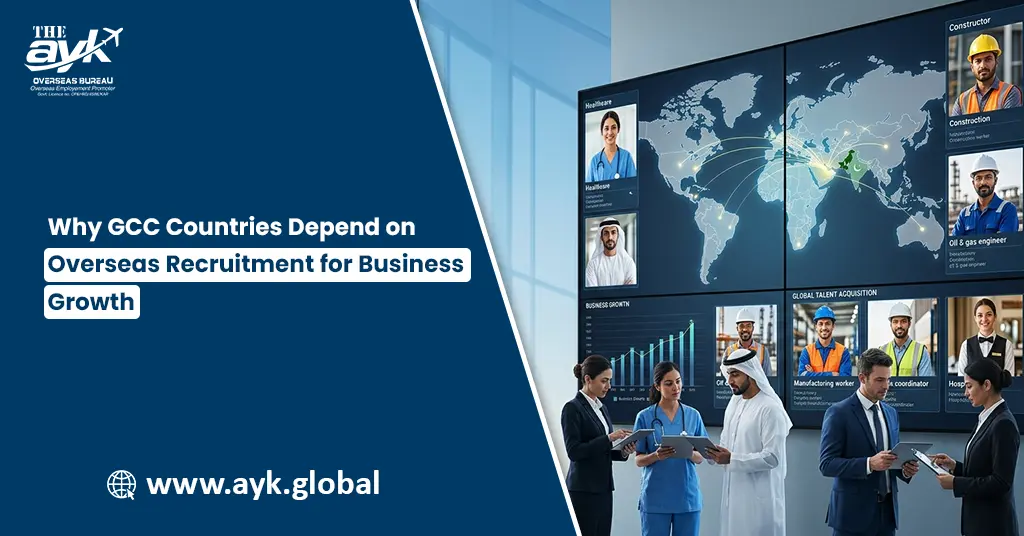
Why GCC Countries Depend on Overseas Recruitment for Business Growth
Published: June 29, 2026 | Views: 19
Introduction: Why GCC Countries Depend on Overseas Recruitment for Business Growth
The Gulf Cooperation Council (GCC) countries, including Saudi Arabia, United Arab Emirates, Qatar, Oman, Kuwait, and Bahrain, are among the fastest-growing economic regions in the world. These countries are continuously investing in large-scale infrastructure, construction megaprojects, smart cities, healthcare systems, logistics hubs, tourism developments, and industrial expansion.
However, one of the biggest challenges these economies face is limited local workforce availability for large-scale and specialized roles. Because of this, overseas recruitment has become the backbone of business expansion across GCC countries.
International manpower sourcing allows companies in the Gulf region to access skilled, semi-skilled, and technical workers from countries like Pakistan, India, Bangladesh, and others. This global workforce flow ensures that development projects continue without delays and businesses can scale rapidly.
Without structured overseas recruitment systems, many GCC companies would struggle to meet project deadlines, maintain operational efficiency, and support rapid economic expansion.
How Overseas Recruitment Drives Business Expansion in GCC Markets
Overseas recruitment plays a direct role in enabling business growth in GCC countries by solving the workforce gap problem. Large-scale construction projects, oil and gas operations, hospitality development, and industrial manufacturing require thousands of workers at different skill levels.
When companies can access international manpower quickly, they are able to expand operations without waiting for local workforce availability. This speed of hiring is critical in competitive markets where project deadlines and investment timelines are strict.
Overseas recruitment also allows businesses to scale operations flexibly. Instead of relying only on local labor markets, companies can adjust workforce size based on project requirements, seasonal demand, or expansion phases.
This flexibility is one of the key reasons why GCC countries rely heavily on international recruitment systems.
Role of Skilled Workforce Supply from Countries like Pakistan
Countries like Pakistan play a major role in supporting GCC expansion by supplying skilled, semi-skilled, and technical workers across multiple industries.
Pakistani workers are widely recognized for their adaptability, discipline, and experience in Gulf work environments. Many have already worked in Saudi Arabia, UAE, Qatar, and Oman, making them familiar with regional standards and workplace expectations.
This experience reduces training time and increases productivity once workers are deployed. It also helps employers maintain consistent quality across large-scale projects.
Recruitment agencies in Pakistan, such as AYK Overseas Recruitment & HR Manpower Agency, play an important role in connecting skilled workers with GCC employers through structured hiring processes and verified candidate selection.
Impact of Overseas Recruitment on Construction and Infrastructure Growth
Construction is one of the largest sectors in GCC countries, and it heavily depends on overseas labor. From skyscrapers and airports to highways and smart cities, these projects require thousands of workers including engineers, masons, electricians, welders, and general labor.
Without international recruitment, many of these projects would face severe delays due to labor shortages.
Overseas recruitment ensures that construction companies can maintain continuous project flow by providing a steady supply of workers at different skill levels. This directly supports national development plans and mega infrastructure initiatives across the GCC.
Role of Overseas Recruitment in Oil, Gas, and Industrial Expansion
The oil and gas sector is another critical industry in GCC countries that relies heavily on skilled international manpower. This includes engineers, technicians, rig workers, safety officers, and maintenance staff.
These roles require specialized skills and experience that are not always available locally in sufficient numbers.
Overseas recruitment allows oil and gas companies to hire experienced professionals from global markets, ensuring safe and efficient operations. It also supports refinery expansion, pipeline projects, and industrial maintenance operations.
This global workforce system ensures energy production stability and long-term industrial growth.
Hospitality and Tourism Growth Through International Hiring
GCC countries are also investing heavily in tourism and hospitality sectors, especially in cities like Dubai, Riyadh, and Doha. Hotels, resorts, and entertainment destinations require large teams of hospitality professionals including chefs, waiters, housekeeping staff, and front desk officers.
Overseas recruitment enables these businesses to maintain international service standards by hiring trained hospitality workers from countries with strong service industry backgrounds.
This helps GCC countries compete globally in tourism by delivering high-quality guest experiences.
Role of Recruitment Agencies in GCC Business Expansion
Recruitment agencies act as strategic partners in supporting GCC business growth by managing the entire hiring lifecycle. This includes sourcing candidates, conducting screening, verifying documents, and handling deployment logistics.
A structured recruitment agency ensures that employers receive pre-verified and job-ready candidates, reducing hiring risks and improving operational efficiency.
In Pakistan, AYK Overseas Recruitment & HR Manpower Agency provides complete overseas recruitment solutions for GCC employers, ensuring structured hiring, compliance support, and workforce readiness for large-scale projects.
Advanced Workforce Strategy, Compliance Systems, Cost Control & Employer FAQs
GCC countries continue to experience rapid economic transformation driven by large infrastructure investments, tourism expansion, industrial diversification, and energy sector development. To sustain this growth, structured overseas recruitment has become a core pillar of workforce planning across the region.
This section explains how advanced recruitment systems support long-term business expansion and operational stability in GCC markets.
Advanced Workforce Planning for GCC Mega Projects
Large GCC projects such as smart cities, metro systems, airports, and industrial zones require highly structured workforce planning. Employers must forecast manpower needs not just for the present, but for each phase of project execution.
Workforce planning includes dividing labor needs into categories such as design, execution, supervision, maintenance, and support roles. Each phase requires different skill sets and hiring volumes.
Overseas recruitment allows companies to scale workforce size dynamically, ensuring that each project phase has the right number of skilled workers available at the right time.
Compliance and Legal Framework in GCC Hiring
Compliance is one of the most important aspects of overseas recruitment in GCC countries. Each country has strict labor laws, visa regulations, and employment policies that must be followed carefully.
Any mistake in documentation or recruitment procedures can lead to delays, penalties, or rejection of work permits.
Professional recruitment agencies ensure that all hiring processes follow legal frameworks in both source and destination countries, reducing risks for employers and ensuring smooth deployment.
Cost Optimization Through International Workforce Hiring
Overseas recruitment helps GCC businesses manage costs efficiently while maintaining high productivity levels. Instead of investing heavily in local workforce development, companies can access experienced international workers who are already trained and job-ready.
This reduces training costs, onboarding time, and operational delays.
However, proper planning is essential to ensure cost efficiency without compromising quality or compliance standards.
Common Mistakes in GCC Recruitment Strategy
One major mistake companies make is relying on unverified recruitment sources, which can lead to skill mismatches and documentation issues.
Another common issue is poor workforce forecasting, where companies fail to predict manpower requirements for different project stages.
Ignoring cultural adaptation and communication training is also a frequent challenge that affects workforce performance.
Role of AYK Overseas Recruitment & HR Manpower Agency in GCC Expansion
A structured recruitment partner plays a crucial role in supporting GCC business expansion. Agencies manage candidate sourcing, verification, documentation, and deployment coordination to ensure smooth hiring processes.
AYK Overseas Recruitment & HR Manpower Agency provides end-to-end recruitment solutions for GCC employers, ensuring access to skilled Pakistani manpower for construction, engineering, hospitality, logistics, and industrial sectors.
This structured support allows employers to focus on operations while recruitment is handled professionally and efficiently.
Final Conclusion of Full Guide
Overseas recruitment is not just a hiring process—it is a strategic growth tool that enables GCC countries to expand rapidly across multiple industries. With structured workforce planning, compliance systems, and reliable recruitment partners, businesses can achieve long-term stability and scalability.
 Complete Guide to Bulk Manpower Recruitment for GCC Projects
 How Licensed Recruitment Agencies Help GCC Employers Hire Better Talent
 KSA Recruitment
 UAE Recruitment
 Qatar Recruitment
 Oman Recruitment
 Kuwait Recruitment
 Libya Recruitment
 Bahrain Recruitment
 Iraq Recruitment
 Malaysia Recruitment
 Malta Recruitment
 Canada Recruitment
 USA Recruitment
 Europe Recruitment
 UK Recruitment
 Romania Recruitment
 Poland Recruitment
 Bulgaria Recruitment
 Albania Recruitment
 Serbia Recruitment
 Lithuania Recruitment
 Japan Recruitment
 Turkey Recruitment
 Kyrgyzstan Recruitment
 South Korea Recruitment